Does Humanize AI Work on Turnitin? The 2026 Answer
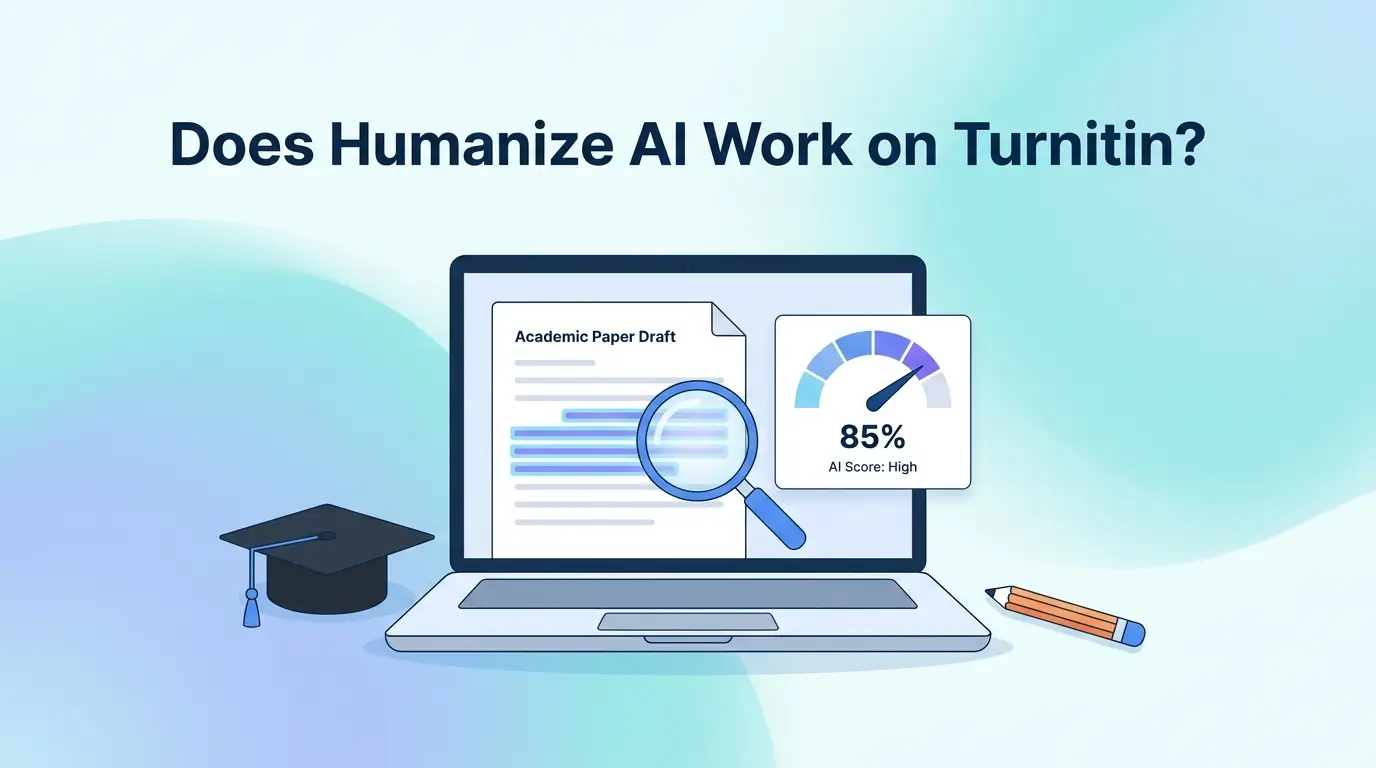
Does Humanize AI work on Turnitin in 2026? See how AI detection treats humanized text, which tools work, and how to use AI safely without flags.
You ran your essay through an AI humanizer, watched the score drop, and now you're hovering over the submit button thinking: will Turnitin actually catch this?
Here's the uncomfortable truth: In 2026, Turnitin can detect humanized AI in most cases. The same humanizer tools thousands of students rely on have become some of the easiest for it to spot, and one flagged paper can put your grade, and even your academic record, on the line.
But the real story is more surprising than a simple yes or no. A few tools genuinely lower your risk, while most quietly make things worse. Some scores trigger an instant teacher review; others slip by unnoticed. And there's a way to use AI that protects your work without ever gambling on a "bypass."
Below, you'll get the full picture in plain English: how Turnitin's detector really works, when humanizers help and when they backfire, what scores like 0%, 18%, 22%, 25%, and 40% actually mean, and the safest way to use AI, all before you hit submit.
Key Takeaways
In this guide, you'll learn:
Whether Humanize AI and other humanizers really work on Turnitin and when they fail or pass.
How Turnitin's AI detector works in simple terms, what it checks and what the 2025–2026 updates changed.
The difference between the Similarity score and the AI Writing score, and what 0%, 18%, 22%, 25%, and 40% usually mean.
Why simple paraphrasers and "undetectable AI" tools are risky, and why "99% bypass" claims can't be trusted.
A safer, step-by-step workflow for using AI as a helper, not a ghostwriter.
Practical tips including for non-native English speakers on what to do if you're flagged and how to protect your record.
Does Humanize AI Work on Turnitin?
If you only want the short version:
Turnitin can detect a lot of "humanized" AI text.
Simple humanizers that just change words or switch sentence order usually do not work.
Some advanced humanizers (those that deeply change sentence structure) plus real human editing can sometimes bring the AI score under Turnitin's visible 20% threshold.
No humanizer is guaranteed to bypass Turnitin every time, and using one to hide AI writing can lead to academic misconduct investigations.
Key Facts (With Sources)
These facts come from Turnitin's own documentation and peer-reviewed research:
Turnitin launched its AI Writing Detection model in 2023 as a separate system from its normal plagiarism "Similarity Check." (Source: Turnitin AI Writing detection product documentation.)
Turnitin reports over 98% accuracy in internal tests for AI-generated text, with a low rate of false positives on human-written text. (Source: Turnitin AI Writing Detection FAQ and educator briefings.)
A 2025 systematic review by Canyakan found Turnitin detected machine-generated text with 92–100% accuracy, and about a 5.3% false-negative rate. (Source: Journal of AI, Humanities and New Ethics.)
A 2023 study by Weber-Wulff and co-authors tested 14 AI detectors and found Turnitin was the most accurate, with zero false positives on 54 human-written texts though paraphrasing did lower detection a bit. (Source: International Journal for Educational Integrity.)
In August 2025, Turnitin added an AI bypasser detection feature that can label text as "AI-generated and then AI-paraphrased," directly targeting humanizers and word spinners. (Source: Turnitin product announcements.)
Since mid-2024, Turnitin shows only an asterisk instead of an exact AI percentage for scores between 1% and 19%. Scores of 20% and higher are shown as a visible number and are far more likely to trigger teacher review. (Source: Turnitin AI Writing indicator guidance.)
Because of these facts, it is risky to trust any tool that claims "100% undetectable AI" or "Turnitin-proof writing."
What Does "Humanized AI" Mean?
AI-humanized content is text that was first created by a large language model (like ChatGPT, Claude, Gemini, or Copilot) and then changed, using a humanizer, a paraphrasing tool, or manual editing to sound more natural and avoid AI detection. People also call it AI-paraphrased, AI-rewritten, "AI-to-human," or "undetectable AI" content.
Not all humanizer tools work the same way. Most fall into three groups:
Types of AI Humanizer Tools
Type | Examples | What it does | Does it beat Turnitin? |
Simple paraphrasers / word spinners | Basic QuillBot, Smodin, Phrasly | Swaps synonyms, shuffles phrases | Rarely, only surface words change |
Basic AI humanizers / bypassers | Undetectable AI, StealthGPT, HIX Bypass, WriteHuman, TwainGPT | Changes more words, varies sentence length slightly | Often still leaves 40–70% flagged |
Advanced structural humanizers | Ryne AI, Humaniser.com, some Humanize AI Pro versions | Rewrites sentence structure, paragraph rhythm, vocabulary | Sometimes — best with heavy human editing, still not guaranteed |
How Turnitin's AI Detection Works
Turnitin uses two different systems when it scans your paper. They measure completely different things.
The Two Turnitin Systems
Feature | Similarity Check | AI Writing Detection |
What it checks | Copied or matching text | AI-style writing patterns |
Compares against | Student papers, web pages, journals | Nothing — analyzes the text itself |
Output | Similarity % (e.g., 10%, 25%, 40%) | AI Writing % for qualifying text |
Main concern | Plagiarism | AI-generated or AI-paraphrased writing |
What Patterns Does Turnitin Look At?
Turnitin is basically asking: "Does this look like a human wrote it, or like a robot wrote it?" It uses ideas from natural language processing and stylometry (the study of writing style). The biggest differences:
Pattern | AI writing tends to… | Human writing tends to… |
Perplexity (word predictability) | Pick the most likely next word; very predictable | Be more surprising and messy |
Burstiness (sentence rhythm) | Use medium, even-length sentences | Mix very short and very long sentences |
Vocabulary | Reuse safe, generic words and stock phrases | Mix simple and complex words, more unique wording |
Structure | Follow a fixed topic → example → neat ending pattern | Jump around, start with a story, skip a perfect wrap-up |
Tone | Stay perfectly consistent and formal | Switch tone, show personal feeling |
Turnitin's model uses many of these features together, not just one — which is why only changing words is never enough.
Turnitin's AI Bypasser Detection (2025 Update)
In August 2025, Turnitin made an important change. Its reports no longer only ask "Is this AI?" — they also ask "Does this look like AI text that was later run through a paraphraser or humanizer?"
Reports can now show two things: AI-generated text only, and AI-generated text that was AI-paraphrased. Turnitin trained its model on the output of popular humanizers, so it learned their "fingerprints." That is why using the same free humanizer that thousands of other students use makes your text easier to spot.
So… Does Humanize AI Work on Turnitin?
The honest answer: it sometimes lowers the AI score, but it does not guarantee safety. Most basic tools fail; a few advanced ones plus real human editing perform much better.
What Research Shows
Raw AI text (a full ChatGPT essay) is caught almost every time.
Simple paraphrasing lowers detection a little, but Turnitin still flags a large part of the text.
Many "undetectable AI" sites fail to beat Turnitin and often produce awkward grammar.
Deep structural rewriting performs better especially when the writer also adds personal examples, edits wording by hand, and varies sentence lengths.
But even the best tools cannot promise a 0% AI score, can still be flagged by new Turnitin updates or stricter school settings, and do nothing to protect you from plagiarism if you copied sources without citation.
Why "99% Bypass" Claims Are Risky
Marketing lines like "99.8% success against Turnitin" or "100% undetectable AI" are unreliable because their tests often use short snippets instead of full essays, different (weaker) detectors instead of Turnitin, or older versions of Turnitin's model. Passing a free detector like ZeroGPT does not mean you will pass Turnitin.
Why Most Humanized AI Still Gets Caught
Only words change, not the "bones." The order of ideas, sentence types, and paragraph pattern stay the same and Turnitin cares about how the writing is built, not just the exact words.
AI-style rhythm remains. Even after humanizing, the text often keeps smooth, similar-length sentences, while real humans write in an uneven mix of short and long.
"AI-isms" give it away. Phrases like "in today's world," "it is worth noting that," "this highlights the importance of," and "plays a crucial role in" appear too often.
Bypasser patterns become training data. The more a popular humanizer is used, the more its "fingerprint" shows up in submissions and the easier Turnitin learns to recognize it.
Safer Ways to Use AI Without Failing Turnitin
The best approach is to treat AI as a helper, not a ghostwriter. A simple hybrid workflow works far better:
Make your own outline. Write your thesis, main points, and examples yourself for a personal structure.
Use AI for ideas, not full essays. Ask it to explain concepts, suggest arguments, or improve a single sentence, don't paste large blocks into your final paper.
Use an advanced humanizer sparingly (optional). If you're stuck, run a few sections through a structural tool to improve clarity, not just to "beat Turnitin."
Edit by hand to add your voice. Add personal examples, references to your class or textbook, and opinions you truly hold, these are hard for AI to fake.
Change sentence lengths and cut AI-isms. Mix short and long sentences on purpose, and replace stock phrases with direct language.
Check your work and keep your drafts. Use a draft Turnitin folder if allowed, and save your outlines and old versions as proof of your process.
Tips for Non-Native English Speakers
Research (including from Stanford) shows AI detectors can be biased and may flag non-native speakers more often, because their style can look "unnatural" to the model. If English isn't your first language: use AI mostly for grammar and clarity, keep earlier versions to show your process, and ask your teacher how much AI help is allowed.
A clarity tool such as AI Writing Humanizer can help smooth out awkward grammar and phrasing while keeping your own meaning and ideas intact. Used this way to polish writing that's genuinely yours rather than to hide AI authorship, it's a legitimate way to make your work read more naturally.
Understanding Turnitin Scores
Students often ask whether a 0%, 18%, 22%, 25%, or 40% score is good or bad. The answer depends on which score you mean, and on your school's rules.
If you want a rough preview before you submit, you can paste your text into a free AI detector to estimate how AI-like it looks. Treat any score from a third-party tool as a signal only, since none of them match Turnitin's exact model.
Similarity Score (Plagiarism)
Score | Usually means | Concern level |
0% | No overlaps found — fine for reflections, unusual for research papers | Low (but check why) |
1–10% | References, quotes, common phrases | Low |
10–25% | Normal for essays with quotes and citations | Low to moderate |
25–40%+ | Safe if mostly cited sources; a problem if copied without quotation | Moderate to high |
AI Writing Score
Score | Usually means | Concern level |
0–5% | Often treated as noise or template text | Low |
6–19% | Turnitin shows an asterisk, not an exact number | Low to moderate |
20%+ | Shown as a visible number; a strong flag of AI use | High, often triggers a conversation |
Important: Every school sets its own policy. Always check your syllabus, your school's academic integrity policy, and any AI-use rules your teacher shared.
Can I Submit to Turnitin Multiple Times?
Yes, but it depends on how your school set up Turnitin.
Draft / practice folder: Some schools create a draft space where you can submit multiple times to check your scores, and your drafts aren't stored in the main repository.
Final submission folder: Often you can submit only once. If that version is stored in the main database, resubmitting a similar paper later can create high similarity to yourself (self-plagiarism).
If you're unsure, ask your teacher whether a draft space exists and avoid random "free Turnitin check" sites that may store your paper and cause self-plagiarism later.
Frequently Asked Questions
1. Can Turnitin detect humanized AI?
Yes. It detects most humanized AI, especially when the tool only does surface paraphrasing, the tool is popular (so its style is in Turnitin's training data), or the student doesn't add their own voice and structure by hand.
2. Can humanized AI be detected?
Yes, and since the August 2025 update, Turnitin can specifically flag text as "AI-generated and then AI-paraphrased," which is exactly what humanizers produce.
3. Can Humanize AI Pro bypass Turnitin?
It may sometimes lower the AI score, especially on shorter texts or with strong human editing. But Turnitin's AI and bypasser detection are built to catch AI-paraphrased text, so no tool including Humanize AI Pro, can honestly promise to bypass it every time.
4. Is a 40% Turnitin score bad?
A 40% similarity score is more likely to raise concern. It can be fine if most of it comes from correctly cited quotes and references, but it's a problem if large parts are copied without proper quotation. A 40% AI Writing score is a strong flag that usually triggers teacher review.
5. Is a 0% Turnitin score good?
A 0% similarity score means no matches were found. That's fine for personal reflections, but unusual for research papers, since most students quote or paraphrase some sources. A 0% AI score is generally good.
6. Is an 18% Turnitin score ok?
An 18% similarity score is usually considered normal, especially for essays with quotes and citations. Teachers will check where the matches come from. An 18% AI Writing score still falls below the visible 20% line, so Turnitin shows an asterisk rather than a number, and most teachers act only if there are other signs of AI overuse.
7. Is a 22% Turnitin score bad?
A 22% similarity score is usually within the normal range and not automatically bad. A 22% AI Writing score, however, is over the visible 20% threshold, so it appears as a number and is more likely to prompt your teacher to start a conversation.
8. Can I submit to Turnitin multiple times?
Yes, if your school provides a draft folder. In a final submission folder you can often submit only once, and resubmitting a stored paper later can cause self-plagiarism. Ask your teacher which setup applies.
9. Can professors see which AI tool I used?
No. Turnitin doesn't name the tool, it only estimates how much text looks AI-generated and whether some looks AI-paraphrased. But teachers can still see the AI percentage, the flagged sections, and changes in your writing style compared to past work.
10. What if Turnitin wrongly flags my human-written essay?
Stay calm, detection isn't perfect. Collect your evidence (notes, outlines, earlier drafts), explain your process to your teacher politely, and ask about your school's appeals process. Many schools say an AI score should start a conversation, not act as the only proof of cheating.
Conclusion
The bottom line is simple: in 2026, trying to "trick" Turnitin is a losing strategy. It now reads how your writing is built, its structure, rhythm, and word patterns so swapping synonyms or running text through a humanizer rarely removes the AI fingerprint, and paraphrasing can itself become a flag. Even the few advanced tools that lower scores can't promise safety on every paper, and relying on them risks your grades and academic record.
The smarter path is easier: use AI as a helper for ideas and grammar, write in your own voice with real examples, keep your drafts as proof, and know your school's AI rules. Do that, and you're not fighting Turnitin at all, you're writing work that's genuinely yours, which is the only thing that truly stays undetectable, because there's nothing to detect.