Do AI Humanizers Actually Work? What the Evidence Shows
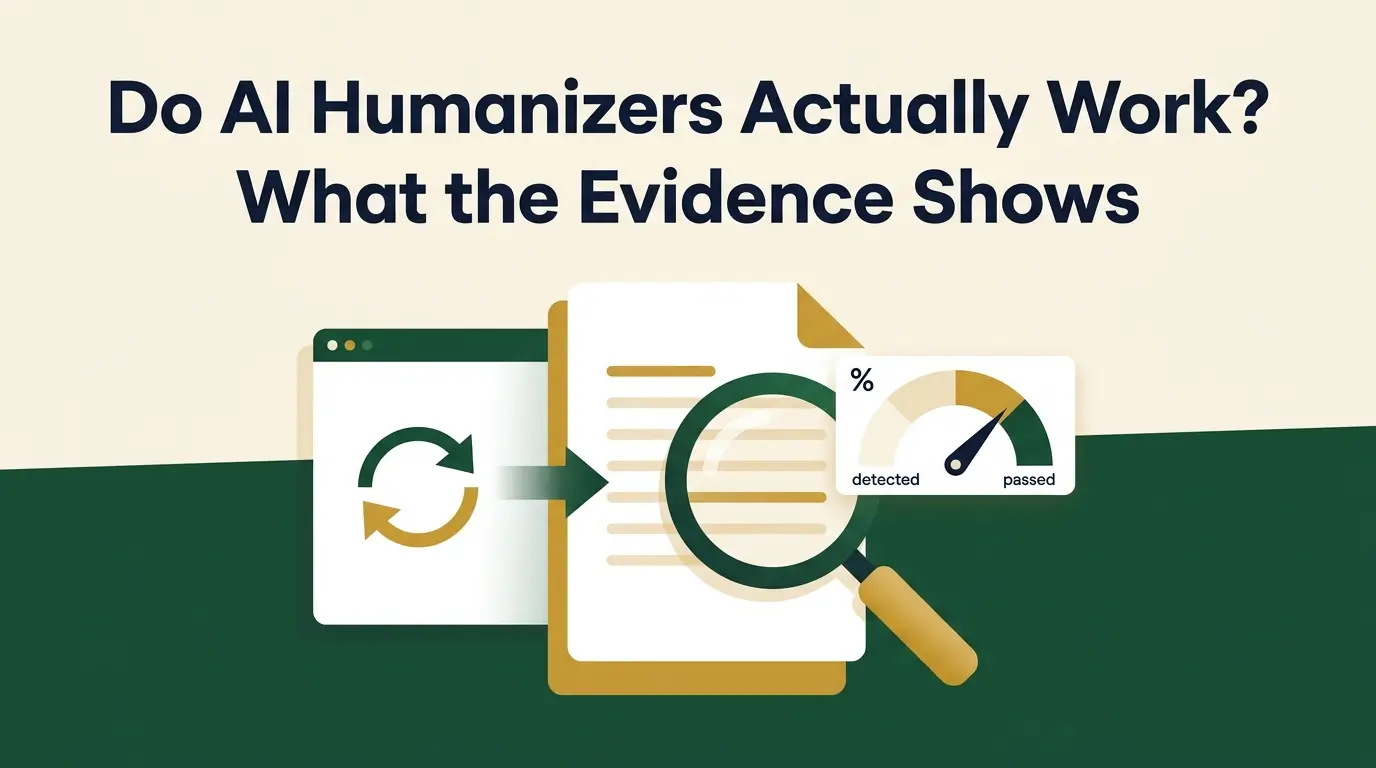
Do AI humanizers actually work? See what peer-reviewed research shows about Turnitin, GPTZero, & other AI detectors, & how to read the results.
Do AI humanizers actually work? Against weak and mid-tier AI detectors, yes, often. Against purpose-built systems like Turnitin's 2025 detection model, results are inconsistent and tend to fade once the detector gets updated. Peer-reviewed testing has found detectors that catch over 90 percent of raw AI text dropping to under 50 percent once the same text runs through a humanizer, but no tool on the market guarantees a permanent pass. Does humanize AI work depends almost entirely on which detector is checking your writing, and this page walks through the actual research behind that answer rather than a vendor's marketing page.
Key Takeaways
Humanizers work on weak detectors but fail more often on Turnitin and Pangram.
No result lasts forever. Detectors update, and a passed score can fail later.
Humanizing can change your text's meaning, drop citations, or shift numbers.
Free tools give shorter word limits and weaker rewrites than paid ones.
Manual editing and better prompts work better than any humanizer tool
Do AI Humanizers Actually Work? Defining What "Work" Means
Do humanizers work in the way most people assume, meaning does the AI score drop and stay down? Sometimes. But that's the shallowest possible way to judge one, and it's exactly the definition every vendor page optimizes for.
A humanizer that's actually doing its job has to clear three separate bars at once, and they often pull against each other.
The first is detection performance. Does the score drop on the specific detector your school, client, or publisher actually uses? A green result on one tool tells you almost nothing about what a different tool will report on the same paragraph.
The second is meaning preservation. Did the rewrite keep your numbers, your technical terms, and your citations exactly where you put them? A tool that lowers an AI score by mangling a source reference hasn't helped you in any way that matters.
The third is durability. Will the result still hold up after the next detector update? This is where most humanizers quietly fail, because they're built to beat today's model, and today's model gets patched.
A tool that nails the first test while wrecking the other two hasn't actually worked. Keep those three checks in mind, because the rest of this page comes back to them repeatedly.
Do AI Humanizers Actually Bypass AI Detectors? What the Research Shows
Do AI humanizers work against real detection software, based on independent testing rather than a company's own claims? The honest answer is that they work well against weaker systems and struggle against the strongest ones, and there's peer-reviewed research behind both halves of that statement.
The Chicago Booth Finding
Researchers Brian Jabarian and Alex Imas at the University of Chicago Booth School of Business tested humanized essays against a set of leading AI detectors. Detectors that caught over 90 percent of raw AI-generated text dropped below 50 percent accuracy once the same text had passed through a popular humanizer. One detector in their test, Pangram, held close to near-100 percent accuracy even against the humanized versions. Every other detector they tested collapsed by comparison.
The RAID Benchmark
A separate benchmark called RAID, presented at ACL 2024, reached a related conclusion using different methodology. The researchers found that AI detectors are easily fooled by paraphrasing and adversarial rewriting, the same two techniques every AI humanizer relies on at its core.
The Historical Pattern
This isn't a new problem. OpenAI retired its own AI Text Classifier on July 20, 2023, because it only caught about 26 percent of AI-written text while incorrectly flagging 9 percent of human writing as AI-generated. If the company that built the underlying language model couldn't reliably detect its own output, third-party detection was never going to be a solved problem. It's an ongoing arms race, not a fixed target.
In practice, the variance between different detectors often matters more than the variance between different humanizers. The same paragraph can score close to 0 percent AI on one checker and 80 percent on another within the same afternoon, which means a clean result on a free tool tells you almost nothing about what a stricter system like Turnitin will report.
Do AI Humanizers Work on Non-English Content?
Most published testing, including the studies above, uses English-language samples. Effectiveness drops noticeably outside English, because the synonym databases and sentence-restructuring models most humanizers rely on are trained overwhelmingly on English text. Spanish, French, German, and other widely spoken languages get partial support at best, and the rewriting tends to fall back to tier-1 synonym swapping even on tools that use full-paragraph rewriting for English. If your writing is in a language other than English, treat any detection-bypass claim as unverified until you test it yourself against the specific detector you're worried about.
Do AI Humanizers Work on Long-Form Content?
Most of the research and vendor testing behind these numbers uses short passages, typically 300 to 500 words. Performance changes on longer documents. Maintaining a consistent voice and preserving meaning across a 2,000-word article is a much harder problem than doing it for a single paragraph, because a humanizer applies the same rewriting patterns repeatedly across the whole document. That repetition creates its own unnatural rhythm, one that both detectors and attentive human readers tend to notice, even when a short excerpt from the same piece would have passed cleanly.
How Do AI Humanizers Work?
How do AI humanizers work at a mechanical level? They rewrite text to increase how unpredictable the word choices and sentence patterns are, since that unpredictability is exactly what most detectors are measuring. Humanizers generally operate at one of three levels of sophistication.
Tier 1: Word-Level Synonym Substitution
The simplest humanizers swap individual words for alternatives pulled from a synonym database. "Important" becomes "crucial." "Use" becomes "utilize." This changes the surface text without touching sentence structure at all, and it produces the most obviously unnatural results of the three tiers.
Tier 2: Sentence Restructuring
More capable tools split long sentences, combine short ones, flip passive voice to active, and reorder clauses. This tier actually changes the rhythm of the writing, which affects what detectors call burstiness, the variation in sentence length across a passage.
Tier 3: Full-Paragraph Rewriting
The most advanced humanizers use a large language model to rewrite entire paragraphs based on its own interpretation of the source text. These produce the most natural-sounding output of the three tiers, but they also carry the highest risk of drifting from your original meaning, since the model has the freedom to drop details or soften claims you actually meant to state firmly.
The statistical logic behind all three tiers is the same. Detectors measure perplexity, how predictable each word is given the words before it, and burstiness, how much sentence length varies across the page. AI-generated text tends to score low on both, since every word tends to be the statistically likely choice and every sentence tends to run close to the same length. Humanizers try to push both numbers up.
One correction worth making here: GPTZero stopped using perplexity and burstiness as its primary detection signals back in autumn 2023, after switching to a deep-learning architecture. The terms are still useful for understanding what makes writing feel human, but they no longer describe the actual engine behind every detection score, and treating them as universal is one of the more common outdated claims still floating around online. If you want the fuller picture of how GPTZero's current model behaves, our review of is GPTZero accurate goes into that directly.
Which AI Detectors Are Hardest to Fool?
Turnitin and Pangram are the hardest detectors to fool as of 2026. Turnitin's AI-bypasser detector, released in August 2025, uses an ensemble of three models, one of which is trained specifically on text that has already passed through a humanizer. GPTZero added its own humanized-text detection update in early 2026. Free web checkers and older detector versions remain the easiest to get past consistently.
Detector | Humanizer Resistance | Key Update | Date |
Turnitin | High | AI-bypasser detector, 3-model ensemble | August 2025 |
Pangram | High | Maintained near-100% in Chicago Booth study | Ongoing |
GPTZero | Medium-high | Humanized-text detection update | Early 2026 |
Originality AI | Medium | Binary classifier, ongoing retraining | Ongoing |
Copyleaks | Medium | No dedicated anti-humanizer feature announced | — |
ZeroGPT | Low-medium | Legacy architecture | — |
Free web checkers | Low | No retraining infrastructure | — |
Will Turnitin detect humanize AI, specifically? It can, and increasingly does. Turnitin's report now splits results into two separate categories: "AI-generated" and "AI-generated and AI-paraphrased." Running an essay through a humanizer can trigger the second flag on its own, one that an academic integrity office may read as evidence of intent to deceive rather than simple AI use. That means humanizing a paper can, in some cases, leave you worse off than submitting the raw AI draft would have. Our dedicated breakdown of can Turnitin detect ChatGPT and our piece on does humanized AI work on Turnitin both go deeper into this exact platform.
Do AI humanizers work on Turnitin at all, then? Sometimes, against older submissions or less aggressive humanizing, but results have gotten noticeably less reliable since the August 2025 update, and there's no way to know in advance which side of that line a given essay will fall on.
Originality AI and Copyleaks sit in a middle tier. Neither has announced a dedicated feature built specifically to catch humanized text, but both continue to retrain against new patterns as they emerge. Our separate reviews of is Originality AI accurate and is Copyleaks accurate cover where each one currently stands.
Looking further ahead, several major AI labs are actively developing watermarking, a technique that embeds a statistical signature into the token-selection process at the moment text gets generated. A watermark survives ordinary paraphrasing because it operates below the level of word choice. If watermarking reaches wide deployment across consumer language models, humanizers that rely on synonym swaps and sentence restructuring would become fundamentally insufficient, regardless of how aggressively they rewrite. This isn't deployed at scale yet, but it changes the long-term math for anyone treating humanization as a durable strategy.
Does Humanized Text Lose Quality and Readability?
Yes. Humanizers that aggressively lower a detection score frequently degrade readability, shift meaning, and strip out precision that was in the original text.
Meaning Drift Is the Real Risk
Humanizers routinely alter qualifications, shift numbers, and soften or strengthen claims beyond what the original said. A sentence that says a treatment "may reduce symptoms in some patients" can come back reading as "the treatment reduces symptoms," which states something the underlying evidence never claimed. For academic and technical writing specifically, this kind of drift is a bigger practical risk than a detection score ever was, since it can misrepresent your actual research.
Voice Gets Flattened
Aggressive rewriting tends to smooth out whatever made a piece of writing sound like a specific person wrote it. A business report, a personal essay, and a research paper can all come out of the same tool sounding oddly similar, because the tool is optimizing for statistical variation, not for preserving anyone's actual voice.
Technical Content Suffers Most
Legal clauses, medical terminology, and financial specifications depend on exact wording. Rewriting "the defendant shall indemnify the plaintiff" into looser language can quietly change the legal meaning of the sentence. The more specialized the vocabulary, the higher the risk that a humanizer introduces an error a reader would actually notice and act on.
The safest way to treat any humanized output is as a rough draft that still needs a full review. Compare it line by line against the original, verify every number and citation, and read the result out loud to catch phrasing that no one would actually say. If an edit changes a claim you can't defend, reject it and keep the original wording.
What Are the Risks of Relying on AI Humanizers?
Relying on a humanizer carries risks that go beyond whether the detection score actually drops.
Detector Updates Can Undo Your Result Without Warning
A paragraph that passes today can get re-flagged after a silent model update next month. Neither Turnitin nor GPTZero sends a notification when their detection model changes. Any claim that a tool achieves a specific bypass rate is a snapshot against one detector version, and that snapshot starts decaying the moment the detector gets updated.
Humanizing Can Add Its Own Red Flag
As covered above, Turnitin's report now distinguishes plain AI-generated text from text that's been AI-generated and then AI-paraphrased. Running a document through a humanizer can produce that second flag on its own, which some reviewers read as a deliberate attempt to deceive. In that situation, humanizing has made things worse than simply submitting the original AI draft would have.
Some Tools Fabricate Scores to Sell a Fix
An investigation published in early 2026 found humanizer tools generating fake AI-detection scores to manufacture a problem they could then charge to solve, flagging content that was demonstrably human-written or even public-domain text as high-probability AI. This is worth knowing before trusting any single tool's own built-in "AI score" at face value.
False Positives Don't Go Away, They Just Get a Second Layer
AI detectors flag non-native English writing at meaningfully higher rates than native writing in peer-reviewed testing. Running that same honest writing through a humanizer doesn't fix the underlying bias. It just adds a second, deception-shaped flag on top of a false accusation that was never fair to begin with. Our piece on why AI detectors flag certain writing covers this bias in more detail, and if a genuine false positive is the actual problem, our guide on can professors detect ChatGPT walks through how that conversation usually plays out in practice.
Humanizing Doesn't Fix Google's Content Quality Standards
For anyone using humanizers on published web content, humanizing text doesn't resolve Google's scaled content abuse concerns on its own. That policy targets content produced at volume with little original value, regardless of whether it passes an AI detector. A humanized article that adds no real information gain over what already exists remains just as vulnerable to that classification as the raw AI draft was. Google's quality systems evaluate experience, expertise, and overall helpfulness, not detection scores, so a thin article that's been humanized will still underperform if it isn't genuinely useful.
Do Free AI Humanizers Work as Well as Paid Ones?
No, though the gap is smaller than most marketing pages suggest. Free tiers typically cap output around 250 words per run, less than a single essay paragraph, and rely on tier-1 or tier-2 rewriting because the more advanced paragraph-level rewriting costs the provider more to run.
Dimension | Free Tier | Paid Tier ($10-20/mo) |
Word limit | ~250 words per run | 10,000-50,000 words/month |
Rewriting depth | Tier 1-2, synonym swap and light restructuring | Tier 2-3, sentence restructuring and full paragraph rewriting |
Detector bypass rate | Lower, less aggressive changes | Higher, but with more meaning-drift risk |
API access | No | Yes, on select plans |
Paid tiers do unlock deeper rewriting and higher word limits, which does translate to somewhat better results against weaker detectors. What paid tiers don't do is reliably beat Turnitin's 2025 model or GPTZero's 2026 update. You're paying for more words and marginally better prose, not for a fundamentally different level of detection evasion.
For content teams processing larger volumes, the more meaningful distinction is often API access versus a web interface, not free versus paid. API-based humanizing applies the same rewriting parameters across every article, which can flatten voice consistency across an entire site. A web interface allows tone control on a per-paragraph basis but doesn't scale past a few thousand words per session.
What Are the Alternatives to AI Humanizers?
Four approaches consistently outperform automated humanizing for anyone who needs writing that genuinely reads as human.
1. Better Prompting at the Drafting Stage
Reduce AI tells before they end up in the text at all. Instructing a model to vary sentence length, avoid specific overused phrases, use active voice, and include appropriate hedging produces a first draft that scores lower on detectors before any humanizing happens. This addresses the underlying cause rather than patching it after the fact. Our guides on how AI can write more like a human and how to prompt AI to write like a human both walk through specific techniques for this.
2. Hybrid Human-AI Drafting
Use a language model for outlining and research synthesis, then write the actual sentences yourself using that output only as a reference. This produces writing that benefits from AI-assisted structure while carrying genuinely human vocabulary and reasoning. The result reads as human because a human actually wrote it.
3. Manual Editing With a Structured Pass
Read a draft aloud, remove boilerplate transitions, vary paragraph length, and swap generic claims for specific examples drawn from real experience. A human editor who understands the subject can restructure an AI draft in roughly 20 to 30 minutes and produce writing that outperforms an automated humanizer on both quality and detection metrics, because a person understands context in a way no algorithm currently replicates. Our practical guide on how to rewrite text to avoid AI detection covers this process step by step.
4. Preserved Draft History and Disclosure
Keep your version history through Google Docs, Word's tracked changes, or a similar record. This demonstrates genuine human involvement in the writing process and addresses the actual underlying question, who wrote this, rather than the symptom, what does a detector say.
If you use Claude or Grammarly as part of your own drafting workflow, our pieces on can Claude humanize text and does Grammarly have a humanizer cover where those specific tools fit into this picture.
Frequently Asked Questions
Do AI humanizers actually work?
They work reliably against weak and mid-tier detectors, with peer-reviewed testing showing efficacy dropping from over 90 percent to below 50 percent on humanized text. Against purpose-built systems like Turnitin's 2025 model, results are inconsistent and can fail within weeks of a detector update.
How do AI humanizers work?
They rewrite text using synonym substitution, sentence restructuring, or full-paragraph rewriting to increase the unpredictability of word choice and sentence length, the same two properties most AI detectors measure. More aggressive rewriting produces more natural-sounding output but carries a higher risk of changing your original meaning.
Are AI humanizers accurate?
"Accurate" here usually means effective at lowering a detection score, and that varies enormously by detector. Independent testing shows wide swings, the same humanized paragraph can score near 0 percent on one detector and 80 percent on another within the same session.
Will Turnitin detect humanize AI?
Increasingly, yes. Turnitin's August 2025 update specifically targets humanized text and can flag it as "AI-generated and AI-paraphrased," a separate category from plain AI detection that some reviewers treat as evidence of intent to deceive.
Do AI humanizers work on Turnitin?
Inconsistently, and less reliably than before the August 2025 update. Older, lighter humanizing sometimes still passes, but there's no way to predict which submissions will and won't get flagged.
Does Undetectable AI actually work?
Like most humanizers, it passes some detectors and fails others, and independent reviews have found it can produce grammatically broken sentences in its more aggressive rewriting modes. It is not immune to Turnitin's or Pangram's current detection models.
Is Humanize AI good?
It functions similarly to other tier-1 and tier-2 humanizers on the market. Whether it's "good" depends on what you're measuring: detection bypass rate, writing quality, and meaning preservation don't always move together, and a tool that scores well on one can score poorly on another.
How accurate is Humanize AI Pro?
Paid tiers generally outperform free ones on detection bypass because they use deeper rewriting methods, but no independently published, verified benchmark confirms a specific accuracy figure for this tool against current detector versions.
Can AI humanizers preserve citations accurately?
Not reliably. Rewriting tools have been documented altering numbers and modifying citation formatting, turning something like "(Chen et al., 2024)" into a slightly different phrasing that no longer matches the original reference style. Academic and research writers should verify every citation, figure, and date after humanizing, since this is one of the most common and easiest-to-miss failure points.
Can you trust AI 100%?
No AI system, including detectors and humanizers, is 100 percent reliable. Detectors produce false positives on genuine human writing, and humanizers can't guarantee a permanent pass. Treat every AI tool's output, on either side of this equation, as one signal rather than a final answer.
Which AI humanizer is the best?
There isn't a single best option, since effectiveness depends on which detector you're up against, how much rewriting aggressiveness you can tolerate, and how much meaning drift is acceptable for your content. A tool that performs well against a free checker may still fail Turnitin's current model.
Conclusion
Do AI humanizers actually work? Against the detectors most people actually run into day to day, often enough to be worth understanding. Against the detectors built specifically to catch them, like Turnitin's current model and Pangram, the odds are worse than most product pages admit, and getting worse as detection systems keep retraining.
The more durable path isn't finding the one humanizer that beats every detector today, since that tool doesn't exist and any claim otherwise is a snapshot that expires. It's writing content whose quality and authenticity don't depend on staying one step ahead of a system that updates without warning.
Check where your own writing currently stands with our free AI detector, or use our humanizer as an editing aid to make an AI-assisted draft read more naturally, not as a guarantee against every detector you might face.