How Accurate Is Grammarly AI Detector? What 99% Means
How accurate is Grammarly AI detector? Learn what its 99% score means, where it struggles on edited text, and how to use your result the right way.
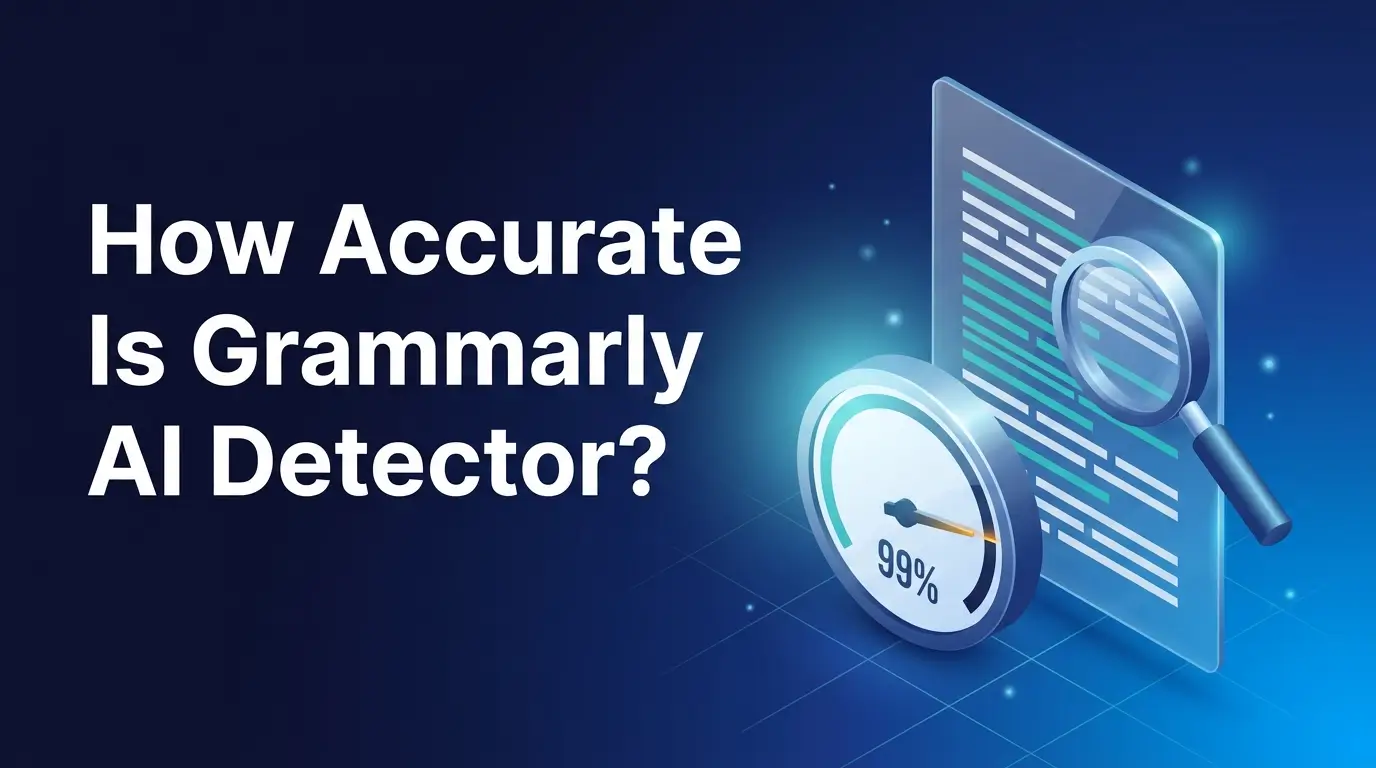
How accurate is Grammarly AI detector? Better than a coin flip, but far less certain than its headline number suggests. Grammarly reports 99% detection on the RAID benchmark, yet that score was measured at a setting that allows roughly 5 in 100 human texts to be flagged. In outside tests, the tool usually catches raw chatbot text and often misses anything edited or humanized.
Key takeaways
The 99% RAID score uses a fixed 5% false-positive rate, so it does not mean 99% of results are correct.
Raw AI text is often caught, while edited or humanized text often slips through.
Formal and non-native English writing is more likely to be wrongly flagged as AI.
Treat the score as one signal and back it up with a second detector and your draft history.
Is Grammarly AI Detector Accurate? The Short Answer
Partly. The tool does one job well: spotting long, untouched text from a mainstream chatbot. It struggles with the cases people actually worry about, such as edited AI drafts, humanized text, short passages, and polished human writing.
Grammarly itself says no detector is 100% accurate and that a result should never be the only basis for deciding whether AI was used. That is a sensible way to read any grammarly ai detector accuracy claim.
Type of text | What usually happens |
Long, raw output from a major chatbot | Often flagged, though scores differ by model |
Lightly edited or paraphrased AI text | Frequently under-scored or missed |
Humanized AI text | Often scores low |
Casual, varied human writing | Usually scores low |
Formal, technical, or non-native English | Higher chance of a false flag |
Very short text | Unreliable either way |
What Does the 99% RAID Score Actually Measure?
Grammarly highlights a 99% detection rate and a top ranking on RAID (Robust AI Detection), an academic benchmark for testing AI text detectors, which includes more than 670,000 texts. The result is genuine, but it is easy to misread.
RAID does not measure overall correctness. Under its 2024 methodology (described in the RAID research paper), each detector's threshold is set so that only 5% of human-written texts get flagged. The benchmark then checks how much AI text is caught at that setting. So 99% means nearly all AI text was caught while about 5 human texts in 100 were wrongly flagged.
That makes it a fair way to compare detectors, but it applies to you only loosely:
You cannot adjust the threshold. You see one fixed score.
The AI texts in RAID were generated in 2024, so newer models may behave differently.
Grammarly says its model was trained on human and AI writing created before 2021, so it is reasonable to ask how well it keeps up with current styles.
Rankings also shift as new tools are added. Grammarly's number-one announcement dates from early 2026, while a competitor's August 2026 snapshot reportedly puts it at about 99.5% but no longer first. A benchmark is a snapshot, not a promise about your document.
How Does Grammarly's AI Detector Work?
According to Grammarly, the tool breaks your text into sections, looks for language patterns commonly tied to AI writing, and returns a percentage estimating how much may be AI-generated. Results fall into two groups: text that "resembles AI" and text where no AI patterns were found.
The patterns involved include predictable sentence structure, uniform phrasing, and low variation. If you want to understand why machine text shows those traits, see our breakdown of how AI writes compared with humans.
Free vs paid Grammarly AI detector
Free checker | Paid AI Detector agent | |
How to use | Paste text or upload a file | Inside Grammarly's paid tools |
Sign-up needed | No | Yes |
Overall AI percentage | Yes | Yes |
Shows which parts may sound AI-generated | No | Yes |
Grammarly's plans and features change, so check its current page before relying on this comparison.
How to Read Your Grammarly AI Score
Many people see "30% AI" and assume 30% of the text was written by a chatbot. That is not what the number proves. It is an estimate based on pattern matching, and the "resembles AI" label means a section matched language patterns the model associates with AI writing. It cannot track who actually wrote the text.
A practical way to read a score:
A low score means the tool did not find the patterns it looks for. It does not prove a human wrote the text.
A high score means some sections look statistically similar to AI output. It does not prove misconduct.
A middle score is the least informative. Test again with a longer sample before drawing any conclusion.
Always judge the score together with the length of the text, the type of writing, and your drafting history.
How Accurate Is Grammarly AI Detector in Independent Tests?
This is where results get messy. Sample sizes are small, and many tests come from companies that sell rival detectors or humanizers. Treat each figure as one data point, not a verdict.
Tester | What they tested | Reported outcome |
Popular Science | Claude and Gemini samples | About 68% and 66% AI |
Pangram (sells a detector) | 3 ChatGPT, 3 Gemini, 3 Claude samples | Flagged 2 of 3 ChatGPT, none of the Gemini or Claude |
Undetectable AI (sells a humanizer) | Raw GPT-5.5, raw Claude, one humanized sample | About 99%, 75%, and 0% |
Originality AI (sells a detector) | RAID dataset, its own method | Recall near 22%, far below the leaderboard |
Humantext. Pro (sells a humanizer) | 12 passages, March 2026 | About 94% raw AI, 22% edited AI, 6% false positives |
Two patterns repeat. Raw chatbot text is caught far more often than edited text, and results change depending on which model wrote the sample. The gap between Originality AI's number and the leaderboard also shows how much the testing method matters.
Is Grammarly AI Checker Accurate for Essays and Academic Writing?
Less than the benchmark implies. Careful, conventional human writing can resemble AI output, so structured academic prose, lab reports, and formulaic business writing sit closest to the line.
Length matters as well. Grammarly publishes no minimum word count, but detectors generally get unreliable on short text. Turnitin requires at least 300 words of prose before it gives an AI score, and OpenAI withdrew its own classifier in 2023 partly over poor accuracy, especially on short passages. Aim for 300 to 500 words of continuous writing when testing.
Applying to college? Personal statements are short, and admissions teams lean mostly on human readers. Here is what actually happens in practice: do college admissions use AI detectors.
Does Grammarly Miss Edited or Humanized AI Text?
Often, yes. Grammarly's own FAQ admits that lightly edited AI text may evade detection, and several reviewers report very low scores on humanized samples.
This is true of most detectors. Rewording changes the surface patterns a pattern-based tool depends on. To judge whether rewriting tools hold up, read do AI humanizers actually work and does Undetectable AI work.
Grammarly now sells its own humanizer, which raises questions about detection. We cover that in does Grammarly have a humanizer.
A score of 0% therefore does not prove a human wrote the text. For a practical walkthrough of what changes in a rewrite, see how to rewrite text to avoid AI detection.
What Happens With Mixed Human and AI Text?
Many writers now draft an outline with AI and write the rest themselves, or paste AI sentences into their own paragraphs. Mixed text is hard for any pattern-based detector, because the human and AI patterns blend together.
Grammarly scores text by section, so a mixed draft can produce a middling overall percentage that hides which parts triggered it. The free tool does not show where the flagged text came from. The paid agent shows which parts may sound AI-generated, which is more useful for mixed drafts, but it is still an estimate.
If you work this way, do not rely on the percentage alone. Keep a record of what you wrote yourself and what you generated. Grammarly's Authorship feature, covered below, is built for exactly this.
Can Grammarly Detect ChatGPT, Claude, and Gemini?
Grammarly says it recognizes text from ChatGPT, Gemini, Claude, and similar tools. Testers, however, report uneven results by model, which fits a detector trained on older material.
Claude text has been harder to flag in some tests and easier in others, so there is no dependable rule. To see how a specific model behaves, check can Claude humanize text and how to make ChatGPT sound more human.
Do scores change over time? Yes. Grammarly says the detector updates continuously, so identical text can score differently after a model change. If the number matters, save a dated screenshot along with your word count.
Can Grammarly's AI Detector Falsely Flag Your Writing?
Yes. Grammarly states that its detector cannot track authorship, so human writing can be flagged, and it describes the tool as built to reduce false positives rather than remove them.
The strongest evidence concerns detectors as a group. A 2023 peer-reviewed study in Patterns by Liang and colleagues (GPT detectors are biased against non-native English writers) tested seven detectors and found they labeled over 61% of non-native English essays as AI-generated on average. Grammarly was not tested specifically, but the mechanism applies broadly: simple, careful English looks statistically close to chatbot output.
So a flag on a non-native speaker's essay should start a conversation, not an accusation. Keep outlines, notes, and dated drafts. Version history in a tool like Google Docs is saved automatically and can be your best evidence if a score is challenged.
What the consequences can look like
A false flag does not cost everyone the same. A student may face an academic integrity meeting. A freelancer may lose a client's trust or a payment. A job applicant may have a writing sample questioned. In every case, the writer with dated drafts, notes, and version history is in a far stronger position than the writer with only a screenshot of a percentage.
Writing as a Non-Native English Speaker:
Because the risk is higher for non-native writers, a few habits help your writing read as clearly yours, without trying to trick any tool:
Add specific detail. Names, places, dates, and personal examples are things generic text rarely contains.
Vary your sentences naturally. Mix short and long sentences, and avoid starting every sentence the same way.
Use your own voice. Opinions, small asides, and concrete experience set your writing apart.
Draft in a tool with version history, so your process is visible.
Do not over-polish. Running every sentence through rewrite features can flatten your style into the uniform pattern detectors look for.
None of this guarantees a low score. It simply makes your writing more distinctive and your process easier to prove.
Is Grammarly Considered AI?
In the broad sense, yes. Grammarly is an AI-powered writing assistant, and its lineup now includes an AI chat, a writer, a paraphraser, and a humanizer next to the classic grammar checker. What matters for school policies is which feature you use.
Is Grammarly's AI the same as ChatGPT? Not exactly. The traditional spelling and grammar checker uses machine learning to suggest fixes to text you already wrote. The newer generative features create or rewrite text on request and behave much more like a chatbot. Rules that restrict "AI" usually target that second group.
Does using Grammarly count as AI? It depends on how you use it. Fixing spelling, grammar, and punctuation in your own writing is generally not treated as AI authorship. Generating paragraphs, rewriting full sentences, or paraphrasing large sections is different, and many courses and employers expect disclosure. Is using Grammarly considered AI by your school? Check the course or institutional policy, since definitions vary.
Which Grammarly features can raise your AI score?
How you use Grammarly | Effect on AI score | Usually counts as AI use? |
Fixing spelling, grammar, punctuation | Rarely moves the score | Generally not treated as AI authorship |
Rewriting full sentences | Can raise the score | Often needs disclosure |
Paraphrasing large sections | Can raise the score | Often needs disclosure |
Generating new text from a prompt | Likely to raise the score | Yes, in most policies |
Humanizer features | Changes surface patterns, no guarantee | Check your policy |
This table is a general guide, not a promise. Results depend on the text, and no tool can tell you your score in advance.
Grammarly Authorship: proof of how you wrote
If you want a record of how a document was built, Grammarly's Authorship feature labels text as typed by you, pasted from a source, or AI-generated. In a dispute, that report can show your process instead of arguing over a percentage. If you plan to use AI for ideas, how to prompt AI to write like a human helps you get a better starting draft.
Will Grammarly Show Up on Turnitin?
Not under its own name. Turnitin does not search for a Grammarly signature. It scores the final text for writing patterns, so the real question is whether the finished piece looks machine-generated.
Plain grammar and spelling fixes are not the target and rarely shift an AI score. Heavy rewrites, AI-generated drafts, and paraphrasing can, because they leave uniform, predictable text. Sources quoting Turnitin's AI detection FAQ say text produced with AI prompts is likely to be flagged.
Can Grammarly be detected by Turnitin if you only use the grammar checker? Usually the edits blend into your own writing, but no tool can promise a score in advance. For more, read can Turnitin detect ChatGPT and does Humanize AI work on Turnitin.
Is Grammarly AI Detector as Accurate as Turnitin?
They serve different purposes. Grammarly's checker is free and open to anyone. Turnitin is an institutional product tied to learning management systems and instructor reports.
Turnitin claims a false positive rate below 1% for documents with a significant share of AI text, but that is a vendor claim under specific conditions, and critics have challenged it. There is no public, independent head-to-head test with trustworthy numbers for both tools on the same documents, so be cautious with any claim that one is clearly better.
What is clear is that they often disagree. Different models, training data, and thresholds mean a low Grammarly score does not predict Turnitin's result. See how accurate Turnitin really is, or try the detector most similar to Turnitin.
How Does Grammarly Compare With Other AI Detectors?
GPTZero: Built around detection and popular with educators. Reviewers often call Grammarly the more conservative tool, with lower AI percentages on the same text. See our GPTZero accuracy review.
ZeroGPT: Free and widely used, but calibration varies. Compare scores using our ZeroGPT accuracy review.
Originality AI: Aimed at publishers and usually seen as stricter. Our Originality AI review covers its false positive risk.
Copyleaks: Sold to institutions and businesses, often placed between casual and strict. See our Copyleaks accuracy guide.
Newer tools: For an example, check whether JustDone's AI detector is accurate.
How Reliable Is Grammarly Overall?
Grammarly is a useful assistant, but it is software making suggestions, not an authority. Its grammar and style advice is often helpful and sometimes wrong or tone-deaf, so accept changes one at a time. The AI detector is a separate feature with its own limits.
How accurate is Grammarly's plagiarism checker? It compares your text with web pages and academic databases and gives an originality score. It is good for catching accidental overlap, but it lacks the repository of previously submitted student papers that Turnitin uses. Older head-to-head tests found it missed copied text more often than Turnitin, but those tests are several years old, so treat them as a caution, not a current measurement. A clean Grammarly result does not guarantee a clean Turnitin report.
Who Should Trust the Score, and How Much?
Reader | How much to trust it | What to do |
Student checking own draft | Light trust, as a gut check | Test 300 to 500+ words, keep drafts and version history |
Teacher or professor | Low, never as sole evidence | Treat a flag as a reason to talk, compare with the student's earlier writing |
Editor or client | Low to moderate | Ask for drafts or Authorship history before judging |
Blogger or content writer | Light trust | Use it as one check, then improve specificity and voice |
Non-native English writer | Be extra careful | Keep process evidence, expect higher false-flag risk |
For instructors weighing these tools, our list of the 15 best AI detection tools for professors and the guide on whether professors can detect ChatGPT add more context.
How to Test Grammarly's AI Detector Yourself
Public tests are small, so your own evidence is best. This takes about ten minutes:
Scan 300 to 500+ words you wrote yourself and note the score.
Scan raw AI text of similar length.
Edit the AI text by hand and scan again.
Scan a blend of your writing and AI text.
Re-scan the same samples a few days later.
Compare every sample against a second detector.
For a second opinion, paste your draft into our AI detector and see how far the result differs from Grammarly's score. If the two tools give very different numbers for the same text, rely on your draft history rather than on any single percentage.
What to Do If Grammarly Flags Your Writing
A high score is a reason to review, not a verdict.
Save the exact text and a dated screenshot.
Gather outlines, notes, earlier drafts, and version history.
Describe honestly which tools you used, such as grammar fixes only or generated paragraphs.
Ask your instructor or editor for a conversation and bring your process evidence.
Use your institution's appeal process if it is not resolved.
If the flag lands only on a few awkward or overly formal sentences, rewriting those parts in your own voice can help. Our AI humanizer can be a first step, but no tool replaces your own details and style.
Where Do Schools Actually Use AI Detectors?
Grammarly's checker is a consumer tool. Most schools rely on detection built into their course platforms, and policies vary:
Is Grammarly a Good AI Detector? Our Verdict
How good is Grammarly's AI detector? It is a good quick check and a poor judge.
Strengths
Free, fast, and simple
Often catches long, raw chatbot text
Tends to be conservative, which can reduce false alarms
Lives inside a tool many people already use
Weaknesses
Misses edited, paraphrased, and humanized AI text
Results vary by AI model and text type
Can still flag formal or non-native English
Scores can shift as the model updates
The free version does not show where AI text came from in a mixed draft
So, is Grammarly a good AI detector? For a gut check on your own draft, yes. For high-stakes decisions about someone else's work, no, and Grammarly says the same.
Conclusion
Grammarly's 99% RAID figure is real, but it was measured at a fixed 5% false-positive setting on 2024 data. Independent tests on current models and edited text paint a more mixed picture. The tool is strongest on long, unedited AI text and weakest on edited drafts, short passages, and formal or non-native English.
Treat the score as a signal, not proof. Test several samples, compare with a second detector, save your drafts, and keep AI help within what your school or employer allows. Process evidence will always carry more weight than a percentage.
Frequently Asked Questions
Is the Grammarly AI detector accurate?
It is accurate on some text and unreliable on other text. It often flags raw AI writing and often misses edited or humanized writing, and Grammarly says no detector is 100% accurate.
Is the Grammarly AI detector accurate as Turnitin? Is it as good as Turnitin?
They are built for different jobs. Grammarly's checker is free and open to anyone, while Turnitin is an institutional tool used by schools. No trustworthy public head-to-head test exists to say which is better, and the two often give different scores on the same text, so one result does not predict the other.
Will Grammarly show up on Turnitin?
Turnitin does not look for Grammarly itself. Plain grammar fixes rarely affect an AI score, but AI rewrites and generated text can.
Can Grammarly be detected by Turnitin?
Not by name. Turnitin scores the final writing pattern, so heavily rewritten or AI-generated text can be flagged whichever tool produced it.
Does using Grammarly count as AI?
Grammarly is an AI-powered tool, but whether your use counts as AI under a policy depends on the feature and the rules you are under. Spelling and grammar fixes are generally not treated as AI authorship. Generating or heavily rewriting text can be, so follow your institution's disclosure rules.
How reliable is Grammarly?
It is reliable as a writing assistant when you review every suggestion. It is less reliable as an authorship test.
How accurate is Grammarly's plagiarism checker?
It catches many web matches, but it does not use Turnitin's student paper repository, and older tests found missed matches. Do not treat it as a replacement for your school's checker.
What does "resembles AI text" mean in Grammarly?
A section matched language patterns the model associates with AI writing. It is a pattern match, not proof of authorship.
Is Grammarly's AI detector free?
Yes. You can paste text or upload a file at no cost. A paid agent adds detail on which parts may sound AI-generated.
What is the minimum word count for reliable detection?
Grammarly does not publish one. Detectors are generally unreliable on short text and Turnitin requires 300 words, so test 300 to 500 words or more.
Is ZeroGPT or Grammarly better for AI detection?
Neither is clearly better. Reviewers often describe Grammarly as more conservative, with lower AI percentages on the same text, while free tools like ZeroGPT vary more in calibration. Compare both on your own samples and treat each score as one signal.
Which AI detector is most accurate?
No single detector is the most accurate for every type of text. Rankings change as new tools are tested, and results depend on the AI model, text length, and whether the text was edited or humanized. Use more than one detector and keep your draft history.
Is Grammarly or ChatGPT better?
They do different things. Grammarly is a writing assistant with a grammar checker and an AI detector, while ChatGPT is a chatbot that generates text. ChatGPT is not a reliable way to check authorship, and OpenAI withdrew its own AI classifier in 2023 partly because of poor accuracy.