Do College Admissions Use AI Detectors? Facts vs Myths
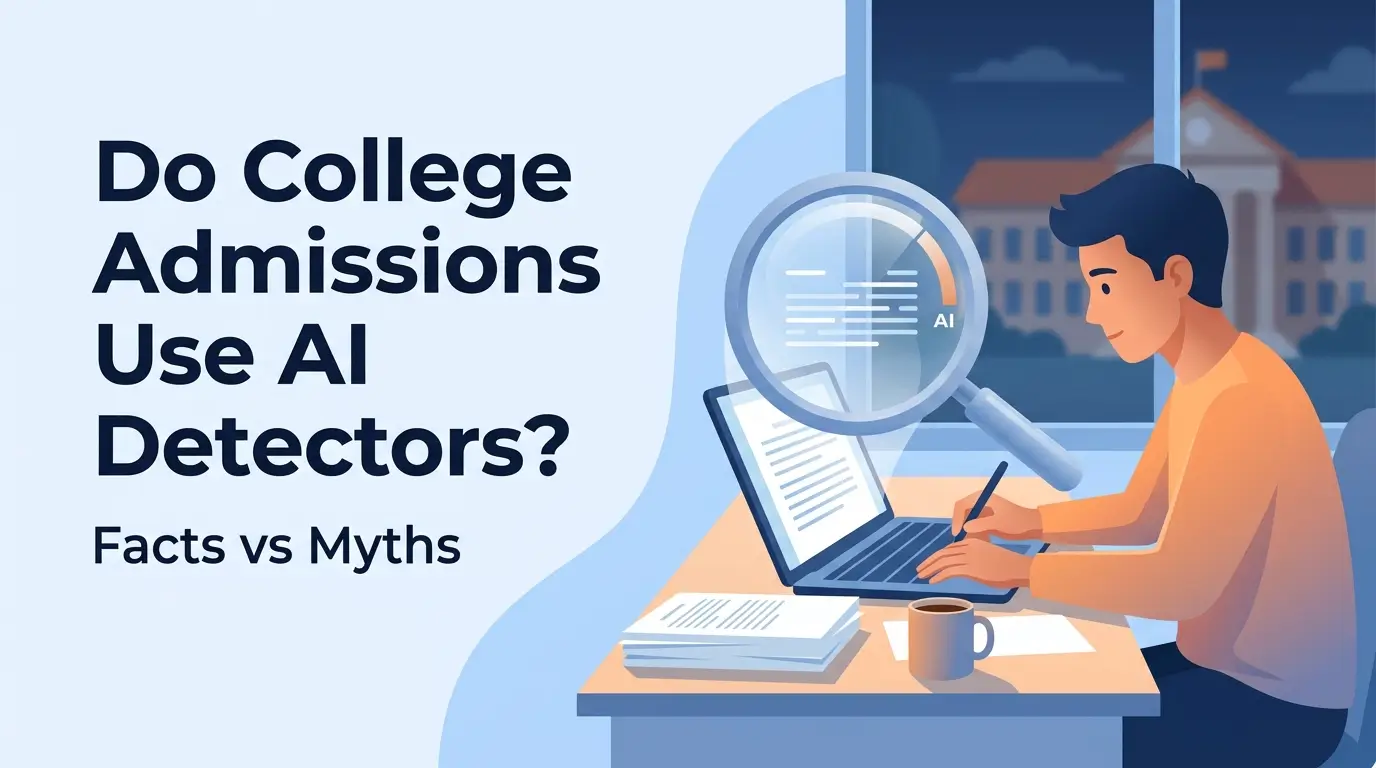
Do college admissions use AI detectors? See what the Common App, College Board, and top colleges really do and how to protect your essay.
Do college admissions use AI detectors? Some schools may use them, but no major U.S. admissions office has publicly confirmed routine detector screening of every essay. Human readers remain the main method, and the real enforcement tool is the Common App's fraud policy, which treats submitting substantive AI-generated content as your own work as fraud. Policies differ by school, so check each college's published AI policy before you submit.
Key Takeaways
Most colleges rely on human readers and your signed attestation, not AI detectors.
The Common App runs no detector, but its fraud policy covers AI-generated content.
Claims that 40%+ of colleges use detectors lack official admissions data.
Detectors are unreliable on short essays and flag non-native writers more often.
Keep dated drafts and write with specific personal detail to protect your essay.
Do Colleges Use AI Detectors for College Applications and Essays?
There is no universal rule across U.S. admissions offices. So, do colleges use AI detectors for essays? Sometimes, but it is the exception rather than the standard, and most schools do not publish whether they do.
You will find articles online that say the answer is a flat yes, and others that say a flat no. The disagreement is real. Several pages ranking for this question are published by companies that sell detection products, and popular statistics such as "40% of colleges use detectors" rarely trace back to an admissions office. The honest answer is that usage is limited, unverified at scale, and varies by school.
The policy landscape is fragmented. Many universities have no AI-specific admissions policy. Some prohibit AI-written content completely. Others allow limited help such as grammar checking or brainstorming, as long as the ideas and wording are yours.
Because policies change every cycle, treat any list of school rules, including this one, as a starting point and confirm on the college's own admissions page.
Do Colleges Use AI Detectors for Applications Beyond Essays?
Detectors, when used at all, are aimed at written material: personal statements, supplemental essays, and sometimes short answers. Some colleges also use AI in other parts of admissions, such as sorting or summarizing applications. One Intelligent.com survey reported that about half of higher education institutions use AI somewhere in the admissions process, but that figure covers all uses, so it does not mean half of colleges scan essays for AI.
Some schools also say openly that AI helps them analyze applications. The University of North Carolina, for example, has said it uses AI programs to produce data points about Common App essays and transcripts, while trained human readers still evaluate every application. That is AI reading applications, which is different from AI hunting for cheaters.
Myth vs. Reality: AI Detectors in Admissions
Common claim | What the evidence supports |
"Every college runs your essay through Turnitin." | Turnitin is mostly deployed for coursework. Its use in admissions is not confirmed at scale. |
"The Common App checks for AI." | It does not run a detector, but its fraud policy covers AI-generated content. |
"A high AI score means you cheated." | Scores are probabilities and can be wrong, especially on short or non-native writing. |
"The College Board checks your essay." | It does not process application essays. |
"If a school has no AI policy, AI is fine." | Common App members still fall under the Common App fraud policy. |
What Is the Common App's AI Fraud Policy
Yes, and this is the rule that matters most for most applicants. In 2024 the Common App updated its fraud policy to include the substantive content or output of an AI platform when it is submitted as your own work. When you submit, you e-sign an affirmation that the application is yours.
The policy targets substantive content, meaning the experiences, ideas, and wording your essay is supposed to show are yours. Running your finished essay through a spelling and grammar tool is treated very differently from asking a chatbot to draft paragraphs.
Because the policy applies across Common App member colleges, it binds you even if a specific school says nothing about AI. A fraud finding can also be reported to the other colleges on your list, so a problem at one school can follow you to the rest. Read the current wording on the Common App site before you apply, since platform rules are updated between cycles.
What Do Individual Colleges Say About AI in Essays?
Well-known schools have published guidance, and the direction is consistent: the essay must reflect your own thinking.
Brown, Harvard, and Georgetown: These schools take a strict stance against AI-generated essay content. Brown allows AI for spelling and grammar review, and Harvard points applicants to the Common App fraud policy and its honor code.
Yale, Caltech, and the University of California system: These tend to be more flexible, allowing grammar checking or light editing while expecting the substance to come from the student. Caltech goes further: its admissions AI guidelines say AI should not generate essay text, and its application asks applicants a confidential question about AI assistance. Caltech also warns that failing to follow its guidelines can lead to rescinded admission.
Duke: Duke stopped giving numerical essay ratings, which reflects a wider shift in how schools weigh essays in the AI era.
University of Michigan: It has no separate AI rule and reminds applicants that the Common App fraud policy applies.
Using Grammarly to fix grammar in text you wrote yourself is generally treated like spell-check, not AI authorship. Generating new sentences is a different matter.
To understand the line between polishing and generating, read our guide on whether Grammarly has a humanizer.
Is Using AI for Your College Essay Allowed?
The answer depends on what you mean by "using AI." Most schools that have spoken on the topic separate help with process from help with content. Brainstorming topics, researching colleges, and checking grammar sit on the acceptable side at many colleges. Having a chatbot outline, draft, or rewrite your paragraphs does not, and some strict policies say so explicitly.
A simple test helps: if an admissions officer asked you to explain any sentence in your essay, could you say where the idea came from and why you wrote it that way? If yes, you are on safe ground.
If a school asks applicants to disclose AI use, disclose it. If it is silent, fall back on the Common App standard and keep the wording yours.
What AI Detectors Do Colleges Use?
Colleges have not agreed on one tool, so which AI detector colleges use depends on the school. The names that come up most in higher education are Turnitin, GPTZero, Originality AI, Copyleaks, and ZeroGPT. Each works a little differently.
No admissions office has published a standard tool. Where detection happens, it is usually a tool the college already licenses for coursework, run case by case after a human reader raises a concern.
Turnitin
Turnitin launched its AI detection module in April 2023 and is the most widely deployed, mainly for coursework through learning management systems. Its maker has said the tool has a false positive rate under 1% for documents with a large share of AI text, but that claim describes vendor testing under specific conditions. Read our breakdown of how accurate Turnitin really is.
If you want to see how it treats ChatGPT-written text specifically, read whether Turnitin can detect ChatGPT.
GPTZero
GPTZero is popular with educators and is often the first tool mentioned in discussions about essay screening. See how it holds up in our GPTZero accuracy review.
Originality AI
Originality AI is more common with publishers and content teams than with schools, but it still appears in education conversations. Our Originality AI review covers its strengths and false positive risk.
Copyleaks
Copyleaks sells to institutions and businesses and offers integrations that some schools use. We tested it in our Copyleaks accuracy guide.
ZeroGPT
ZeroGPT is free and widely known, which is why applicants often try it on their own essays. It is also one of the less trusted options, as our ZeroGPT accuracy review explains.
All of these tools analyze word choice, sentence rhythm, and structure, then return a probability score such as "85% likely AI." That is a statistical estimate, not proof.
Which AI Detector Do Colleges Use After You Enroll?
Once you are a student, the question changes from admissions to coursework. Does university use AI detector tools at that stage? Often yes, and it usually comes through the platform your course runs on. Many first-year students are surprised by how different this is from the admissions process.
If your school uses Canvas, see whether Canvas has an AI detector.
Blackboard users can check the same for Blackboard, and Moodle schools can read about AI detection in Moodle.
Younger students and some colleges also use Google tools. Here is what to know about Google Classroom.
If you want to know which free or paid tool behaves most like the one your school uses, see the detector most similar to Turnitin.
Have Universities Stopped Using AI Detectors?
Some have. In August 2023, Vanderbilt announced it was disabling Turnitin's AI detection tool. Its reasoning was practical: even at a 1% false positive rate, roughly 750 of the 75,000 papers the university submitted the previous year could have been wrongly labeled as AI-assisted. Vanderbilt also cited a lack of transparency about how the tool reaches its scores and the higher error rates for non-native English writers.
That decision concerned coursework, not admissions, but it shows how much doubt surrounds detector accuracy at large scale. Several reports say other universities, including Johns Hopkins, Yale, and Northwestern, have turned off the feature too, and the University of Waterloo and Curtin University are also said to have discontinued it. Only Vanderbilt's decision is backed by its own public statement in our research, so treat the longer list as reported rather than confirmed. Turnitin has also acknowledged that its own tool can miss AI text. A school that has disabled a detector for students is unlikely to lean on it heavily for a high-stakes admissions decision.
What AI Detector Does the Common App Use?
None. The Common App does not screen essays with AI detection software before sending them to colleges. Its enforcement runs through the fraud policy and the affirmation you sign, not through a scanner.
The personal statement is capped at 650 words, which is short enough that detector reliability starts to suffer (more on that below).
What AI Detector Does the College Board Use?
None for admissions essays. The College Board does not process college application essays. It runs AP exams and the CSS Profile, so its AI rules apply to AP work, not admissions essays.
The Coalition App, now operated by Scoir, also leaves AI policy to member schools. Harvard, for example, treats AI-generated essay content as a violation of the Coalition standards as well.
Platform | Screens Essays with AI Detectors? | AI Policy Scope |
Common App | No | Fraud policy covers AI-generated content |
College Board | No | AP exams and coursework only |
Coalition App (Scoir) | No | Defers to member colleges |
If detection happens at all, it happens at the individual college after your application is delivered, not at the platform level.
Do Med Schools Use AI Detectors?
Do medical schools use AI detectors? AMCAS does not publish a public AI detection policy for primary or secondary essays and leaves integrity enforcement to individual programs. Each medical school sets its own standards for personal statements and secondaries.
If a school suspects AI authorship, the usual path is human review first, then cross-checking against the rest of your file, and possibly asking about the essay in an interview. Being able to talk about your own experiences in detail is your best protection.
Does This Apply to Grad School and Scholarship Essays?
The same logic carries over. Graduate programs and scholarship committees mostly rely on human readers, and each program sets its own AI rules. Scholarship essays can be especially exposed because committees are small and read closely, so a generic or unusually polished essay stands out.
Whatever the application type, the safest approach is the same: read the specific policy, write in your own voice, and keep your drafts.
Do Professors and Publishers Use AI Detectors?
Do professors use AI detectors? Many do, often through Turnitin or similar tools built into their course platforms, though some universities have switched the feature off. See our list of the best AI detection tools for professors.
Whether an instructor can spot AI without any software is a separate question. We cover it in our article on whether professors can detect ChatGPT.
Do publishers use AI detectors? Some publishers and editors run submissions through tools like Originality.ai or Copyleaks, though practices vary widely and few share their rules.
How Accurate Are AI Detectors on Short Essays?
Detectors get less reliable on short text. Many tools recommend a minimum of around 300 words, yet many application essays fall below that. Supplemental essays are often 150 to 250 words, and even a full Common App essay tops out at 650. With less text to analyze, both false positives and false negatives become more likely.
Sophisticated human writing can also trigger flags, and small edits can shift a score dramatically. That fragility is why a detector score should be treated as a rough signal, not evidence.
Can AI Detectors Falsely Flag Human-Written Essays?
Yes. A 2023 peer-reviewed study in Patterns by Liang and colleagues found that several popular detectors flagged writing by non-native English speakers as AI-generated far more often than writing by native speakers.
The reason is structural. Writers working in a second language often use simpler vocabulary and more predictable sentence patterns, and detectors read those patterns as machine-like. If you are an international applicant, your risk of a false flag is higher even when every word is yours.
Do not change your natural voice to game a detector. Keep proof of your process instead: dated drafts, outlines, and version history.
Google Docs saves version history automatically, which makes it a handy record if your essay is ever questioned.
Should You Run Your Own Essay Through an AI Detector?
Many applicants do, and it is understandable. Just use the result carefully. A high score on your own honest writing does not mean you did anything wrong, and a low score does not guarantee anyone else will agree. Different tools often give very different numbers for the same text.
If you want a quick second opinion, you can check your draft with our AI detector and treat the score as one rough signal among many.
Comparing more than one tool helps you see how much scores vary. Our review of whether JustDone's AI detector is accurate is a good example of why no single number should decide anything.
If a score worries you, do not start rewriting your essay to please a tool. Look at the passages the tool highlights and ask whether they sound generic. Adding a specific detail or a real moment usually improves both the essay and the score.
Can AI Humanizers Protect an Admissions Essay?
Applicants sometimes wonder whether a humanizer tool can make AI text "safe." There are two problems with that idea. First, results are inconsistent, and we looked at the evidence in our article on whether AI humanizers actually work.
Second, a humanizer changes surface patterns, not the thing admissions officers care about. An essay with no real specifics or personal voice still reads as thin, and it still will not match the rest of your application. It also does nothing about the Common App fraud policy, which is about who wrote the content, not what a scanner says.
Results against specific detectors also vary. See whether humanize AI works on Turnitin for one example.
If you want help smoothing the wording of a draft you wrote yourself, our AI humanizer can support that step, though it cannot add the personal detail that makes an essay yours.
If your goal is simply to make your own draft sound more natural, read about how to rewrite text so it reads as human and see whether Undetectable AI holds up before you rely on any tool.
How Do Admissions Officers Spot AI Essays Without Software?
Experienced readers rely on pattern recognition and cross-checking. They compare the voice and vocabulary in your essay with your recommendation letters, short answers, and interview notes. A mismatch across those materials is a much stronger signal than any detector percentage.
A Washington Post experiment reported that an admissions counselor could pick out AI-written essays through vague details, clichés, and wandering structure. A separate study of residency applications found that human reviewers identified AI-written applications correctly about two-thirds of the time, which beats guessing but is far from perfect.
One more tell comes from volume: when many applicants feed the same prompt to a chatbot, the essays tend to share phrasing, structure, and tone, and a reader who sees hundreds of them notices the sameness.
The most reliable clue is a lack of specifics. Real essays are anchored in concrete moments, like a particular room, a real conversation, or a specific failure. AI drafts tend to stay abstract.
Common red flags include:
Generic examples with no personal detail
Stock phrases such as "tapestry" or "it's important to note"
Perfectly even paragraphs with no natural variation
Vocabulary that does not match the rest of the application
Little real emotion or reflection
A voice that changes between essays
What If a College Suspects Your Essay Was Written by AI?
There is no standard process. Outcomes depend on the school and the strength of the evidence, but the path usually looks like this:
Initial concern: A reader or a tool raises a flag. Applicants are usually not told.
Human review: A senior reader or committee looks at the essay. A score alone should not decide the outcome.
Cross-check: Your essay is compared against the rest of your application.
Extra verification: The school may request another writing sample, hold an interview, or contact your counselor.
Decision: Results range from asking you to resubmit to denying the application or, in serious cases, rescinding an offer.
If a finding is treated as application fraud, the Common App's policy allows the matter to be shared with the other colleges you applied to. That is why a false flag is worth answering quickly and with evidence.
If you believe you were flagged unfairly, offer your draft history right away. Admissions offices generally welcome evidence of a genuine writing process.
How to Write an Application Essay That Sounds Like You
The best protection is specific detail and your own voice. Start with a story only you can tell, use concrete scenes, and read the essay aloud to catch anything that sounds unnatural. If you use AI for brainstorming, keep the final wording your own.
Here is a short checklist to run before you submit:
Every example is a real moment you can describe in detail
Your voice matches your short answers and other essays
You saved dated drafts or version history
You checked each school's current AI policy and the Common App fraud policy
You can explain any sentence if asked in an interview
To understand why AI text often sounds flat, read how AI writes like a human and what separates it from real writing.
If you use AI for brainstorming, it helps to know how to prompt AI to write like a human so the ideas it gives you are useful starting points, not finished text.
Editing your own draft with a chatbot is another gray area. See how to make ChatGPT sound more human and whether Claude can humanize text, then keep any edits limited to polish.
Conclusion
So, do college admissions use AI detectors? Sometimes, but not as a confirmed, standard step. Human readers remain the main line of defense, and the Common App, College Board, and Coalition App do not screen essays at the platform level. Where detectors are used, they act as a rough signal that leads to human review, not as a final verdict.
The bigger risks for applicants are not hidden software. They are essays that sound generic, a voice that does not match the rest of the application, and the Common App fraud policy that applies even when a school stays silent. International applicants also face a higher chance of false flags, which makes keeping draft history even more important.
Your best approach is simple: read each college's current AI policy, write about moments only you can describe, save your drafts, and keep any AI help limited to brainstorming or polish. An essay that sounds like you is the strongest protection you have.
Frequently Asked Questions
Do college admissions use AI detectors?
Most do not use them routinely, and few publish their practices. Human review and the signed application affirmation are the dominant safeguards, with detection software used by a minority of schools, usually case by case.
Do colleges use AI detectors for applications?
Some may, mainly on essays and short answers, but it is not confirmed as a standard step. Each college sets its own approach, so read the policy of every school on your list.
Which AI detector do colleges use?
There is no single standard. Turnitin, GPTZero, Originality AI, Copyleaks, and ZeroGPT are the tools most often mentioned, and most colleges do not say which, if any, they use for admissions.
Does university use AI detector software after admission?
Often it is available through the course platform, but some universities have disabled it because of false positives. Check your school's academic integrity policy.
Can colleges see if you use AI?
Not directly. Colleges cannot see your chatbot history. They can only infer AI use from the essay itself, from a detector score at the few schools that use one, or from mismatches with the rest of your application. Your signed affirmation that the work is yours is what makes AI-written content a fraud issue.
How do admission officers detect AI?
Mostly by reading. Officers look for generic examples, stock phrases, an even polished tone, and a voice that does not match your recommendations, short answers, or interview. Cross-checking these materials is more reliable than any detector score.
Does College Board check for AI?
Not for college application essays. The College Board runs AP exams and the CSS Profile, so its AI rules apply to AP work. Your essay is submitted through the Common App or Coalition App, not the College Board.
Do applications check for AI?
The application platforms do not scan essays with detectors. Checking, when it happens, is done by the individual college through human review and sometimes a detection tool, and every Common App applicant is bound by its fraud policy.
Is using AI for brainstorming considered cheating?
Many schools allow brainstorming or outlining but prohibit having AI write the essay. Definitions vary, so check each school's policy.
Does Grammarly count as AI in college applications?
Grammar and spelling correction on your own writing is generally not treated as AI authorship. Generating new text is different.
Can colleges see my AI detection score?
Scores are typically internal. Applicants are not automatically told if their essay was screened or what score it received. A high score usually leads to human review before the school contacts you.
Do AI detectors work differently on international student essays?
Yes. Research shows higher false positive rates for non-native English speakers, so international applicants face a higher risk of incorrect flags on human-written essays. Keeping draft history is the best safeguard.
Should I run my college essay through an AI detector first?
You can, but treat the result as a rough signal. Scores vary widely between tools and can be wrong on short, honest writing.
Does the Common App consider AI-written essays fraud?
Its fraud policy covers the substantive content or output of an AI platform submitted as your own work. Using a tool for spelling and grammar on your own writing is treated differently.