Can Professors Detect ChatGPT? Yes, Here's How (2026)
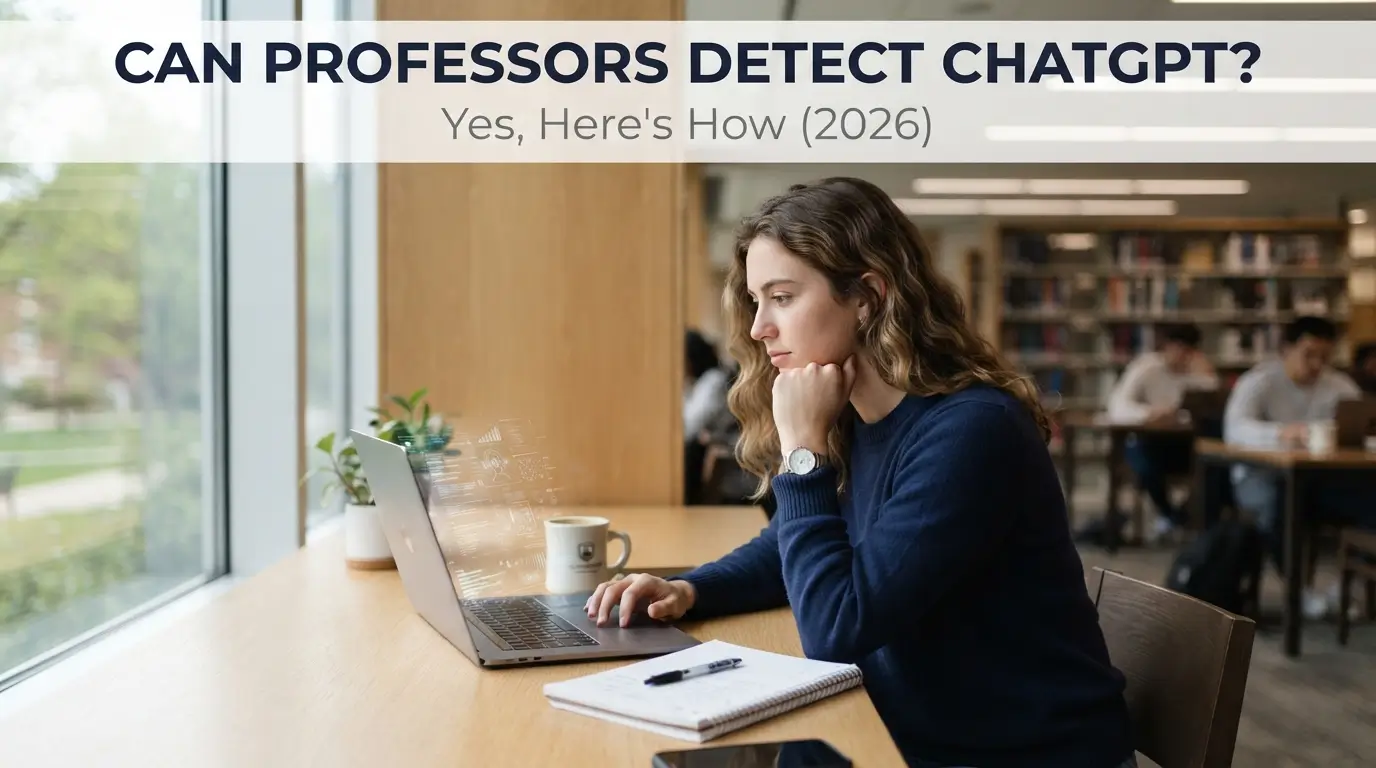
Can professors detect ChatGPT? Learn how detection works, what schools check for, and what to do if you get flagged by mistake.
Picture this: you wrote every single word of your essay yourself, stayed up late fixing your thesis, double checked your sources, and hit submit feeling pretty good about it. Then your professor calls you in and asks, "Did you use ChatGPT for this?"
Your stomach drops. You didn't cheat, so why are you suddenly on the defensive?
This is happening to more students every semester, and not just the ones who actually used AI. If you've been searching "can professors detect ChatGPT" because you're worried about a false flag, curious how the tech works, or just trying to stay one step ahead of academic policy, you're about to get the full, honest picture.
Short answer: yes, professors can detect or strongly suspect ChatGPT use. They combine AI detection software (like Turnitin and GPTZero), learning platform activity logs (like Canvas), document edit history, and old fashioned human judgment. None of these methods are perfect on their own, and most schools require solid proof before penalizing a student.
Key Takeaways
Yes, AI writing can be flagged, but no single tool proves it with 100% certainty.
AI detectors look for patterns, not meaning, using signals called perplexity and burstiness.
False positives are real, especially for non-native English speakers and formal writers.
Canvas doesn't detect AI itself, but it logs timestamps and activity that professors use as evidence.
Google Docs version history is one of the strongest pieces of proof you can show if you're falsely accused.
Paraphrasing lowers your detector score, but it does not make AI text your own original work.
AI humanizer tools have limits too, none of them guarantee you'll pass every detector.
The best defense is authentic writing, a real drafting process, and being able to explain your work out loud.
How AI Detectors Like Turnitin and GPTZero Actually Work
When you submit a paper, your school may run it through an AI writing indicator such as Turnitin, GPTZero, Winston AI, Copyleaks, or Originality.AI. These tools don't "read" your essay the way a human does. Instead, they run statistical analysis and look for two main patterns:
Perplexity (predictability): AI models are built to choose the most statistically likely next word, so AI text tends to read as smooth and predictable. Human writing is messier and less predictable, full of idioms, fragments, and unexpected phrasing.
Burstiness (sentence rhythm): AI tends to produce sentences that are all roughly the same length. Human writers naturally mix short, punchy sentences with longer, complex ones.
These two signals are the backbone of almost every AI detector on the market today, including the ones your university has likely already licensed. A detector isn't scanning for "AI words." It's running your entire document through a language model and measuring how predictable each sentence is compared to what a typical human writer would produce.
To put a number on it: Turnitin reports that its AI writing indicator flags around 97% of fully AI-generated text correctly, while misidentifying less than 1% of purely human-written text as AI. That sounds reassuring, but those figures apply mainly to short, "pure" samples, not the mixed, edited drafts most real students submit. A paper that's part AI-assisted and part rewritten by hand doesn't fit neatly into either bucket, which is exactly where detectors get shakiest.
These signals are useful, but they're statistical guesses, not proof. A detector can tell you that your paragraph "looks" statistically similar to AI output. It cannot tell you, with certainty, that you personally typed it into ChatGPT. That gap between "looks like AI" and "was written by AI" is exactly why detector scores are meant to start a conversation, not end one.
The False Positive Problem: When Human Writing Gets Flagged as AI
AI detectors are far from perfect, and one group is disproportionately affected: non-native English speakers.
A widely cited Stanford study tested multiple AI detectors on essays written by English language learners and found the tools misclassified a large share of genuinely human writing as AI generated, in some tests, well over half. Formal, structured, and predictable writing, which is common for students writing in a second language, can trigger the same statistical signals AI text produces, even when a human wrote every word.
Source: Stanford HAI, "AI Detectors Biased Against Non-Native English Writers"
This false positive risk is a big part of why schools are told not to treat a detector score as final proof, and why students should know how to push back if they're wrongly accused. It's also why so many students who write in a careful, formal style, even without touching AI, end up needing to defend perfectly original work.
Can Professors Spot AI Writing Without Software? The Human Signals
Long before an AI detector even runs, experienced instructors often notice AI generated writing on their own. Here's what they look for:
Writing style shifts (stylometry): if a student who usually writes casually suddenly submits polished, journal level prose, it stands out immediately, especially to a professor who has read that student's work all semester.
Hallucinated citations: ChatGPT frequently invents book titles, authors, and page numbers that don't exist. Verifying a source takes a professor under a minute, and a fake citation is often the fastest way to get caught.
Generic "AI" phrasing: repeated stock phrases like "delve into," "a rich tapestry," or "it is crucial to note" are common tells.
Missing course context: AI doesn't know what happened in your lecture last week. Essays that never reference specific class discussions or assigned readings can look generic and disconnected.
Inability to explain the work verbally: this is the most reliable check of all. A student who wrote their own paper can explain their thesis, their sources, and their reasoning out loud. A student who didn't, usually can't.
None of these signals require any software at all. A professor who has been grading essays for ten or fifteen years often develops an instinct for this long before they ever open Turnitin. That instinct is part of why even a "clean" detector score doesn't always end the conversation.
Does Canvas Detect ChatGPT?
Canvas, Blackboard, and Moodle are learning management systems (LMS), not AI detectors. On their own, they don't have any built in "AI brain" reading your essay.
What Canvas can do is log everything around your submission:
Submission and access timestamps
Number of attempts
Time spent on a page
Device and IP information
Whether text appeared instantly (for example, a 1,500 word essay pasted in two seconds)
If your school connects Turnitin to Canvas, which many do, your essay automatically gets an AI writing score the moment you submit it. The same logic applies to Google Classroom, if you're curious whether that platform has its own built-in AI checker, this explainer on Google Classroom's AI detection capabilities covers exactly what Classroom can and can't see on its own.
Can Teachers See ChatGPT Use in Google Docs?
Google Docs doesn't detect AI on its own, but it quietly builds a complete paper trail through your version history.
A normal writing process looks messy: typing, deleting, rearranging paragraphs, editing over several days. A document that appears from a blank page to a finished 1,500 word essay in one "paste" event, with no drafting history, is one of the biggest red flags a professor can see.
Practical tip: draft and revise inside Google Docs from the start. Your version history becomes your best evidence that the work is genuinely yours, and it's evidence a professor can literally scroll through in front of you.
Can Professors Detect ChatGPT on Multiple-Choice Quizzes?
Text based AI detectors are useless here since they can't analyze an A, B, C, or D answer. But that doesn't mean cheating goes unnoticed.
Schools instead rely on:
Proctoring software (Respondus LockDown Browser, Honorlock, Proctorio) that monitors your screen, webcam, and tab activity
Answer timing, since finishing a 60 question exam in three minutes with a perfect score is an obvious red flag
Answer pattern analysis comparing your quiz performance to prior assessments
For quizzes, the risk isn't really about text detection at all. It's about behavioral data: how fast you answered, whether your browser lost focus, and whether your performance suddenly jumps in a way that doesn't match your history in the course.
Does Paraphrasing ChatGPT Text Prevent Detection?
This is one of the most searched questions about AI detection, so let's be direct: paraphrasing lowers your detector score, but it doesn't fix the underlying problem.
What paraphrasing changes:
Individual word choices
Surface level phrasing
What paraphrasing doesn't change:
Hallucinated citations that still don't exist
Predictable paragraph level structure
The absence of your genuine voice and course specific detail
Some students turn to dedicated rewriting tools instead of paraphrasing by hand, hoping a more sophisticated rewrite will hide the underlying pattern. Others assume any tool marketed as a "humanizer" will get them past Turnitin specifically, since that's the detector most universities use. The honest answer is more nuanced than most marketing suggests.
OpenAI itself has told educators that AI detection tools are "not fully reliable" and that small edits can lower a detector score without changing whether the work is actually the student's own. That's why OpenAI recommends looking at a student's process, meaning drafts, notes, and revision history, rather than trusting a detector score alone.
Source: OpenAI Educator FAQ, "How can educators respond to students presenting AI-generated content as their own?" (help.openai.com)
If you want to check your own writing before submitting, especially if you're worried about a false positive, you can run it through our AI detector to see how it scores against the same signals your school's software looks for.
Popular AI Humanizer Tools: Do They Actually Work?
Because so many students search for ways to lower their AI score, an entire category of "humanizer" tools has popped up. It's worth understanding what these tools actually do before you rely on one, since results vary a lot between products. If you're weighing whether a bold claim like "undetectable AI" actually holds up, it's worth reading whether humanizing AI text really works on Turnitin before trusting it with an assignment that matters.
The pattern across all of these tools is consistent: they can reduce a detector's confidence score, but none of them can guarantee zero detection, and none of them turn AI generated ideas into your own original thinking.
The 2026 Detection Arms Race
Detection isn't standing still. As newer AI models write in ways that are harder to statistically separate from human writing, detector companies keep retraining their systems to keep pace, and the two sides keep leapfrogging each other. What flagged text reliably a year ago may slip through today, and what slips through today may get caught again next semester once detectors update. The practical takeaway: don't plan around beating today's detector. Build a genuine drafting process instead, since that's the one thing that doesn't go stale.
Detection Methods Compared
Method | What It Actually Checks | How Reliable Is It Alone? |
AI detectors (Turnitin, GPTZero) | Perplexity and burstiness patterns in text | Moderate, prone to false positives, especially with non-native speakers |
Writing style comparison | Consistency with your past submissions | High, if the professor has prior samples of your writing |
Source/citation verification | Whether cited sources actually exist | Very high, hallucinated citations are easy to catch |
Canvas/LMS activity logs | Timestamps, paste events, submission speed | Moderate, supports other evidence, isn't standalone proof |
Google Docs version history | Drafting process over time | High, when available |
Proctoring software | Screen, tab, and webcam activity during quizzes | High for real-time exams |
Oral defense / follow-up questions | Whether you can explain your own work | Very high, the hardest signal to fake |
What to Do If Your Original Work Is Falsely Flagged
If you wrote every word yourself and still got flagged, don't panic. The burden of proof is usually on the school, not you.
Stay calm and don't delete anything. Preserve your drafts, notes, and document history exactly as they are.
Export your version history. Download your full edit history from Google Docs or Microsoft 365 as proof that the document was built over time.
Gather your notes. Bring your outline, rough drafts, and research sources to any meeting.
Request a real conversation, not just an email. Ask to sit down and explain your argument out loud. A strong oral defense is hard evidence.
Know your school's policy. Most institutions, including Turnitin's own guidance, state that an AI score alone should never be the sole basis for penalizing a student. It should start a conversation, not end one.
Universities are increasingly aware of how often false positives happen, which means a calm, well documented response usually gets taken seriously. Panicking or getting defensive tends to work against you far more than the accusation itself.
How to Use AI Ethically in Your Coursework
You don't need to avoid AI completely. You need to follow your school's disclosure policy.
Generally acceptable (with permission):
Brainstorming topic ideas
Getting a suggested outline structure
Grammar and clarity checks
Asking AI to explain a concept you're stuck on
Generally prohibited:
Submitting AI generated text as your own final work
Using AI during proctored exams
Skipping disclosure when your syllabus requires it
If your professor allows AI as a drafting aid, it still helps to keep the ideas AI assisted but the final voice your own, and to add specific examples from class discussions that a generic AI response could never know. And if you're working on an AI-assisted first draft that your syllabus permits, our humanizer tool can help smooth out overly robotic phrasing without changing the ideas you're responsible for.
Frequently Asked Questions
Can professors detect ChatGPT?
Yes. They combine AI detection software, writing style comparison, source verification, document history, and direct conversation. No single method is 100% conclusive on its own, but together they usually give a clear picture.
Does ChatGPT get detected by Turnitin?
Yes, in most cases. Turnitin's AI writing indicator is specifically built to flag text that statistically resembles GPT family output, including ChatGPT. It's most accurate on largely unedited AI text and less reliable on heavily paraphrased content, which is why Turnitin recommends its score be reviewed by a human, not treated as final proof.
Can ChatGPT really be detected?
It can be flagged with reasonable accuracy, but not with total certainty. AI detectors are statistical tools, not lie detectors. They estimate the likelihood that text is AI generated based on predictability and sentence patterns. That's why detector results are typically combined with source checks, version history, and an oral conversation before any action is taken.
How to make sure ChatGPT is not detected?
There's no reliable way to guarantee AI written text won't be flagged, and trying to evade detection to submit AI work as your own violates most academic integrity policies regardless of whether a detector catches it. The safer approach is to use AI only within what your syllabus allows, disclose it when required, and keep your actual writing process, meaning drafts, notes, and edit history, as proof of your own work.
Does paraphrasing ChatGPT text prevent detection?
Not reliably. Paraphrasing changes wording but not the underlying sentence length uniformity or predictability that detectors analyze, and it doesn't fix issues like fabricated citations or a missing personal voice.
Can Canvas detect ChatGPT on its own?
No. Canvas is a learning management system, not an AI detector. It can show timestamps and activity logs, and schools often connect Turnitin to Canvas for AI scoring on submitted work.
Is a 20% AI detection score bad?
Not necessarily. A low score often just means the text contains a few common, formulaic phrases. Most instructors only investigate further when scores are significantly higher.
Conclusion
Professors can detect ChatGPT through a mix of AI detectors, activity logs, citation checks, and their own judgment of your writing. But detection isn't perfect, and honest students do get falsely flagged sometimes, especially non-native English speakers.
The safest path isn't trying to outsmart a detector. It's writing in your own voice, keeping your drafts and research notes, following your school's AI policy, and being ready to explain your own work out loud. If you can do that, you have nothing to worry about.