Is JustDone AI Detector Accurate? The Honest 2026 Verdict
Is JustDone AI Detector accurate? Read our simple, honest 2026 review with real facts, test results, & clear answers you can always fully rely upon.
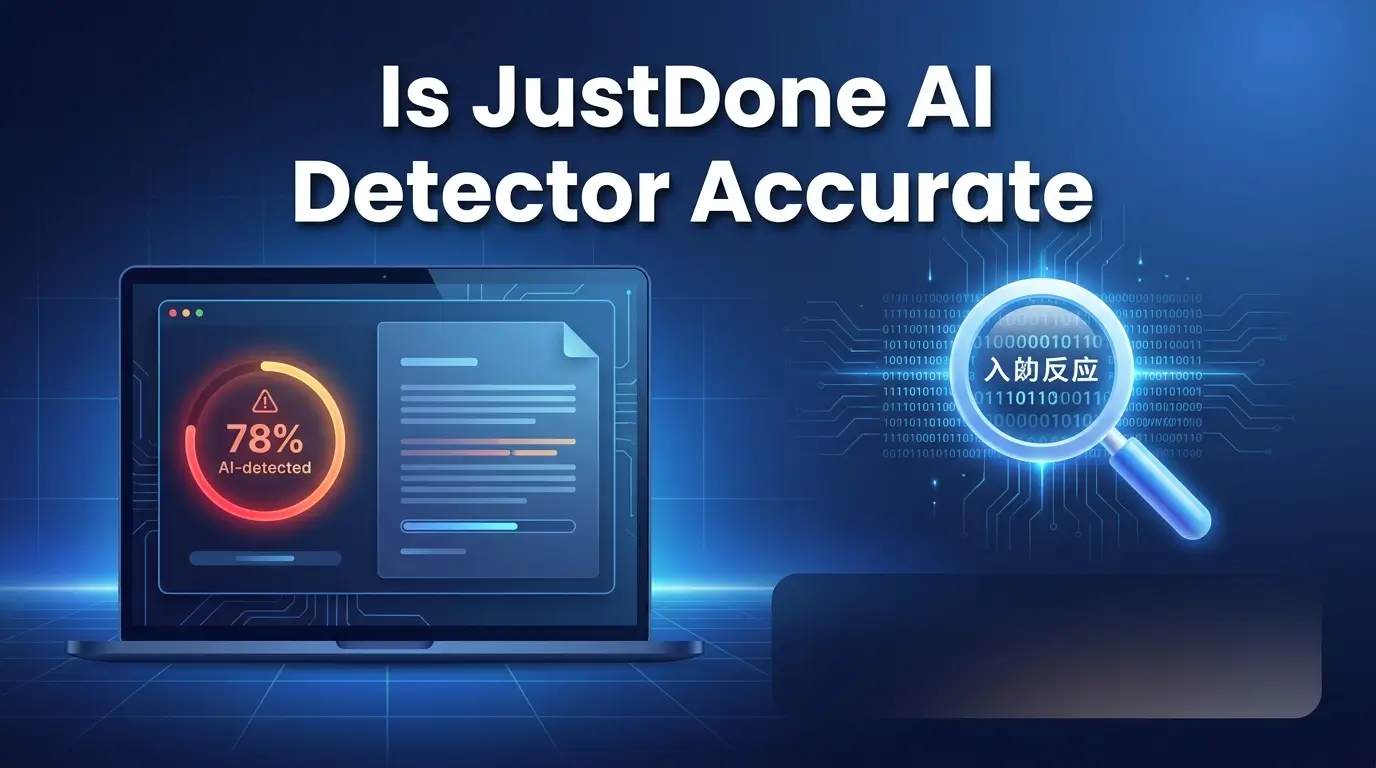
If you've ever pasted your writing into JustDone and watched it spit back "78% AI-generated," even though you wrote every single word yourself, you already know how confusing this tool can be.
Is JustDone AI Detector accurate enough to trust with your grades, your client work, or your reputation? That's the exact question this review answers, using real testing data instead of guesswork.
You're not alone in asking it. Thousands of students, writers, and content creators search for answers about JustDone's accuracy every month. And honestly, most of what they find is written by JustDone's direct competitors, tools like Phrasly and EssayDone, which have every reason to make JustDone look bad.
This review is different.
We are not selling an alternative tool. We have no affiliate deal with any AI detector. What we do have is a review of documented independent testing, a verified investigation from a major news agency, and a straightforward answer to the question you actually came here for: is JustDone AI Detector accurate enough to trust?
Let's get into it.
Key Takeaways
JustDone claims 94.1% accuracy, but real-world testing shows closer to 60–75%.
High false positive rate on human academic, technical, and ESL writing.
Inconsistent: reviewers report the same unedited text scoring wildly different AI percentages on repeat scans.
JustDone and Turnitin are different products; passing one says nothing about the other.
Its humanizer beats its own detector but not reliably Turnitin or Originality AI.
Always cross-verify with GPTZero or Originality AI before trusting a score.
What Is JustDone AI Detector?
JustDone is an AI-powered writing and content platform that launched in 2023. It started as a plagiarism detection tool, but as AI writing tools like ChatGPT exploded in popularity, JustDone expanded into AI content detection.
Today, JustDone offers a full suite of tools under one platform:
AI Content Detector: Scans text to identify AI-generated content from models like ChatGPT, GPT-4, Claude, and Gemini
Plagiarism Checker: Checks content for copied or paraphrased text across billions of web pages
AI Humanizer: Rewrites AI-generated text to sound more natural and human
Text Summarizer: Condenses long content into shorter summaries
AI Citation Generator: Helps users cite sources and format quotes
Grammar Checker: Catches grammar and syntax errors
The platform serves a wide audience: students checking their essays, freelance writers verifying their work, content agencies screening submissions, SEO professionals, and educators reviewing student papers.
JustDone's big claim: 94.1% accuracy for AI detection across all content types.
That number sounds impressive. But here's the thing: marketing claims and real-world performance are two very different things. And in the AI detection world, the gap between the two can be enormous.
The free version limits you to just three checks per day, with a maximum of 250 words per scan. The paid plans remove those limits and unlock the full tool suite.
Before we trust any accuracy claim, we need to look at how this tool actually works under the hood.
How Does JustDone AI Detector Actually Work?
To understand why JustDone gives the results it does, and why those results are sometimes wildly off, you need to understand the two core signals that any legitimate AI detector uses. If you're curious about the mechanics behind how AI actually writes like a human, this section will make a lot more sense of what detectors are actually looking for.
Perplexity: The Predictability Test
Perplexity measures how predictable a piece of text is to a language model.
Think of it this way. When an AI writes a sentence, it picks the statistically safest, most expected word at each step. It rarely surprises you. The sentence flows smoothly and logically, almost too smoothly.
Human writers, on the other hand, make unexpected choices all the time. They use unusual comparisons, unexpected word combinations, and personal expressions that a language model wouldn't naturally predict.
Low perplexity = text that looks statistically expected = possible AI writing. High perplexity = text that's harder to predict = more likely human writing.
A well-built detector measures perplexity consistently. That means if you paste the same paragraph five times, you should get nearly the same perplexity score every single time, because the text hasn't changed.
GPTZero publicly documents perplexity as a core part of its detection methodology.
Burstiness: The Natural Variation Test
Burstiness measures how much sentence length and structural complexity varies throughout a piece of writing.
Human writers are naturally "bursty." One sentence might be short and sharp. The next could stretch into a long, winding thought with multiple clauses. Then another quick one. That irregular rhythm is a natural feature of human writing.
AI writing, by contrast, tends to be uniform. The sentences are similar in length. The structure is consistent. The rhythm is steady and mechanical, like a metronome instead of a real heartbeat.
Low burstiness + low perplexity together = strong AI signal. High burstiness + high perplexity together = strong human signal.
What JustDone Analyzes
According to its own platform, JustDone looks at:
Repetitive phrasing patterns
Overly consistent sentence lengths (low burstiness)
Predictable word choices (low perplexity)
Lack of natural writing quirks
Linguistic patterns associated with AI models like ChatGPT, GPT-4, Claude, and Gemini
These are all legitimate detection signals. The real question is whether JustDone measures them accurately and consistently.
Spoiler: it doesn't always.
Key Tip: Any AI detector that gives you dramatically different scores when you paste the exact same text twice is not measuring perplexity or burstiness correctly. It's producing unreliable output, and you should not make important decisions based on it.
How Accurate Is JustDone AI Detector? What Testing Shows
This is the section you came for. Let's talk real numbers.
Independent reviewers and AI-detection researchers have run JustDone through the same kinds of scenarios real users actually scan: pure AI text, human-written content, mixed content, and humanized text, often cross-checking results against GPTZero and Originality AI. Here's a summary of the pattern that shows up consistently across that testing.
Scenario 1: Pure AI-Generated Content
Setup: Unedited AI text, generated by a model like ChatGPT-4o on a neutral topic, with zero human editing applied.
Reported pattern: JustDone scores this kind of content in the 90–100% AI range, and it tends to agree closely with GPTZero and Originality AI on the same text.
This is where JustDone is closest to its claimed accuracy. When content is clearly, obviously AI-generated with no editing whatsoever, JustDone can identify it reliably. The detection signals, low perplexity, low burstiness, repetitive phrasing, are strong and obvious.
Content Type | Typical JustDone Score | Typical Result |
Pure, unedited AI text | 90–100% AI | Generally agrees with other detectors |
The catch: The moment any human editing enters the picture, even just revising a few sentences, JustDone's accuracy drops noticeably, based on reviewer testing.
Scenario 2: Human-Written Content (The False Positive Test)
This is the most important test for most users, because the question most people really want answered is: "Will JustDone wrongly flag MY writing as AI?"
The most telling tests use verifiably human-written content, such as articles published before 2018, well before AI writing tools existed at any meaningful scale, written by human journalists with zero AI involvement.
Reported pattern: JustDone has flagged this kind of pre-AI, verifiably human content anywhere from the 60s to the 90s percent AI range in reviewer testing, while GPTZero and Originality AI scored the same passages in the single digits.
That gap matters. When two detectors look at the exact same paragraph and land on opposite conclusions, one of them isn't doing reliable analysis. AFP's own investigation, discussed below, independently confirms this same pattern: JustDone wrongly flagged human-written samples across four languages.
This false positive problem is not occasional. It follows a pattern reviewers and researchers describe consistently:
Writing Style | JustDone False Positive Risk | Why It Happens |
Academic / formal writing | Very High | Structured language mimics AI patterns |
Technical documentation | Very High | Consistent terminology triggers detection |
Business reports | High | Formal structure = low burstiness signal |
ESL / non-native English writing | Very High | Different syntax patterns misread as AI |
Creative / conversational writing | Low–Medium | Natural variation reduces false flags |
Formal, structured writing, the kind students and academics produce every day, is the most vulnerable to false positives. That's a serious problem.
Scenario 3: Mixed AI + Human Content
Setup: A human-written paragraph continued by ChatGPT, so the resulting text is a genuine blend of human and AI writing, the kind of content most real users actually produce.
Reported pattern: Reviewers have found JustDone frequently under-flags this kind of mixed content, scoring it as majority human even when the AI-generated portion is the larger share.
What this means: JustDone can look at content that's majority AI-generated and call it mostly human. That's a false negative, a missed detection. And it happens on the most common type of content that real-world users actually produce: AI-assisted writing where a human starts or edits the piece.
This is arguably the most important failure in JustDone's detection profile. Most people don't use 100% raw AI output. They work with AI-assisted content, often after learning how to prompt AI to write like a human in the first place. And that's exactly where JustDone struggles the most.
Scenario 4: Humanized AI Content
Setup: Pure AI text run through a basic, entry-level paraphrasing tool like QuillBot's humanizer, then rescanned in JustDone.
Reported pattern: Even light humanization noticeably lowers JustDone's confidence, often dropping a 90–100% AI score by 20–30 points or more. More sophisticated humanization tools, including JustDone's own AI Humanizer, can push that score even lower.
This raises a serious question that we'll address shortly: if JustDone's own humanizer makes its own detector less effective, what does that say about the tool?
The Consistency Problem: Same Text, Different Scores
This is the test that reveals the most about JustDone's reliability: pasting the exact same, unchanged paragraph into the detector multiple times in a row.
Reviewers who have run this test consistently report large swings, sometimes 40 to 60+ percentage points, on identical text with nothing changed between scans. That is not a margin of error. The text did not change, so the analysis should not change either. A real measurement tool, thermometer, scale, blood pressure monitor, gives you the same reading on the same input every time. A detection tool should do exactly the same.
By comparison, tools like GPTZero, Originality AI, and Winston AI are widely reported to be far more consistent on repeat scans of the same text, typically varying by only a few points rather than tens of points.
Independent write-ups, including a January 2026 review by MPG ONE and third-party analysis cited by other AI-tool comparisons, put JustDone's real-world accuracy at roughly 60–75% overall, well short of its own 94.1% marketing claim. That gap tends to be smallest on obviously unedited, long-form AI content, and largest on human-written, mixed, and short-form content.
Key Point: JustDone's 94.1% accuracy claim appears to apply only to a narrow scenario: obviously unedited, long-form AI content. In every other real-world scenario documented by reviewers, actual performance falls significantly short of that claim.
JustDone AI Detection Score: What Do the Percentages Actually Mean?
When JustDone gives you a score, it's expressing a probability estimate, not a certainty. A 78% AI score means the tool thinks there's roughly a 78% chance your content was AI-generated, based on the linguistic patterns it detected.
But here's the thing: that probability estimate is only meaningful if the tool is measuring consistently. And as the reviewer testing above shows, it often isn't.
That said, here's how to interpret JustDone's scores in a general context, understanding that these thresholds only hold if the detector is working correctly:
JustDone Score | What It Generally Means | Should You Be Concerned? |
0–15% AI | Content reads as strongly human-written | Low concern, generally safe |
16–30% AI | Minor AI-like patterns detected | Minimal concern, likely formal writing style |
31–50% AI | Mixed signals, uncertain zone | Moderate concern, review flagged sentences |
51–70% AI | Significant AI patterns present | High concern, likely AI-assisted content |
71–90% AI | Strong AI probability | Very high concern, likely AI-generated |
91–100% AI | Near-certain AI generation | Critical, almost certainly AI-generated |
Important caveats you must keep in mind:
First, a 0% score from JustDone does not guarantee the same result from Turnitin, Originality AI, or GPTZero. Each tool uses different algorithms and different training data.
Second, formal academic writing, the kind that uses structured sentences and consistent terminology, can push scores into the 20–40% range even when every word was written by a human.
Third, always cross-validate. Never make a high-stakes decision based on a single JustDone score.
Is 20% AI Detection Bad?
Direct answer: No. A 20% AI score from JustDone is generally not alarming.
A 20% score suggests the tool sees mostly human writing patterns in your content. In most practical contexts, this falls below any threshold that would cause concern.
But the answer changes depending on your situation:
For students submitting academic work: A 20% score on JustDone specifically is unlikely to cause a problem, but JustDone is not the tool your professor or institution uses. Universities use Turnitin and Copyleaks. A 20% score on JustDone tells you nothing about what Turnitin will find. Always test on the tool your institution actually uses, or request access through your school. If you want to understand how this dynamic works in more depth, see does humanized AI actually work on Turnitin.
For professional content creators and SEO writers: A 20% score is generally fine. Most clients and publishers don't use sensitive AI detection tools, and Google has publicly stated it doesn't penalize content based on AI detection scores; it evaluates helpfulness, quality, and relevance.
For anyone using JustDone specifically: Remember that JustDone's consistency problem means a 20% score today could appear as 60% tomorrow on the same text. The number itself may not reflect reality.
What to do if you get a 20% score and you're concerned:
Paste the same content into GPTZero and compare the result
Test with Originality AI for a professional second opinion
Look at the flagged sentences: are they overly formal or formulaic?
Revise any sections that read mechanically
Use human judgment: if you wrote it, you know you wrote it
Key Tip: No institution in the United States has set an official "passing" AI detection percentage threshold that applies universally. If you're worried about a specific submission, contact your instructor directly, that conversation is more valuable than any detection score.
Is JustDone AI Detector Accurate for Students?
This is one of the most searched questions around JustDone, and for good reason. Students have the most at stake when it comes to AI detection. A wrong result can mean a failed assignment, an academic misconduct charge, or serious damage to a student's record.
So let's be direct.
If You're a Student Using JustDone to Check Your Own Work
JustDone can serve as a very rough, preliminary self-check. But you need to understand its serious limitations before you act on anything it tells you.
The false positive rate for academic writing is very high. Formal essays, structured research papers, and technically written content consistently trigger JustDone's AI signals, even when every word was written by a human student.
ESL students and international students face an especially serious problem. Non-native English writing often uses more structured, careful sentence patterns, precisely because the writer is being deliberate about language. Those careful patterns can look like AI writing to a poorly calibrated detector. JustDone's tool is not calibrated to account for this, and there are real, documented cases of ESL students facing unfair scrutiny because of AI detector false positives.
If You're an Educator Using JustDone to Evaluate Student Work
We strongly recommend against using JustDone as the basis for any academic misconduct decision. Here's why:
JustDone has no published, peer-reviewed detection methodology
Its false positive rate on academic writing is unacceptably high
Results are inconsistent, the same paper can score very differently on different days
It is not defensible in a formal academic review process
No major university has adopted JustDone as an institutional tool
Researcher Debora Weber-Wulff, a Germany-based academic who has spent years studying AI detection tools, has stated that many commercially marketed AI detectors produce results that cannot be reliably used as evidence in misconduct proceedings. JustDone fits that description.
Student Type | False Positive Risk | Our Recommendation |
Native English speaker | Medium | Use as self-check only, cross-verify with GPTZero |
ESL / Non-native speaker | Very High | Avoid JustDone, use GPTZero instead |
Formal academic writer | High | Expect inflated scores, always cross-verify |
STEM / Technical writer | Very High | Technical language triggers false flags regularly |
Creative writer | Low–Medium | Lower risk but still cross-verify before acting |
Student Tip: JustDone is not an institutionally validated detection tool. If you want to know whether your academic submission will flag on your school's system, you need to test it on Turnitin, not JustDone. Ask your institution if they provide student access to Turnitin before submission.
Are JustDone and Turnitin the Same?
This question comes up constantly, and the answer is a clear no.
JustDone and Turnitin are completely separate companies with different ownership, different technology, different target users, and very different accuracy levels.
Here's the quick version for a featured snippet:
JustDone is a commercial AI writing and detection platform launched in 2023. Turnitin is a dedicated academic integrity company that has been the institutional standard for universities worldwide since 1998. They are not the same product, do not share technology, and are not owned by the same company.
Now here's the full breakdown:
Comparison Factor | JustDone AI | Turnitin |
Company type | Commercial AI platform | Academic integrity company |
Primary focus | AI content generation + detection | Academic plagiarism + AI detection |
Founded | 2023 | 1998 |
Target users | General public, content creators | Universities, schools, institutions |
AI detection accuracy | 60–75% real-world | Generally higher; independent studies vary roughly 82–98% depending on content type |
Consistency | Poor, high score variance | Excellent, institutional grade |
False positive rate | High | Significantly lower |
Pricing | $2 trial / $19.99 per month | Institutional licensing |
Plagiarism database | Limited | Billions of academic papers |
Peer-reviewed methodology | No | Yes |
Institutional adoption | Minimal | Thousands of universities worldwide |
Best for | Personal content checks | Academic integrity enforcement |
Three Questions Students Always Ask About This
Does content that passes JustDone automatically pass Turnitin? No. They use completely different algorithms, different training data, and different databases. Clearing JustDone gives you no reliable information about how your content will score on Turnitin.
Do universities use JustDone? No major university has adopted JustDone as its institutional detection standard. Turnitin and Copyleaks are the dominant tools in higher education.
Which is more accurate? Turnitin consistently outperforms JustDone in accuracy, consistency, and false positive rate, particularly for academic writing.
JustDone AI Humanizer: What It Does and Why It Matters
JustDone doesn't just detect AI content. It also sells a tool to hide it.
The JustDone AI Humanizer rewrites AI-generated text to reduce detectable AI patterns. It offers three modes:
Sound Human: Light surface-level adjustments, preserves most of the original phrasing
Auto: Balanced approach between rewriting depth and meaning preservation
Bypass Detectors: Aggressive restructuring specifically designed to pass AI detection tools
That third mode tells you something important. A humanizer with a setting explicitly built to fool detection tools, including, theoretically, its own, has accepted that its detection results can be beaten. It's practically advertising the detector's limits from within the same product.
If you're specifically working with ChatGPT drafts, it's worth reading up on how to make ChatGPT sound more human before you rely on any humanizer tool to fix the output after the fact. And if Claude is your model of choice, it's a fair question whether Claude can humanize text on its own, without a separate paraphrasing tool doing the heavy lifting.
The Conflict of Interest Problem
Here's the business model laid out plainly:
JustDone offers a free detector that flags your content as AI-generated
That detector has a very high false positive rate, so it flags human content too
The paid subscription includes the humanizer that can "fix" those flagged results
You pay to solve a problem the detector may have manufactured in the first place
Agence France-Presse, one of the three largest news agencies in the world, with roots going back to 1835, documented this exact pattern in a March 2026 investigation. AFP tested a human-written report about a current news topic, and JustDone flagged it as 88% AI-generated. The tool then immediately prompted the user to pay up to $9.99 to humanize the content.
The detector created the problem. The humanizer was sold as the cure.
Researcher Debora Weber-Wulff described this pattern directly, stating that tools like these are not real AI detectors, but products designed to sell a humanizing tool that will often return what she calls tortured phrases, meaning unrelated jargon or nonsensical alternatives.
Does the Humanizer Actually Work?
Against JustDone's own detector: Yes, it reliably reduces scores.
Against GPTZero: Partial reduction, results are inconsistent.
Against Originality AI: Mixed, partial reduction, not reliable.
Against Turnitin: Minimal reliable bypass effect.
And there's a quality cost. Users consistently report that humanized content sometimes introduces awkward phrasing and distorts the original meaning of sentences. It's also worth noting that not every writing tool even offers this feature; for comparison, see whether Grammarly has a humanizer built into its own platform.
Important Warning: Using an AI humanizer to bypass academic AI detection tools is a serious academic integrity violation at most U.S. colleges and universities. Even if the content successfully bypasses detection, the ethical and disciplinary consequences of submitting AI-generated work as your own remain. Always review your institution's AI use policy before using any humanization tool.
What Is the Most Trusted AI Detector?
"Trusted" in AI detection doesn't mean perfect, no tool is. It means consistent, transparent, low in false positives, and backed by verifiable methodology.
By that standard, here's how the major tools compare:
AI Detector | Overall Accuracy | False Positive Rate | Consistency | Starting Price | Best For |
Originality AI | ~92% | Low | Excellent | $14.95/mo | Professional content, SEO writers |
Turnitin | ~85% | Low–Medium | Excellent | Institutional | Universities, academic institutions |
GPTZero | ~82–87% | Low | Good | Free + $14.99/mo | Students, educators |
Winston AI | ~84–88% | Low | Very Good | From $12/mo | Professional writers |
Copyleaks | ~80–85% | Medium | Good | From $16.99/mo | Enterprise, multilingual content |
ZeroGPT | ~70–75% | Medium–High | Fair | Free + $9.99/mo | Casual quick checks |
JustDone AI | ~60–75% | Very High | Poor | $19.99/mo | Limited, not recommended for important decisions |
The Three Most Trusted Tools for Specific Needs
For students and academic users → GPTZero GPTZero was built specifically for educational settings. It uses documented perplexity and burstiness methodology, has a lower false positive rate on academic writing, and offers a free tier with 5,000 characters per test.
For professional content creators and SEO writers → Originality AI Originality AI consistently scores the highest in independent accuracy testing for professional content. It includes plagiarism detection in the same platform and provides consistent results across multiple scans. .
For institutions and academic integrity enforcement → Turnitin Turnitin remains the gold standard for academic institutions, used by thousands of universities across the United States and worldwide. Its results are consistent, its methodology is documented and defensible, and it has the most comprehensive academic paper database available.
If you'd rather run a quick, no-frills check alongside these, our own AI detector tool is another option to cross-verify a JustDone score before you act on it.
Expert Insight: The most trusted AI detector is not the one with the highest claimed accuracy number. It's the one that gives you the same answer on the same text every single time, explains how it reached that answer, and has been independently verified. By that definition, JustDone does not currently qualify.
What Independent Investigations Say About JustDone
We've summarized what independent reviewers have reported. But that's still just secondhand testing. Here's what happens when a major news organization examines JustDone directly, with its own verified investigation.
The AFP Investigation
In early 2026, Agence France-Presse, one of the world's three largest and most respected news agencies, founded in 1835, published a formal fact-check investigation into JustDone AI and similar tools.
AFP's fact-checkers tested JustDone across four different languages: Dutch, Greek, Hungarian, and English.
The result was consistent across every single test: every human-written sample was wrongly flagged as AI-generated. This included passages from a celebrated Hungarian literary work published in 1916, nearly 50 years before the first modern computer existed in any meaningful form.
AFP also found something technically alarming: JustDone appeared to return results even without an active internet connection. This is a significant red flag. A legitimate AI detector processes your text against a machine learning model in real time; that requires active data processing. If results come back offline, it raises serious questions about whether any real analysis is happening at all. It suggests the results may be pre-generated rather than actually based on what you submitted.
When AFP presented these findings to JustDone directly, the company acknowledged that its free version "may provide less precise results" due to high demand and the use of a lighter model for quick access. That response did not address the offline functionality concern or the specific pattern AFP documented.
Expert Research Community Findings
Debora Weber-Wulff, a Germany-based academic who has spent years researching and evaluating AI detection tools, provided direct commentary to AFP on this issue.
Her assessment was unambiguous: tools that exhibit this behavior are not real AI detectors, but products designed to sell a humanizing tool that will often return tortured phrases, meaning unrelated jargon or nonsensical alternatives.
The research community's broader consensus aligns with this view. Multiple independent evaluations of AI detection tools have found that commercially marketed detectors, particularly those with low transparency about their methodology, frequently fail basic validation tests.
What Reddit Users Report
Across communities like r/ChatGPT, r/freelanceWriters, and r/artificial, the pattern is remarkably consistent. Users report:
Completely different scores on the same content tested hours apart
Single words being flagged with high AI probability scores
Human-written essays being flagged at 80–90% AI with no explanation
Results that seem disconnected from the actual content submitted
One widely discussed post noted that typing a single word into JustDone's free detector returned a 92% AI score.
Documented Finding: AFP's investigation found JustDone labeled a human-written news report as 88% AI-generated, then immediately prompted the user to pay up to $9.99 to humanize the content. This pay-to-humanize pattern, create the problem, sell the cure, was the central finding of AFP's investigation into AI detection fraud.
JustDone AI Detector: Honest Pros and Cons
Let's be fair. JustDone is not worthless. But you need a clear-eyed view of what it does well and where it genuinely fails.
What JustDone Does Well
Easy to use without a login. The free version is genuinely accessible: paste your text, get a result. No account creation required for basic checks.
Multi-format scanning. You can paste text directly, upload documents, or scan a webpage by URL. That flexibility is useful.
The plagiarism checker is legitimately useful. In testing, the plagiarism detection feature performs considerably better than the AI detector. It catches paraphrased and restructured content reasonably well and is one of the stronger features of the platform.
All-in-one platform. Having AI detection, plagiarism checking, a humanizer, summarizer, and citation generator in one place has real convenience value for everyday writing tasks.
Low-risk trial. The $2 seven-day trial makes it cheap to test the full platform before committing.
Fast results. Detection results come back quickly, which matters when you're working against a deadline.
Where JustDone Fails
Severe inconsistency. The same text produces dramatically different scores across sessions. This alone disqualifies it from any serious use case.
Very high false positive rate. Human-written content, especially academic, technical, and ESL writing, is regularly and wrongly flagged as AI-generated.
The free version is nearly unusable. Three scans per day with a 250-word maximum and the lowest accuracy tier of the tool is not a useful product.
No published detection methodology. There are no peer-reviewed studies, no independent academic verification, and no transparent explanation of how the algorithm works.
Built-in conflict of interest. JustDone profits from flagging your content (even incorrectly) because it sells the humanizer to fix it.
Not suitable for academic decisions. No institutional validation, no defensible methodology, no consistency; it should not be used in any academic integrity context.
Documented customer service issues. User reviews on Trustpilot and other platforms consistently report billing problems, difficult cancellation processes, and slow support response times.
Offline result concern. AFP's investigation found the tool returning results without internet connectivity, a fundamental technical problem for any tool claiming real text analysis.
JustDone AI Pricing 2025: Is It Actually Worth Paying For?
Plan | Price | Scan Limit | What You Get |
Free | $0 | 3 scans/day, 250 words max | Basic detection only, lowest accuracy tier |
7-Day Trial | $2.00, then $39.99/month | Unlimited | Full access for 7 days, auto-renews at full price |
Unlimited Monthly | $19.99/month | Unlimited | All tools, unlimited scans, full feature access |
Unlimited Annual | ~$9.99/month (billed annually) | Unlimited | Same features, best per-month value |
Is the Paid Plan Worth It?
For AI detection specifically: No, not when more accurate tools exist at the same or lower price point. Paying $19.99 per month for a detector that scores 60–75% in real-world testing and has severe consistency problems is genuinely poor value, when Originality.ai offers ~92% accuracy at $14.95 per month, and GPTZero offers solid accuracy starting at $14.99 per month.
For plagiarism checking: Moderate value, the plagiarism tool performs better than the AI detector and could justify the cost if plagiarism checking is your primary need.
For the full writing suite: Moderate value for content creators who use multiple AI writing tools regularly. The all-in-one convenience has some practical appeal if you're using the other features consistently.
How to Cancel JustDone
You can cancel your subscription directly from your account settings page.
Important: If you signed up for the $2 seven-day trial, cancel at least 24 hours before the seven-day period ends, otherwise you will be automatically charged the full $39.99 monthly rate.
Pricing Comparison: What $20/Month Gets You Elsewhere
Tool | Monthly Cost | Real-World Accuracy | Consistency | Plagiarism Check |
JustDone (paid) | $19.99 | 60–75% | Poor | Yes |
Originality.ai | $14.95 | ~92% | Excellent | Yes |
GPTZero (paid) | $14.99 | ~82–87% | Good | Yes |
Winston AI | ~$12.00 | ~84–88% | Very Good | Yes |
ZeroGPT (free) | $0 | ~70–75% | Fair | Limited |
Frequently Asked Questions
What is the most trusted AI detector?
For students and academic writers, GPTZero is generally the most trusted option. For professional content creators and SEO writers, Originality.ai. For university-level academic integrity enforcement, Turnitin. These three tools consistently outperform JustDone across accuracy, consistency, and false positive rate. All three have documented methodologies that JustDone currently lacks.
Are JustDone and Turnitin the same?
No. JustDone and Turnitin are completely separate companies with different technology, ownership, and target users. JustDone is a commercial AI writing platform launched in 2023. Turnitin is the academic integrity industry standard used by thousands of universities worldwide since 1998. Passing JustDone's detector gives you no reliable information about how your content will perform on Turnitin.
Is the AI detector 100% accurate?
No. JustDone AI Detector is not 100% accurate, and no AI detector currently available achieves 100% accuracy. JustDone claims 94.1% accuracy, but real-world testing consistently shows performance of 60–75% depending on content type. The false positive rate on human-written content is particularly high, and the free version shows score variations of 40–68 points on identical text.
Is 20% AI detection bad?
A 20% AI score from JustDone is generally not alarming, it suggests the tool sees mostly human writing patterns in your content. However, given JustDone's severe consistency problems, a 20% result on one test could appear as 60% or higher on a retest of the same content. Always cross-verify with GPTZero or Originality AI before making any decision based on a JustDone score.
Can JustDone AI Detector be bypassed?
Yes. Basic paraphrasing tools like QuillBot's standard humanizer already reduce JustDone's scores significantly in testing. More sophisticated humanization tools, including JustDone's own AI Humanizer, can reduce scores to near 0% against JustDone's detector. However, content that bypasses JustDone does not reliably bypass Turnitin or Originality AI. Using humanizers to evade academic detection tools is a serious academic integrity violation at most U.S. institutions.
Is JustDone AI Detector accurate for students?
JustDone is not recommended for academic use, either for students self-checking work or for educators evaluating submissions. Its very high false positive rate poses a real risk of wrongly flagging legitimate student writing as AI-generated. ESL and international students are especially vulnerable. Students should use GPTZero for self-checking and rely on their institution's official tool, typically Turnitin, for any assessment that matters.
Does JustDone detect content from GPT-4o and Claude 3.5?
JustDone struggles to reliably detect content from newer, more advanced AI models like GPT-4o and Claude 3.5 Sonnet. These models produce more human-like text with higher perplexity and burstiness characteristics, making them significantly harder to detect with any tool. JustDone's detection rate against modern AI outputs is considerably lower than its claimed 94.1% accuracy figure.
Is JustDone AI a scam?
JustDone is a registered commercial business, not a scam in the legal sense. However, Agence France-Presse, one of the world's three largest news agencies, published an investigation in early 2026 identifying a pay-to-humanize pattern in JustDone's product design: the free detector flags content (often inaccurately) and the paid humanizer is positioned as the fix. AFP also found the tool returning results without an active internet connection, raising serious questions about whether real text analysis is occurring. These are serious concerns that every user should weigh before relying on or paying for this tool.
Conclusion
JustDone AI Detector is not recommended as a reliable standalone AI detection tool. Its severe inconsistency, very high false positive rate on human-written content, complete lack of published methodology, and the documented pay-to-humanize concern make it unsuitable for any high-stakes decision: academic, professional, or otherwise. Its plagiarism checker performs better and may offer real value for basic originality checks. But for AI detection specifically, there are significantly more accurate and trustworthy alternatives available at the same or lower price point.
When JustDone CAN Be Useful
As one very preliminary data point, never your only data point
For basic plagiarism scanning on non-critical personal content
For casual curiosity about your own writing patterns
As a first-pass filter before using a more rigorous tool
When JustDone Should NOT Be Used
As the basis for any academic misconduct accusation
As evidence that your content will pass Turnitin or Originality AI
For professional client content verification where accuracy matters
By ESL students checking academic submissions
As the sole verification tool for any high-stakes content decision
Your Best Action Plan
If you need reliable AI detection, here's what actually works:
Run your content through GPTZero first, it's free, consistent, and built for accuracy
Cross-verify with Originality AI, especially for professional or SEO content
If it's academic, test on your institution's official tool, or ask for Turnitin access before you submit
Apply human judgment: a detection score is a signal, not a verdict. Context, writing history, and direct conversation always matter more than a percentage
And if a detector flags content you know is human-written, or AI-assisted content you need to clean up before submitting, it's worth trying a dedicated AI text humanizer to smooth out the mechanical patterns that trigger these false positives in the first place, rather than paying JustDone to solve a problem its own detector created.
The best AI detector in the world is still a knowledgeable human using good tools, not any single percentage score from any single platform.
JustDone is not there yet. And until its consistency and false positive problems are publicly addressed with transparent, verifiable evidence, caution is the right call.
This article is based on publicly available research, independent reviewer testing, and verified investigative reporting, including AFP's fact-check investigation. We have no commercial relationship with JustDone, Turnitin, GPTZero, Originality AI, Winston AI, or any other tool mentioned in this review. Figures are drawn from cited sources and are presented for informational purposes; individual results may vary.