What AI Detector Is Most Similar to Turnitin? (2026 Guide)
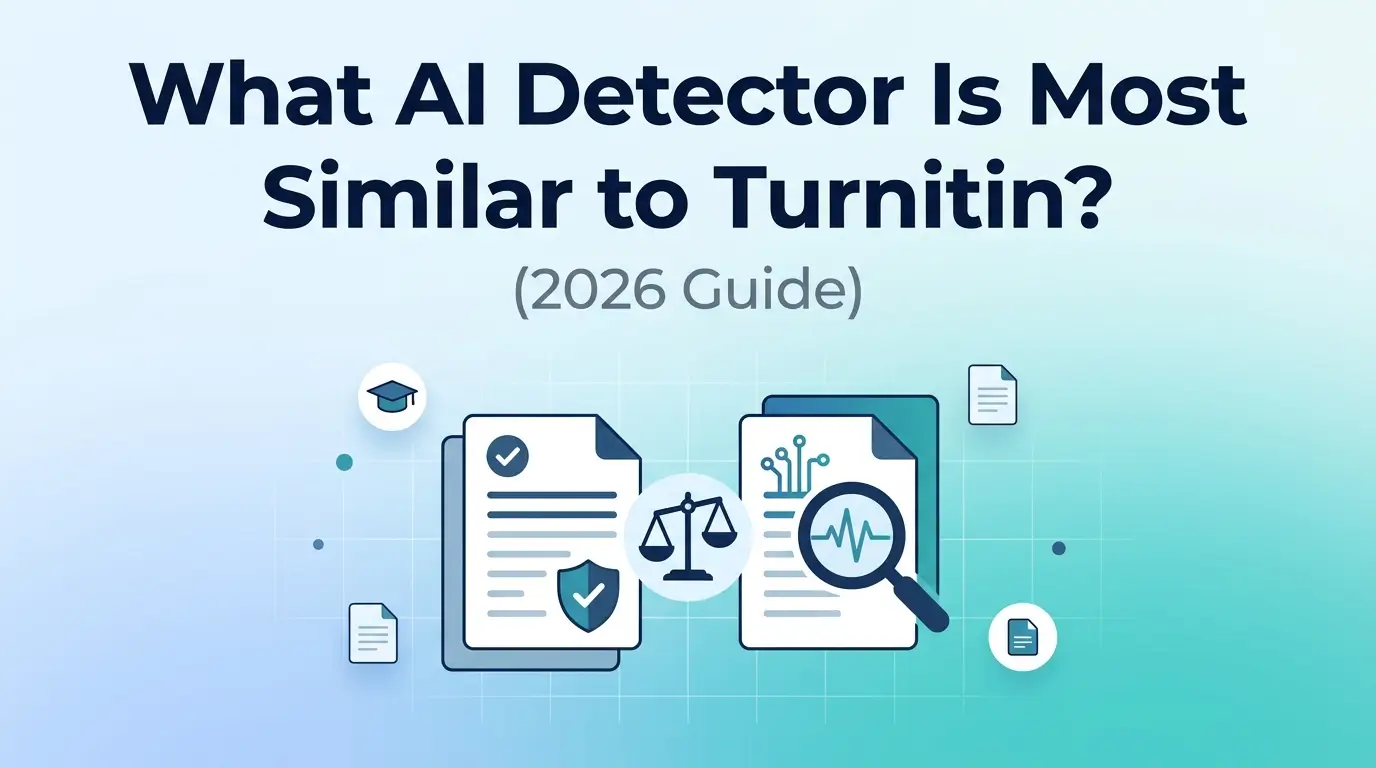
What AI detector is most similar to Turnitin? Compare Copyleaks, Originality.ai, Winston AI and GPTZero on accuracy, LMS support and price.
Search for what AI detector is most similar to Turnitin and you will find a different answer on almost every website. One guide says Winston AI. Another says TwainGPT. A third says JustDone or . Paperpal points to itself. Walter Writes AI points to itself. This is not because these sites are lying to you. It is because "similar to Turnitin" is not one benchmark, it is at least four separate ones, and every comparison study measures a different combination of them, on a different sample of essays, against a different snapshot of Turnitin's model.
This guide takes a slower approach. Instead of naming one winner in the first sentence, we break down what Turnitin actually measures, what independent researchers, not vendor marketing pages, have found when they tested it, and where each major alternative genuinely lands once accuracy, plagiarism database size, classroom integration and reporting quality are separated into their own categories. If your real question is whether AI-assisted writing is safe to submit at all, our guide on does humanize AI work on Turnitin is a better starting point than any detector comparison.
Why Every "Closest to Turnitin" Article Disagrees
A handful of patterns show up repeatedly when you read through the existing coverage on this topic.
Different studies measure different things
Some guides test agreement on human-written essays only, which favors tools tuned to avoid false positives. Others test agreement on fully AI-generated text only, which favors tools tuned for high sensitivity. Very few test hybrid or humanized text, even though that is the category where Turnitin itself struggles most and where most real disputes happen.
Many "winners" are the vendor doing the testing
Several of the most confident "X is closest to Turnitin" articles are published by the tool being recommended. This does not automatically make the claim false, but it means the comparison was never neutral to begin with.
None of this means the alternatives are useless. It means the honest answer to what AI checker is most similar to Turnitin depends entirely on which of its behaviors you are trying to match, and any single-tool answer, including ours, deserves some skepticism.
What AI Detector Is Most Similar to Turnitin: The Four Dimensions That Matter
1. AI detection accuracy and false positive rate
Does the tool identify AI-generated text at a comparable rate to Turnitin, and does it avoid wrongly flagging human writing?
2. Plagiarism database and source coverage
Does the tool index a comparable body of web pages, student papers and academic publications? This is the dimension hardest to replicate, since it depends on decades of accumulated submissions rather than model quality alone.
3. LMS integration and grading workflow
Does the tool embed directly into Canvas, Blackboard, Moodle, D2L Brightspace or Schoology the way Turnitin Feedback Studio does, rather than redirecting to a separate dashboard?
4. Reporting format and explainability
Does the tool produce sentence-level AI confidence scores and source matching detailed enough to hold up when a student disputes a flag?
Educators who ask for a "Turnitin equivalent" usually mean one of two things in practice: a score that will roughly match Turnitin's result for a pre-submission check, or a complete workflow replacement with grading integration built in. No tool on the market currently satisfies both requests equally well.
What Turnitin Actually Reports, and What Independent Testing Found
Turnitin's published accuracy claims
Turnitin's own figures state roughly 98% document-level accuracy with a sub-1% false positive rate, for documents where AI-generated content exceeds 20% of the total text. The company also confirms it deliberately allows a portion of AI-generated writing to pass unflagged to reduce false accusations, a figure its own Chief Product Officer has put at around 15%.
What peer-reviewed studies actually found
Independent research tells a considerably messier story than that headline number suggests. A 2026 peer-reviewed study by Hadra, Cambridge and Mesbah tested Turnitin and Originality AI against 192 human, AI-generated and hybrid texts, and reported an overall accuracy for Turnitin of just 0.61, with hybrid writing proving especially hard to classify correctly. A separate 2026 study covering Turnitin, GPTZero, Copyleaks and Pangram across 160 documents with known ground truth found that Turnitin substantially underestimated AI content in fully AI-generated documents produced through newer generation workflows.
A widely cited Nature-reported test in July 2026 found that only three of sixteen AI detectors evaluated performed strongly on both AI-generated and human writing at once, which shows how rare genuinely balanced performance is across the entire category, not just for Turnitin.
Accuracy after editing or paraphrasing
Detection drops sharply once text has been edited. Research summarized by multiple 2026 reviews puts detection accuracy at roughly 60 to 85 percent once AI-generated text has been manually edited or paraphrased. A widely cited 2024 study by Perkins and colleagues found baseline detector accuracy across seven tools averaged only around 39.5 percent, falling further once simple adversarial rewriting was applied, with Turnitin recording the largest single accuracy drop of any detector tested in that study.
The non-native English problem
False positive rates for non-native English writers are the most consistently reproduced finding across independent research. Stanford's Human-Centered AI institute found that AI detectors, Turnitin included, misclassify non-native English writing at meaningfully higher rates than native English text. Later reviews put non-native false positive rates anywhere from three to five times higher than for native speakers, with some individual studies citing figures above 30 percent for ESL writing on certain detectors. If your institution serves a large international student population, this is not a minor footnote. It is one of the most important caveats in the entire category.
None of this means Turnitin is unreliable in absolute terms, and it does not mean the alternatives are more trustworthy by default. Every number in this comparison, including the ones vendors publish about themselves, should be read as a claim to verify rather than a settled fact.
Turnitin AI Detector Alternative Comparison Table
The table below compares the alternatives most frequently discussed as similar to Turnitin. Vendor-reported numbers are marked as claimed. Numbers derived from independent testing are marked as estimated or sourced.
Criterion | Turnitin | Copyleaks | Winston AI | GPTZero | Originality AI | QuillBot |
AI detection accuracy | 98% claimed, 61 to 91% independently observed | 98.4% claimed | 99.2% claimed | 95% claimed | 96.3% agreement with Turnitin on human text | Not published |
False positive rate | Under 1% claimed, 3 to 12% observed independently | 2 to 4% estimated | 1 to 3% claimed | 5 to 8% estimated | 3.7% on human text, GEDE study | High, user-reported |
Plagiarism database | 93 billion plus web pages, 170 million plus student papers, 80 million plus academic publications | 70 billion plus web pages, limited student repository | Web only, no student repository | Web only, no student repository | Web only, no student repository | Web only, limited |
Canvas, Blackboard, Moodle | Native | LTI 1.3 and plugin | LTI | LTI | Not supported | Not supported |
D2L Brightspace | Native | LTI | Not supported | Not supported | Not supported | Not supported |
Schoology | Native | Not supported | Not supported | Not supported | Not supported | Not supported |
Report format | Sentence-level percentage plus source match | Sentence-level flags plus source | Paragraph-level AI map | Sentence-level highlights | Binary classification plus confidence percentage | Basic score |
Individual access | Not available | Available | Available | Available | Available | Available |
Pricing model | Institutional license, 3,000 to 10,000 plus dollars per year | Per seat, 13.99 dollars per month | Per seat, 12 dollars per month | Freemium, 10 dollars per month | Per scan, 0.01 dollars per 100 words | Freemium, 4.17 dollars per month annual |
COPPA compliant | Yes | Yes | No | No | No | Yes |
How Accurate Are Turnitin Alternatives, in More Detail
Document-level versus sentence-level scoring
Turnitin reports a single document-level percentage, the share of qualifying text its model believes is AI-generated. Copyleaks and GPTZero instead provide sentence-level highlighting with individual confidence scores, and Winston AI works at the paragraph level. A document-level score of 15 percent on a 4,000-word essay means roughly 600 words triggered the model. A sentence-level tool spreads that same signal across many individual sentences, which usually gives an educator more concrete material for a student conversation.
False positives on human writing
In cross-tool testing across 50 human-written undergraduate essays spanning humanities and STEM subjects, Copyleaks flagged 3 of 50 submissions, a 6 percent false positive rate, while GPTZero flagged 7 of 50, a 14 percent rate. Formulaic academic prose, structured thesis statements and conventional literature reviews consistently pushed scores higher on the more sensitive tools. Turnitin's own 20 percent suppression threshold exists specifically to manage this trade-off, and most alternatives do not offer an equivalent calibration step.
Humanized and paraphrased AI text
No detector currently catches all humanized AI writing reliably, and any tool claiming complete detection of paraphrased AI text is overstating its ability, a point independent research on adversarial rewriting backs up directly. When AI-generated essays were run through commercial humanizing tools in a 30-essay test, Copyleaks correctly identified 22 of 30 as likely AI, roughly 73 percent. Winston AI identified 19 of 30, roughly 63 percent. GPTZero identified 11 of 30, roughly 37 percent. Readers curious about why this gap exists at the technical level can see how AI writes like a human and does Undetectable AI work for a closer look at the underlying mechanics.
For AI-polished human drafts, where a student writes the essay and uses AI only to refine grammar, results are somewhat better. Originality AI's GEDE study found its 40 percent AI Allowance setting agreed with Turnitin on 92.1 percent of AI-polished essays, arguably the most realistic and most contested student use case in practice.
If you are in that exact situation, the safest approach is not to guess which detector will be lenient. Run the draft through our AI Detector first to see which sections read as AI-influenced, then use the AI Humanizer to smooth out only those sections rather than rewriting the whole essay.
Non-native English writing
This is the single most consistently reproduced finding in the independent literature. Detectors across the board, Turnitin included, misclassify non-native English writing at rates several times higher than native English text, driven by simpler sentence structures and more predictable vocabulary that happen to resemble statistical patterns AI models also produce. Copyleaks offers AI detection in 30 plus languages, which reduces this bias for genuinely non-English submissions, but for English-language work by non-native speakers, every current detector carries elevated risk. Treat any single AI score for this population as one data point, never a verdict.
Can Any Alternative Match Turnitin's Plagiarism Database
No. This is the most important honest distinction in the entire comparison, and it is the one place where marketing claims and independent research actually agree. Turnitin indexes more than 93 billion web pages, 170 million student submissions and 80 million academic publications, a repository built over two decades through a network effect. Every institution using Turnitin adds to the same shared database, which means the archive grows more useful with every semester that passes.
Copyleaks comes closest with an estimated 70 billion plus web pages and a growing academic index, but its student paper repository is a fraction of Turnitin's size. Winston AI, GPTZero, Originality AI and QuillBot offer web-based plagiarism checking only. None of them maintain a student submission database, which means none of them can catch a student copying from a classmate's previously submitted paper. If traditional plagiarism detection, not AI detection, is your core need, Turnitin remains the standard, and the alternatives are strongest specifically as AI detection layers rather than full replacements.
LMS Integration: Canvas, Blackboard, Moodle and D2L
LMS integration is often the real difference between a tool faculty actually use and one they abandon after the first week. The important distinction is between a native LTI integration that renders a full report inside the LMS grading interface, and a redirect integration that sends students or instructors to an external dashboard.
Turnitin Feedback Studio renders reports directly inside Canvas and Blackboard. Copyleaks and Winston AI offer LTI 1.3 integrations for Canvas and Blackboard that return scores to the gradebook. GPTZero's LMS integration works but requires an extra click through to view the full report. Originality AI and QuillBot have no LMS plugins at all, so every submission needs a manual upload, which becomes a real bottleneck for a department processing hundreds of papers a semester. If your institution runs D2L Brightspace or Schoology specifically, Turnitin and Copyleaks are currently your only options with native support.
Reporting Format, FERPA Compliance and Data Privacy
Report granularity and explainability
When a student contests an AI flag, the report needs to show exactly which sentences triggered the score and why. Tools that return a single number with no breakdown tend to create adversarial dynamics in integrity proceedings rather than resolving them.
Turnitin and Copyleaks both provide sentence-level detail with source matching, which makes their reports the most defensible in formal hearings. Winston AI works at the paragraph level, GPTZero highlights individual sentences with perplexity and burstiness detail, Originality AI returns a binary classification with a confidence percentage, and QuillBot offers only a basic score with limited highlighting.
Data retention and FERPA compliance
All six tools compared here state FERPA and GDPR compliance, but COPPA compliance, required for K-12 use with students under 13 in the United States, is confirmed only for Turnitin, Copyleaks and QuillBot. Before piloting any tool, ask three direct questions of the vendor. Does the tool store student submissions after scanning.
For how long. Is student writing ever used to train the detection model. Turnitin retains submissions permanently by default, which is what powers its plagiarism matching. Copyleaks offers configurable retention with deletion on request. Winston AI and GPTZero state submissions are not used for model training. Originality AI does not store scanned documents at all. Confirm every one of these details directly in the vendor's data processing agreement rather than relying on marketing copy.
The Wider Field: Other Tools Frequently Named as "Closest to Turnitin"
Beyond the five alternatives compared in detail above, several other tools show up regularly in Turnitin comparison guides, and it is worth understanding why the field is so fragmented before trusting any single recommendation, including this one.
Vendor-led comparisons
TwainGPT has published its own comparative testing claiming closer alignment with Turnitin across human, AI-generated, mixed and humanized text categories than Copyleaks or GPTZero, though this data comes from the vendor itself rather than an independent third party. JustDone markets itself around mirroring Turnitin's sentence-level analysis and multilingual support.
Bundled and workflow-focused tools
Paperpal, aimed specifically at researchers, bundles AI detection with plagiarism checking and writing support rather than competing purely on detection accuracy. Walter Writes AI positions itself around pairing detection with a built-in rewriting tool for flagged text, a genuinely different value proposition than a pure detector like GPTZero or Copyleaks. Scribbr and Grammarly Premium are also frequently mentioned, though both are positioned more as writing and citation tools with detection features attached rather than dedicated academic integrity platforms.
The pattern across all of these is consistent. Every vendor's own comparison tends to name itself the closest match to Turnitin. That does not make the claims false, but it does mean the only reliable way to evaluate any single tool is to test it directly against a small batch of your own known human and known AI writing samples, rather than taking any one article's ranking, including this one, at face value.
Turnitin Pricing vs Alternatives
Tool | Model | Starting Price | Free Tier | Institutional Plan |
Turnitin | Institutional license | 3,000 to 10,000 plus dollars per year | Not available | Custom, based on enrollment |
Copyleaks | Per seat | 13.99 dollars per month | Limited free tier | Custom enterprise |
Winston AI | Per seat | 12 dollars per month | Trial available | Custom institutional |
GPTZero | Per seat | 10 dollars per month | Basic free tier | Education plans available |
Originality AI | Per Scan | 0.01 dollars per 100 words | Trial credits only | Team plans |
QuillBot | Per seat | 4.17 dollars per month, billed annually | Basic free tier | Not available |
Turnitin's institutional-only pricing is usually what drives this search in the first place. If your school already holds a license, the real question is whether an alternative earns its keep as a secondary verification layer rather than a replacement. If you sit outside an institutional license entirely, as an individual educator, a tutoring center, or a small private school, the alternatives above offer individual access that Turnitin simply does not provide at any price.
Which Turnitin Alternative Fits Your Situation
For universities and large institutions
Copyleaks is the closest full-stack alternative once accuracy, LMS integration and compliance are all weighed together. It offers LTI integrations across Canvas, Blackboard, Moodle and D2L Brightspace, plus FERPA and COPPA compliance. Treat it as a complementary AI detection layer running alongside Turnitin rather than a full replacement, given the much smaller plagiarism database.
For individual educators and small schools
Winston AI or GPTZero offer affordable per-seat pricing with genuine individual access, though neither has a plagiarism database anywhere close to Turnitin's. Use them specifically for AI detection, not as a substitute for traditional plagiarism checking.
For students pre-checking a submission
Originality AI at 40 percent AI Allowance produces the highest documented agreement with Turnitin on human-written text, which makes it the closest available proxy, though not a guarantee given how much independent research shows detector agreement breaking down on hybrid and edited text specifically.
Before relying on any pre-check, it is worth reading can professors detect ChatGPT and can Turnitin detect ChatGPT to understand how these scores actually get used once they reach an instructor. Our own free AI Detector is another quick way to sanity-check a draft before you submit it anywhere, without needing a paid account.
For publishers and content teams
Originality AI is built for web publishing workflows with bulk scanning and team collaboration, but it has no LMS integration and no student paper database, so it is not suited to academic use despite the overlap in branding.
When You Should Stay With Turnitin
Switching is not the right call for every institution. Stay with Turnitin if any of the following apply to you.
You need comprehensive plagiarism detection, not just AI detection. The 170-million-student-paper repository is a 20-year network effect that nothing else on the market currently replicates.
Your institution needs deep LMS integration across D2L Brightspace or Schoology specifically, where Turnitin remains the only tool with native plugins across all five major platforms.
Your academic integrity policy requires evidentiary-grade reporting for formal misconduct hearings, where switching to a less established tool can complicate proceedings that are already adversarial.
You serve a large multilingual student body and need plagiarism detection across 40 plus languages, an area where Turnitin's coverage still leads the field.
Your procurement cycle is already locked into a multi-year Turnitin contract, in which case adding a secondary AI detection tool is more practical than a full switch mid-contract.
Frequently Asked Questions
What is the closest alternative to Turnitin?
Copyleaks is the closest overall alternative once you weigh AI detection accuracy, LMS integration and reporting depth together. For matching Turnitin's actual score output specifically on human-written text, Originality AI at 40 percent AI Allowance is the closest documented proxy, though independent studies show this agreement narrows considerably on hybrid and edited writing.
What AI checker is most similar to Turnitin?
It depends on which behavior you are matching. On raw scoring agreement, Originality AI leads the published data. On full classroom workflow, including grading integration and sentence-level reporting, Copyleaks leads. Several vendors, including TwainGPT and JustDone, publish their own comparative testing claiming the closest match, so treat any single answer, including this one, as a starting point for your own testing rather than a final verdict.
Which is better, Turnitin or iThenticate?
They are built for different audiences rather than one being categorically better. Turnitin is designed for coursework and classroom grading workflows, with LMS integration built directly into Canvas, Blackboard and Moodle. iThenticate, also owned by Turnitin's parent company, is aimed at researchers and publishers checking manuscripts before submission, and individual accounts do not store documents in a searchable repository the way Turnitin does by default.
Is Turnitin the strongest AI detector?
On paper, Turnitin's claimed 98 percent accuracy with a sub-1 percent false positive rate is among the strongest publicly cited figures in the category. Independent testing complicates this picture considerably. Peer-reviewed studies in 2026 have found overall accuracy figures as low as 0.61 on hybrid text, and adversarial testing has found Turnitin's accuracy drops more sharply than most competing detectors once text is edited or paraphrased.
Turnitin's real advantage is less about raw detection strength and more about the combination of AI detection with its unmatched plagiarism database and deep LMS integration, a combination no single competitor fully replicates yet.
Which AI detector is the most accurate?
Based on vendor-reported figures, Winston AI at a claimed 99.2 percent and Copyleaks at a claimed 98.4 percent report the highest accuracy among Turnitin alternatives, close to Turnitin's own claimed 98 percent. Independent testing across the category as a whole tells a more cautious story. A widely cited 2026 evaluation found only three of sixteen tested detectors performed strongly on both AI-generated and human writing simultaneously, and detection accuracy for every tool drops substantially once text has been edited or paraphrased.
Can any AI detector replace Turnitin's plagiarism database?
No. Turnitin indexes more than 93 billion web pages, 170 million student papers and 80 million academic publications. No alternative currently matches this repository size.
Will using an AI detector other than Turnitin flag my students' real writing?
Every AI detector carries some false positive risk, and independent studies generally find higher real-world rates than vendors publish, particularly for non-native English writers and heavily edited text. Always treat an AI score, from any tool, as one data point in a broader evaluation, not a standalone verdict.
Do AI detection alternatives integrate with Canvas, Blackboard and Moodle?
Copyleaks, Winston AI and GPTZero all offer LTI integrations for Canvas, Blackboard and Moodle. Copyleaks also integrates with D2L Brightspace. Originality AI and QuillBot do not offer LMS plugins and function as standalone web tools requiring manual upload.
Is it legal to use AI detectors on student work under FERPA?
Yes, provided the tool is FERPA compliant and student data is handled according to your institution's data processing agreement. Confirm the vendor does not use student submissions to train its detection models and offers a data deletion option before deploying any tool at scale.
How do AI detectors perform against humanized or paraphrased AI text?
Performance drops sharply for every tool once AI text has been run through a humanizing tool or heavily paraphrased, and this is where the gap between vendor marketing and independent research is largest. Cross-checking with more than one detector and reviewing writing process evidence, such as document revision history, remains the most reliable approach available today. Our guide on how to rewrite text to avoid AI detection covers the mechanics of why this happens in more depth, and our AI Humanizer is built specifically to address the perplexity and burstiness patterns that trigger most of these flags.
Conclusion
No single AI detector replicates Turnitin across every dimension, and the field of guides claiming otherwise mostly disagrees with itself because each one is measuring a different slice of the problem. The right pick depends on which capability actually matters for your situation.
Most similar AI detection accuracy on published figures: Copyleaks
Most similar scoring output to Turnitin on human-written text specifically: Originality AI at 40 percent AI Allowance
Most similar LMS integration depth: Copyleaks
Most similar plagiarism database: none currently, Turnitin remains unmatched
Most similar reporting format: Copyleaks, through sentence-level flags combined with source matching
Best value for individual educators: Winston AI or GPTZero
Best for a near-full institutional replacement: Copyleaks, with meaningfully reduced plagiarism coverage as the trade-off
If your goal is a full Turnitin replacement, Copyleaks comes closest across the largest number of dimensions. If your goal is a secondary AI detection check running alongside an existing Turnitin license, Originality AI at 40 percent AI Allowance offers the highest documented scoring agreement for student pre-checks, with the caveat that agreement narrows considerably once the writing being checked is edited, hybrid, or humanized.