How to Rewrite Text to Avoid AI Detection: 12 Techniques
Struggling with AI detection flags? Discover how to rewrite text to avoid AI detection using 12 techniques that actually work on Turnitin & GPTZero
You already have the text. Maybe ChatGPT wrote it. Maybe you wrote every word yourself and a detector flagged it anyway. Either way, you need a fix that actually works, not another list of synonyms to swap.
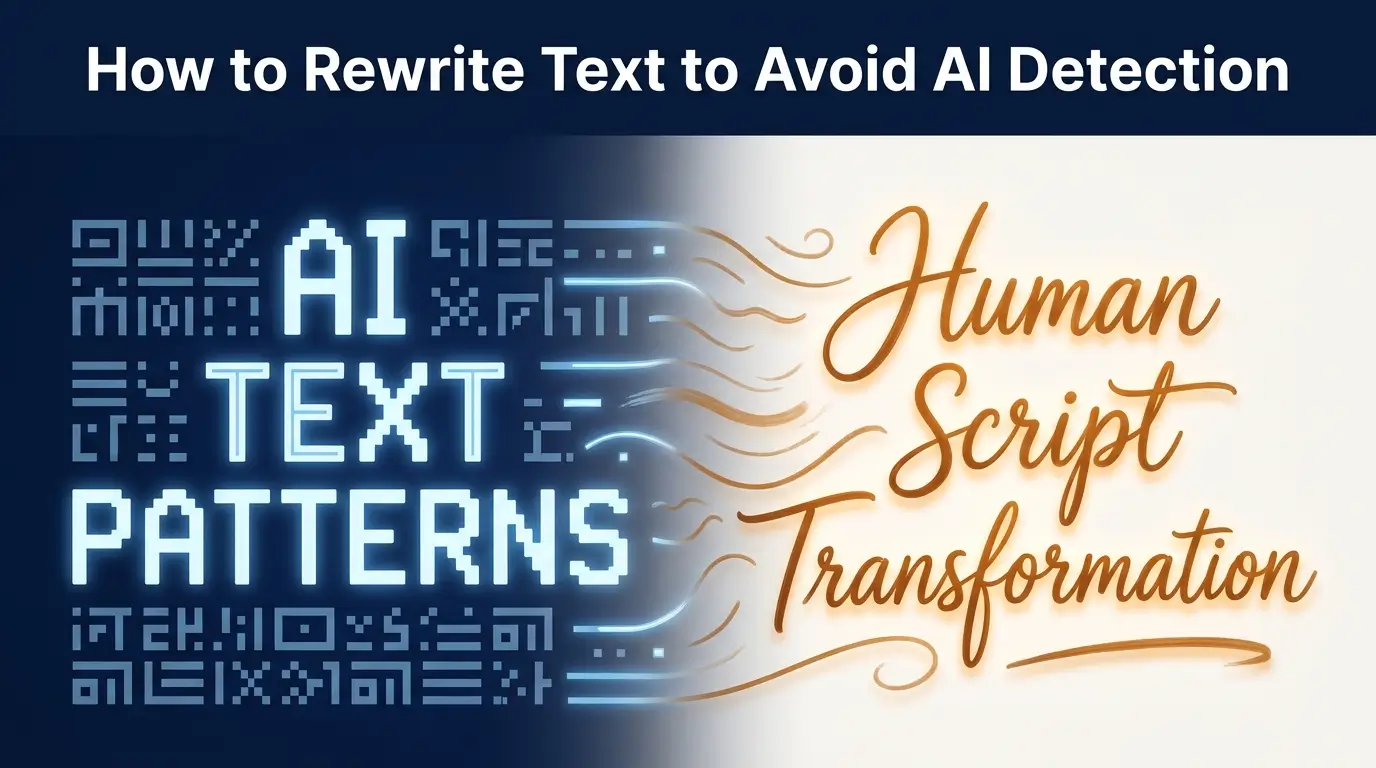
Here is what most guides get wrong: AI detectors do not read your text for meaning. They measure how predictable your writing is. So if you want to know how to rewrite text to avoid AI detection, the real answer is that you change the shape of your sentences, not just the words inside them.
This guide breaks down 12 tested techniques, an honest look at how AI humanizer tools actually perform, real data on how often detectors get it wrong, and exactly how to prove you wrote something yourself if you're ever accused. Read it in order. The first three techniques alone fix most flagged documents.
Key Takeaways
Detectors measure sentence shape, not meaning
Structural edits beat synonym swaps
Paraphrasing tools rarely lower your score
The free manual method works better than most paid humanizers
Non-native writers get flagged more, and that's a detector bias, not your fault
No score is permanent, detectors keep retraining
Google doesn't penalize AI-assisted writing on its own
Your version history protects you better than any score
How AI Detectors Actually Work
Before fixing anything, it helps to know what you're fixing. Most articles stop at two words: perplexity and burstiness. There's more to it, and understanding the rest is what makes the techniques below actually work.
Perplexity: how predictable your words are
A language model writes by guessing the next token, a small chunk of a word. For each guess, it has a ranked list of options and usually picks a high-probability one.
That's what makes AI text easy to spot. It sticks to safe, expected words. In statistical terms, this is low perplexity.
Humans are messier. We pick odd verbs, use regional slang, and repeat a word because we forgot we already used it. All of that pushes perplexity up.
Key point: The most "correct-sounding" writing is often the most detectable writing. Polish is the signal.
Burstiness: how much your sentence lengths change
Burstiness measures how much sentence length and structure vary across a page.
Real writers produce a 34-word sentence, then a 4-word one, then two medium ones, then a fragment. AI output tends to cluster tightly, usually 15 to 22 words per sentence, paragraph after paragraph.
Key point: Burstiness is the signal paraphrasing tools do not fix. That's exactly why paraphrasing fails so often, and we'll cover that in detail below.
Stylometry: your writing fingerprint
Stylometry is the study of writing style as a fingerprint. It's an old field, used long before AI existed to settle disputes over who really wrote certain texts. It's also called authorship attribution.
Detectors borrow from this field. They look at your function words (the, of, and, but), your type-token ratio (how many different words you use), your n-gram patterns (which word pairs repeat), and your clause density (how packed your sentences are).
They also flag structural habits AI tends to overuse: perfectly balanced three-item lists, "not only X, but also Y" constructions, paragraphs that open with a topic sentence and close by restating it, and headings that all follow the same grammatical pattern.
Key point: Detectors don't measure quality or honesty. A sloppy, badly argued essay can score 0% AI. A strong human essay can score 90%. The score measures shape, not substance. If you want a deeper look at what separates natural writing from generated text, see how AI can write like a human.
The four detection methods in use today
Method | What it does |
Zero-shot detection | Uses a reference model's word probabilities. No training on your text needed. |
Supervised classifiers | Models trained on large sets of human and AI writing to tell them apart. |
Probability curvature | Slightly alters your words and checks whether the probability score shifts differently than human text would. |
Watermark detection | Looks for a hidden signal added while the text was generated. |
Signal | AI-generated text | Human-written text |
Perplexity | Low, safe and expected word choices | Higher, odd or idiomatic choices |
Burstiness | Low, sentences are similar length | High, short and long sentences sit side by side |
Structure | Neat, balanced, symmetrical | Uneven, wandering |
Specificity | "A recent study," "many experts" | Real names, dates, and numbers |
Hedging | Stacked ("can potentially help somewhat") | Rare and purposeful |
AI text vs. human text at a glance
What Makes Text Look AI-Generated?
Nine patterns show up again and again in flagged text.
Every sentence is roughly the same length. The biggest tell.
Every paragraph runs four to five sentences. Block after block.
Everything comes in threes. Three examples, three benefits, three reasons.
"Not only X, but also Y." And its cousin, "It's not just X, it's Y."
Stacked hedges. "May potentially help to somewhat improve."
Vague nouns instead of names. "A leading platform" instead of "Shopify."
Topic sentence, then a restatement. Every paragraph opens and closes the same way.
All headings share one grammar pattern. All questions, or all noun phrases.
An unnecessary summary paragraph. "In conclusion, we have seen that..."
The AI Tell Word List
These words appear far more often in AI writing than in human writing. Find them and replace them.
Type | Cut these | Use these instead |
Verbs | delve, navigate, foster, leverage, harness, unlock, underscore, embark | dig into, handle, build, use, show, start |
Nouns | landscape, realm, tapestry, testament, cornerstone, game-changer | market, field, proof, base |
Adjectives | pivotal, crucial, vital, robust, seamless, comprehensive | important, strong, complete |
Transitions | furthermore, moreover, additionally, in conclusion | but, so, still, and, or just delete |
Openers | in today's fast-paced world, it is worth noting that, when it comes to | delete the whole phrase |
Vague words | a recent study, many people, some experts, numerous | a 2023 study, 4,200 people |
Stiff formality | utilize, it was determined that, gave consideration to | use, we found, considered |
Key point: Deleting these words alone will not clear a flag. They travel with structural signals, and structure carries most of the score.
How to Rewrite Text to Avoid AI Detection: 12 Techniques That Work
These are ranked by impact. If you only have ten minutes, focus on techniques 1, 2, and 5.
1. Break your sentence-length pattern
Signal moved: Burstiness | Effect: Very high | Time: 8 minutes per 1,000 words
Force at least one sentence under 8 words and one over 30 words into every paragraph. Don't space them evenly. Put the short one where it lands hardest.
Before: "Effective time management can significantly improve productivity levels, and it also helps reduce stress in demanding work environments."
After: "Time management cuts stress. That's the part nobody sells you on. Everyone talks about getting more done, and then you notice you've stopped lying awake running through tomorrow."
2. Swap vague nouns for real names and numbers
Signal moved: Perplexity | Effect: Very high | Time: 5 minutes
AI reaches for category words. You reach for the actual thing.
Before: "Recent research has shown significant cost savings for many businesses."
After: "A 2023 audit of our hosting bill cut $4,200 a year, mostly by killing two staging servers nobody had touched since March."
Real names raise perplexity because they're low-probability word choices. They also make your writing checkable, which matters to editors and professors far more than any score does.
3. Delete filler transitions
Signal moved: Stylometry | Effect: High | Time: 3 minutes
Cut furthermore, moreover, additionally, in conclusion, and it is worth noting. Most sentences don't need a connector at all. When you do need one, use the plain spoken option: but, so, and, still, then.
4. Break the rule of three
Signal moved: Stylometry | Effect: High | Time: 4 minutes
AI writes three items with matching grammar. Use two, or four, or write three where one is twice as long and a little messy.
Before: "The tool is fast, affordable, and easy to use."
After: "It's fast and cheap. It's also easy to use, as long as you never touch the export settings, which have confused every single person on my team at least once."
5. Add a detail only you could know
Signal moved: Perplexity and human review | Effect: Very high | Time: 5 minutes
This is the strongest single move on this list. One sentence with a real, checkable, personal detail beats any tool: a date, a client's exact objection, the name of the app that crashed, what you got wrong the first time.
A detector can't fake lived experience. Neither can the model that wrote your draft.
6. Vary your paragraph lengths
Signal moved: Burstiness | Effect: High | Time: 3 minutes
Follow a six-sentence paragraph with a one-sentence paragraph.
Like this.
AI drafts almost never do it, and it resets the rhythm of the whole page.
7. Add real analysis, not just reporting
Signal moved: Perplexity and human review | Effect: High | Time: 10 minutes
After stating a fact, add one thinking move: a limit ("this works for X but not Y"), a counterargument you then answer, or what the finding actually means. Real reasoning produces word choices no model predicts, and it's also the thing a professor or editor checks that no software can score.
8. Kill the stacked hedges
Signal moved: Perplexity | Effect: Moderate | Time: 3 minutes
"Can potentially help to somewhat improve" becomes "improves." AI stacks hedges because it's trained to sound careful. Confident writing doesn't.
9. Use active voice and specific verbs
Signal moved: Perplexity | Effect: Moderate | Time: 5 minutes
"The report was written by the team" becomes "The team wrote the report." "It was determined that" becomes "We found." Push further by trading generic verbs for job-specific ones: "utilize" becomes "wire up," "reconcile," "backtest," or whatever your field actually says.
10. Let some imperfection in
Signal moved: Burstiness | Effect: Moderate | Time: 3 minutes
A fragment. A side comment in parentheses that doesn't fully earn its place. A word repeated on purpose. Human writing isn't optimized, so don't make yours optimized either.
11. Reorder your argument
Signal moved: Stylometry | Effect: Moderate | Time: 6 minutes
AI presents ideas in the order the prompt listed them. Move your best point out of sequence. Open with the objection. Hold the definition back until someone needs it.
12. Read it out loud
Signal moved: All three | Effect: High | Time: 5 minutes
Read the whole thing aloud and fix every sentence you trip on. This one pass catches most leftover AI rhythm, because that rhythm is even and mechanical, and your mouth notices it before your eyes do.
Key point: Techniques 1, 2, and 5 do most of the work. Everything else is cleanup.
Tip: Write from key points, not from the draft. Read the AI output once, write down the 3 to 5 things it actually says, close it, then write the section yourself from your notes. This removes AI phrasing at the source instead of scrubbing it out later.
How to Avoid AI Text Being Detected for Free
You don't need a subscription. Here is the full no-cost path.
The free manual method (about 25 minutes per 1,000 words)
Step | What you do | Time |
1 | Structure pass: reorder the argument, break up sets of three | 5 min |
2 | Sentence-length pass: force short and long sentences into every paragraph | 8 min |
3 | Word pass: run the AI Tell Word List above as find-and-replace | 5 min |
4 | Specificity pass: swap every vague noun for a name, date, or number | 4 min |
5 | Read-aloud pass: fix every stumble | 3 min |
No signup, no word cap, no credit limit, and it outperforms most paid tools because you're fixing meaning and statistics at the same time. If you'd rather run the process through a dedicated tool instead of doing every pass by hand, our own AI Humanizer applies the same structural logic automatically.
Free detectors you can check against
Test your writing yourself before you submit it. Free tiers exist for GPTZero, ZeroGPT, Copyleaks, Sapling, Scribbr, and QuillBot's AI Detector. You can also run a quick check with our own AI Detector to see how your rewrite scores before you submit it anywhere.
Tip: Never trust one detector. Run your text through at least two. The same paragraph can score 20% on one tool and 80% on another on the same afternoon. If two tools agree, you have real information. If only one flags you, you likely have noise. If you're curious how a newer checker stacks up, we broke down whether Justdone's AI detector is accurate in a separate review.
How to Rewrite ChatGPT Text Specifically
ChatGPT has its own accent, and once you notice it, you can't unsee it. We cover this in more depth in how to make ChatGPT sound more human, but the short version is below.
The ChatGPT tells
Em dashes scattered through nearly every paragraph
"It's not just X, it's Y," the signature move
Cheerful openers like "Great question!" or "Absolutely!"
Bolded key terms sprinkled evenly through every section
A closing paragraph that repeats the intro and adds nothing
All headings written in the same grammar (all questions, or all "how to" phrases)
A recurring word cluster: delve, tapestry, landscape, realm, testament, navigate
Fix it at the prompt, before you edit
This part cuts your editing time roughly in half, and almost nobody covers it.
ChatGPT sounds the way it does partly because it's trained to give agreeable, safe, middle-of-the-road answers. That safe register is exactly the detection signal, and you can push against it before a single word gets written.
For a longer walkthrough of this approach, see how to prompt AI to write like a human.
Four prompt-level controls:
Raise temperature and top-p slightly, if you have access to those settings. Higher values mean less predictable word choices.
Ban the word list inside the prompt. Paste the AI Tell Word List in and tell the model those words are forbidden.
Prime it with your own writing. Paste 200 words you actually wrote and ask it to match your rhythm. This is the most effective of the four.
Demand sentence-length variance out loud. Models follow this instruction well when you make it a specific number.
A prompt block you can copy:
Write [topic] in my voice. Match the sample below for rhythm and word choice. Rules: every paragraph must contain one sentence under 8 words and one over 25 words. Never use: delve, tapestry, landscape, realm, pivotal, crucial, furthermore, moreover, additionally, in conclusion, "it's not just X it's Y." Never write lists of exactly three items. Use specific names, dates, and numbers instead of vague phrases like "a recent study." Do not end with a summary paragraph. Here is my writing sample: [paste 200 words of your own writing]
Key point: Prevention beats repair. A well-prompted draft needs about half the editing of a default one.
Can AI Be Detected If You Rewrite It?
Yes, rewritten text can still be flagged. The outcome depends on how the text was created, how much original work you added, which detector is used, document length, how heavily it was edited, and whether the detection model has been updated recently.
A passage may score low on one detector and high on another. That disagreement doesn't mean one result is correct. It means the two systems are producing different estimates from different training data.
This is exactly why claims like "bypass," "beat," or "make undetectable" are misleading. A method may produce a favorable result today and a different one after the next model update.
Does Paraphrasing Avoid AI Detection?
No, not reliably, and there's a clear mechanical reason why.
Paraphrasing tools swap synonyms and shuffle clauses. They keep your sentence structure and length distribution almost exactly the same. So perplexity shifts slightly, but burstiness barely moves at all.
Since burstiness carries heavy weight in most detectors, your score doesn't change much either.
Worse, synonym swapping breaks collocations, the natural word pairs readers expect together. "Make a decision" becomes "manufacture a decision." A detector might miss that. A human reader never does.
What to do instead: structural rewriting. Go back to techniques 1, 4, and 6 above. Changing sentence shapes moves the score. Changing sentence words mostly doesn't.
Tip: If you use a paraphraser, treat its output as a first draft, never a final one. Paraphraser output pasted straight in is some of the most detectable text there is, because it carries the original AI pattern and the paraphraser's own pattern layered on top.
Manual Rewriting vs. AI Humanizer Tools
Manual rewriting | AI humanizer tool | |
Detector pass rate | High, and it stays high | Varies, and drops as detectors retrain |
How it reads after | Same or better | Often worse |
Time per 1,000 words | 25 to 40 minutes | Under 1 minute |
Cost | Free | Capped free tier, or roughly $10 to $30 per month |
Survives a human reader | Yes | Often no |
Grammar risk | None | Introduces errors |
Works on technical writing | Yes | Poorly |
Best used for | Anything someone will read closely | A rough first pass on long documents |
Can you bypass AI detection with a tool alone?
Sometimes, against some detectors, temporarily. The failure mode nobody advertises is text that scores 0% and reads like a bad translation.
A detector isn't your actual audience. Your professor is. Your client is. Your editor is. Passing the machine while failing the human is one of the most common complaints in writing communities: people clear a detector and then get told their paper reads like gibberish.
Key point: Judge every tool on two things: did it pass the detector, and is the writing still good? Most "best humanizer" comparisons only measure the first one. If you're weighing whether to use a general chatbot for this instead of a dedicated tool, we tested whether Claude can humanize text and the results were mixed.
Why Grammarly and QuillBot Can Raise Your AI Score
This surprises people, and it's a real cause of false accusations. It also answers a question we get a lot: does Grammarly have a humanizer? Not really, and using it like one can backfire.
Grammar and clarity tools push your writing toward the statistical middle, which is their whole job, and that statistical middle is exactly what detectors flag.
Clarity and conciseness suggestions replace unusual sentence shapes with standard ones, trim long sentences, and even out your rhythm. Paraphrasing suggestions swap in high-probability synonyms. Both actions lower perplexity and lower burstiness, the two signals you need to keep high.
Writers who type every word themselves, then accept a full grammar-tool rewrite pass, regularly watch their AI score jump on text no model ever touched.
What to do:
Accept spelling fixes, punctuation fixes, and factual corrections.
Reject "clarity," "conciseness," and full-sentence rewrite suggestions on anything that will be scored.
Run your grammar check last, after all structural work, never before.
Key point: Heavy grammar-tool editing is one of the most common causes of a false positive on genuinely human writing.
Is It Possible to Get 0% AI on Turnitin?
Yes, 0% is possible, but it isn't permanent.
Turnitin updates its detection model over time, so the same document can score differently after an update. Treat a 0% result as a snapshot from one afternoon, not a state you've permanently unlocked.
That matters because most guides on this topic treat "undetectable" as a switch you flip once. It isn't.
Realistic score expectations by method:
Method | Typical result | Stability |
Full manual rewrite | Lowest scores | Stable |
Write-from-key-points | Lowest scores | Stable |
Humanizer plus manual pass | Low | Fairly stable |
Humanizer only | Mixed | Drops fast as detectors update |
Paraphraser only | Barely changes | Poor |
Several universities have disabled or limited built-in AI detection features over the years, citing concerns about false positives and limited transparency around how scores are generated. If major institutions don't fully trust the number, treat it as one data point rather than a verdict. For more on this specific question, see does humanized AI work on Turnitin.
Why Your Own Writing Gets Flagged as AI
If you wrote every word yourself and still got flagged, you did nothing wrong. Six real causes explain most false positives.
You're a non-native English speaker. A smaller working vocabulary can genuinely produce lower perplexity, and detectors often read that as machine writing.
You write in a formulaic genre. Lab reports, legal drafting, technical documentation, and standardized formats all have low variance built in.
You edited heavily with a grammar tool. See the section above.
Your document is short. Below roughly 300 words, most detectors are unreliable.
Your writing is very structured. Consistent headings, parallel lists, and clean organization can look machine-made to a classifier.
Your writing is simple and clear. Clarity and predictability look identical to a statistical model, so good plain writing sometimes gets punished.
Research on this topic has repeatedly found that detectors misclassify non-native English writing as AI-generated far more often than writing from native speakers, largely because of lower word-choice variation, not because of any actual AI use.
Key point: An AI detection score is a probability estimate from a system with documented bias against non-native speakers, short texts, and formulaic writing. It is not proof of who wrote something.
Tip: If English is your second language, sentence-length variation matters more for you than for anyone else. It's the single signal most likely to be dragging your score down for reasons that have nothing to do with authorship.
How Accurate Are AI Detectors, Really?
Not as accurate as the marketing suggests.
Detectors have been shut down before. At least one major AI lab launched a public text classifier and pulled it down within months, citing low accuracy, after it correctly identified only a modest share of AI-written text while also mislabeling human writing as AI a meaningful percentage of the time.
Perfect detection may not be possible. Independent research has argued that as AI writing gets closer to human writing statistically, even an ideal detector's accuracy approaches a coin flip.
Detectors carry documented bias against non-native speakers, as covered above.
Some universities have scaled back or disabled AI detection features in their plagiarism software, citing false-positive concerns.
The math problem nobody explains
Imagine a detector with a 1% false positive rate. That sounds excellent. Now run it across 10,000 honest submissions.
That's 100 innocent people flagged.
This is the base-rate problem. A tiny error rate sounds reassuring on a product page and becomes alarming the moment you apply it at real scale. It's the core reason a percentage score should never be treated as evidence on its own.
What Happens If Your Text Gets Flagged
Three situations call for three different responses.
If you're a student, the flag typically goes to your instructor for review, and in serious cases to an academic integrity panel. Most institutional policies state that a detector score alone is not sufficient evidence, so find your school's written policy before you respond to anything. If your assignments run through Google Classroom, it's worth knowing whether Google Classroom has an AI detector built in or relies on a separate tool.
If you're a freelancer, the client may ask for a revision or hold payment. Get any detection-score threshold written into your contract before a project starts, not after.
If you're a publisher or author, you may face an editorial rejection or a disclosure requirement, since several major self-publishing platforms now require disclosure of AI-generated content.
What to do in the first hour:
Don't delete anything: not drafts, not notes, not browser history.
Don't quietly rewrite and resubmit. That looks worse than the original flag.
Save your version history immediately, and screenshot it if you can.
Ask for the sentence-level breakdown, not just the percentage.
Key point: Preserve your evidence before you respond. Rewriting the document after an accusation destroys the exact version history that would have cleared you.
How to Prove You Wrote It Yourself
This is the section people need most, and almost nobody covers it.
Google Docs version history. Open File, then Version history, then See version history. It shows your document being built over time with timestamps. Writing directly in Docs instead of pasting in a finished block builds this evidence automatically.
Keystroke-replay extensions. Some browser extensions can replay a Google Doc's edit history like a video of you writing it. This is one of the most convincing things you can show an integrity panel.
Microsoft Word revision history. Available through AutoSave and cloud version tracking, plus Track Changes.
Your research trail. Browser history, annotated PDFs, handwritten notes photographed with a timestamp, outline drafts, and screenshots of sources.
Your earlier work. Instructors and clients often compare new writing to your older writing, and in practice this convinces people more than any software output.
Ask questions instead of defending. Ask which sentences were flagged, how long the document was, and whether the institution's written policy allows a detector score as sole evidence. Often it doesn't.
Tip: Build the trail before you need it. Drafting in Google Docs instead of pasting from a chat window costs nothing and creates strong evidence automatically. It's the highest-value habit in this entire guide.
The Three Checks That Run After the Detector
A clean score clears one gate. Three more are waiting.
Check 1: The voice test
A professor who's graded three of your essays already knows your vocabulary range, sentence complexity, and usual tone. A client who's read your work for six months knows your rhythm.
A sudden shift in register gets noticed in the first paragraph, before anyone opens any software. Writing that's suddenly too smooth, too even, or too free of opinion reads as generated even when it scores 0%.
How to pass it: Open something you wrote before this assignment. Read its first paragraph, then your new first paragraph. If they don't sound like the same person, revise until they do.
Check 2: The conversation test
A paper that clears every detector fails the moment you can't explain your own argument without the document in front of you. This applies to clients too. "Why did you structure it that way?" is a normal question, and "I'm not sure" is a bad answer.
How to pass it: Before you submit, close the document and explain each section out loud. If you can't, you don't own that section yet.
Check 3: The source test
Language models can invent citations with total confidence: real-sounding author names, real-sounding journals, and identifiers that lead nowhere. These are called hallucinations, and they're one of the fastest ways to fail a submission.
A four-step check:
Search the exact title of each source in Google Scholar.
Confirm the author, journal, volume, and year match your citation exactly. One mismatch means it's wrong.
Open the source and find the specific claim you cited, since models often attribute real findings to the wrong paper.
Keep a log of the title, link, and the date you accessed it.
Key point: A fake citation is worse than a high AI score. A score is arguable. A source that doesn't exist is not.
What Doesn't Work (And Makes Things Worse)
Six dead ends worth skipping entirely.
Running a humanizer and stopping there. It swaps words, leaves the structure intact, and adds grammar errors a human catches faster than any detector.
Stacking tools. Two humanizers in sequence layer two sets of fingerprints, and the combined result is more obvious than either one alone.
Character tricks. Swapping letters for lookalike characters or inserting hidden spaces. Modern detectors analyze language patterns, not characters, and some systems flag the manipulation itself, which is a worse problem than the one you started with.
Synonym spinning. Moves perplexity slightly, moves burstiness not at all, and damages your natural word pairings.
Clearing one detector and calling it done. Detectors disagree with each other on the same text on the same day, so one green light means very little.
Adding deliberate mistakes. It hurts readability, which is the thing that actually decides your outcome.
Tip: If a fix makes your writing harder to read, it isn't a fix. Every technique that damages readability fails the review that matters most: the human one.
Does Google Penalize AI-Generated Content?
No. If you're a blogger or in SEO, you may have been solving the wrong problem.
Google has stated publicly that its focus is on content quality rather than how content was produced, and that using AI isn't against its guidelines unless it's being used to manipulate rankings.
What Google actually polices is scaled content abuse: generating large volumes of unoriginal content mainly to manipulate rankings. This policy applies whether the content was made by automation, by people, or by both together.
Two things follow from this:
Google doesn't run AI detectors as part of its ranking system, so chasing a low detector score for your blog optimizes for a number Google never looks at.
What matters is information gain (whether your page tells a reader something other pages don't) and demonstrable expertise.
Key point: Detector scores matter for clients, editors, and schools. They don't matter for Google rankings. Know which problem you're actually solving.
Text Watermarking: Why This Gets Harder Over Time
Everything above deals with detectors that guess after the fact. A different approach is arriving, and it works completely differently.
Watermarking puts the signal in at the moment of generation. While the model writes, it uses a hidden key to favor certain words over others in a way that's invisible to a normal reader but detectable to a system holding the matching key.
Some major AI labs have already published production-scale watermarking research for their own models.
What this means for you:
Watermarks weaken under heavy paraphrasing, and they only exist in models that chose to add them, which most still don't.
The overall direction is clear: proof of origin is moving from the reader's side to the generator's side.
Techniques that beat perplexity scoring don't necessarily beat watermark detection. They're different problems entirely.
Disclosure requirements are spreading through regulation and publishing platforms alike.
Key point: Evasion techniques have a shelf life. Genuine human input (your own data, your own experience, your own judgment) doesn't, and it's worth more to the person actually reading your work.
AI Detection Is Not Plagiarism Detection
People mix these up constantly, so here's the difference in plain terms.
A plagiarism checker compares your text against a database of existing content and reports similarity. It's looking for copying.
An AI detector looks at your text on its own and estimates the probability that a language model wrote it. It doesn't compare your text to anything else.
These measure completely different things. A clean plagiarism report tells you nothing about your AI score, and a 0% AI score tells you nothing about whether your sources are original or whether they even exist.
How Long It Takes and What It Costs
Method | Time per 1,000 words | Cost | Detector result | Still reads well? |
Full manual rewrite | 25 to 40 min | Free | Best, stays stable | Yes |
Write from key points | 20 to 30 min | Free | Best, stays stable | Yes |
Humanizer plus manual pass | 10 to 15 min | Free tier or roughly $10 to $30/mo | Good | Usually |
Humanizer only | Under 1 min | Free tier or paid | Unpredictable | Often not |
Paraphraser only | 2 to 3 min | Free tier or paid | Poor | No |
Planning a 3,000-word paper? Budget 60 to 90 minutes total. That covers the rewrite, a detector pass, a grammar pass, a voice-consistency check against your older work, and a citation check. Run the grammar check last, always.
Where This Advice Stops
This guide is built for the editor turning an AI first draft into something publishable, the non-native speaker whose honest work keeps getting falsely flagged, the freelancer who needs to prove authorship to a client, the publisher meeting quality and disclosure rules, and the student using AI for research and outlining at a school that allows it.
Submitting AI-written work as your own where that's banned is a different situation, and no editing technique changes what it is. Penalties attach to the misrepresentation itself, not to the score, so a clean detector result won't help if authorship gets established some other way.
A growing number of schools and clients now allow AI assistance with disclosure, which makes the whole problem disappear. Check the policy that applies to you before relying on anything in this guide.
Key point: Every technique in this guide makes writing better, which is exactly why it works on detectors. Text with real variation, real specifics, and real thinking is harder for a machine to classify and better for a person to read. Those aren't two separate goals. They're the same one.
Conclusion
There's no single trick that guarantees a clean score forever, and anyone promising permanent undetectability is selling, not testing. What actually works is treating detection scores as a byproduct of good writing, not the goal itself. Vary your sentence lengths, swap vague claims for real details, add your own analysis, and read your work out loud before you send it anywhere.
That's really the whole answer to how to rewrite text to avoid AI detection: write the way a person actually thinks and speaks, with uneven rhythm, specific detail, and real reasoning behind it. Do that consistently, keep your drafts and version history as backup, and you'll pass both the machine and the human reader, which is the only combination that actually matters. If you want to speed up the process, try running your draft through our AI Humanizer and then checking the result with our AI Detector before you submit it anywhere.
Frequently Asked Questions
How do you rewrite text to avoid AI detection?
Vary your sentence lengths so short and long sentences sit side by side, swap vague words for real names and numbers, delete filler transitions, break up three-item lists, add a personal detail only you would know, and read the whole thing out loud. These five moves target the actual signals detectors measure: perplexity, burstiness, and stylometry.
How do you rephrase without AI detection?
Basic rephrasing (swapping synonyms) usually doesn't work well on its own, because it leaves your sentence structure and length pattern intact. Instead, close the original text, write down the key points in your own words, and rebuild the passage from those notes. Add real analysis and specific details as you go, then check the result for accuracy and voice.
How do you avoid AI text being detected?
Use the free manual method: a structure pass, a sentence-length pass, a word pass, a specificity pass, and a read-aloud pass. Together these take about 25 minutes per 1,000 words and address perplexity, burstiness, and stylometry at the same time, which is more reliable than relying on a single paraphrasing or humanizer tool.
Can AI be detected if you rewrite it?
Yes. Rewritten text can still be flagged, since the result depends on the detector used, the amount of genuine human editing, document length, and how often the detection model has been updated. A passage that scores low on one detector may score higher on another, so no rewriting method guarantees a permanent result across every tool.
Does paraphrasing avoid AI detection?
Usually not. Paraphrasing tools swap synonyms but keep your sentence structure and length pattern intact, so burstiness barely moves. Since detectors weigh burstiness heavily, scores often stay close to where they started. Structural rewriting, not word-level rewriting, is what actually shifts a score.
Can Turnitin detect ChatGPT?
Turnitin flags text with statistical patterns typical of large language models, including ChatGPT. It generally needs a minimum document length to produce a reliable result and returns a percentage rather than a definitive verdict. Turnitin itself acknowledges higher error rates on shorter documents and at the sentence level.
Is it possible to get 0% AI on Turnitin?
Yes, but it isn't permanent. Detection models get updated over time, so the same document can score differently after an update. Treat a 0% result as a snapshot from one point in time rather than a state you've permanently locked in.
Why is my own writing flagged as AI when I wrote it myself?
Clear, simple, well-organized writing has low perplexity, which is the same trait detectors associate with AI text. Non-native English, technical or formulaic writing genres, short documents, and heavy grammar-tool editing all tend to push scores up. This is a known limitation of detection tools, not evidence of anything.
Do non-native English writers get flagged more often?
Yes. Multiple studies have found that AI detectors misclassify writing from non-native English speakers as AI-generated significantly more often than writing from native speakers, largely due to lower word-choice variation rather than any actual AI use.
What percentage of AI detection is considered acceptable?
There's no universal number. Some content clients set thresholds between 0% and 20%. Schools set their own policies, and some don't accept detector scores as evidence at all. Ask whoever is running the check what their actual threshold is rather than guessing.
What's the difference between an AI detector and a plagiarism checker?
A plagiarism checker compares your text to a database of existing content and reports similarity. An AI detector analyzes your text alone and estimates the probability that a language model produced it. A clean result from one tells you nothing about the other.
Is using an AI humanizer against the rules?
It depends on which rules apply. It's generally acceptable in commercial content work but usually prohibited under academic integrity policies, since those policies typically ban AI authorship itself rather than just detectable AI authorship.
Is it safe to use AI for research and then write manually?
Usually yes, and it's the approach recommended throughout this guide. Use AI to outline, summarize sources, or list counterarguments, then write every sentence yourself and verify every fact. Check your specific policy, since some institutions require disclosure even for research-only use.
Which free AI detector is most reliable?
No free detector is fully reliable on its own. GPTZero, ZeroGPT, Copyleaks, Sapling, and Scribbr all offer free tiers. Run your text through at least two, and if they disagree sharply, that disagreement is itself useful information about how much weight to put on either score.