Can Turnitin Detect ChatGPT? What the Data Actually Shows
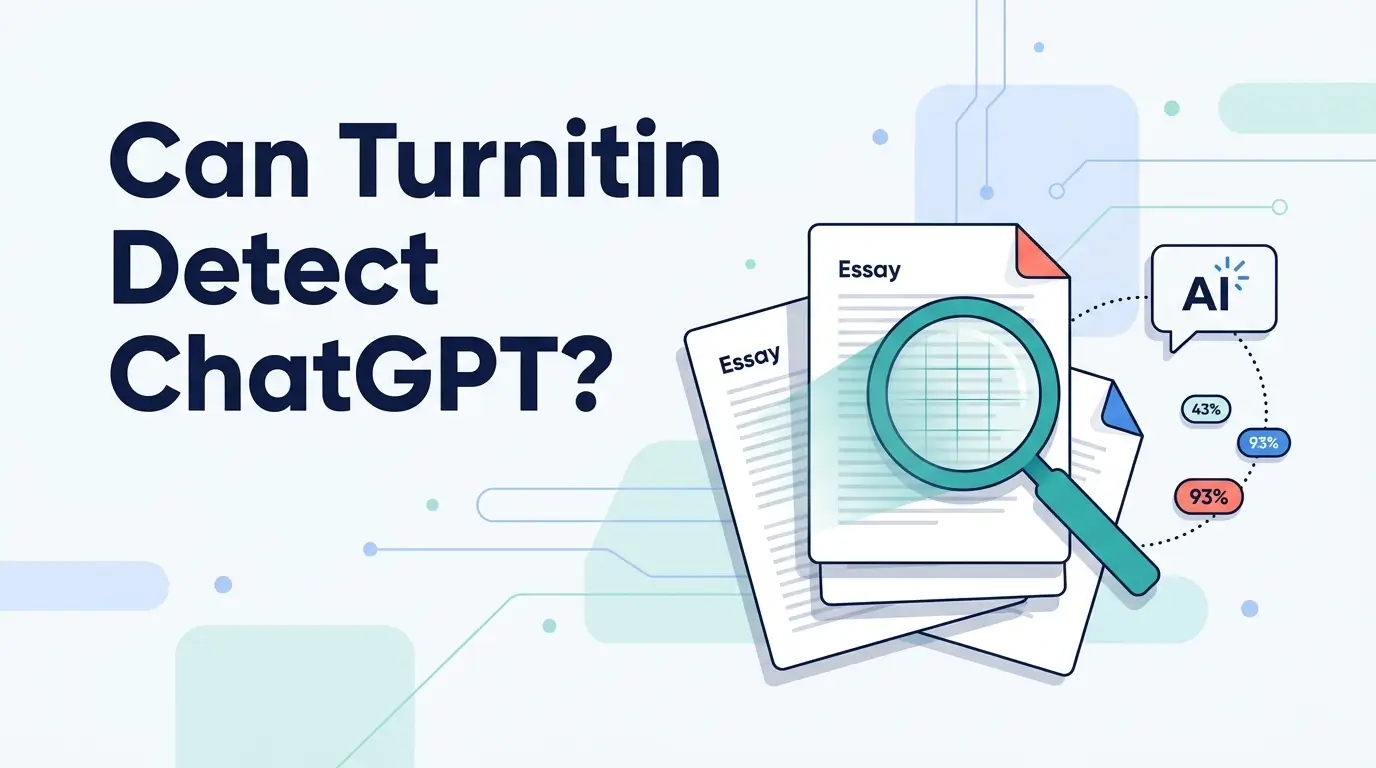
Can Turnitin detect ChatGPT? Yes, but accuracy depends on editing and length. See real detection rates and what to do if flagged.
Yes, Turnitin ChatGPT detection can identify text generated by ChatGPT, including output from GPT-3.5, GPT-4, and GPT-4o. But detection reliability depends on three variables: whether the text is raw or edited, how long the document is, and whether your instructor has actually turned the feature on.
If you're trying to understand what your AI score actually means, or whether AI-humanizing tools change the outcome, does Humanize AI work on Turnitin is worth reading alongside this guide.
Key Takeaways
Raw ChatGPT text is caught with high confidence; edited or rewritten text is much harder to detect.
Detection isn't automatic. It only runs if your institution and instructor both enable it.
A score is a probability estimate, not proof, and it can't confirm which tool you used.
If flagged, your draft/version history is your best evidence.
Your Professor May Not See an AI Score at All
This is the fact no one leads with, and it changes everything.
Turnitin's AI detection is not automatic. It runs on a three-step opt-in chain: Turnitin licenses the AI detection feature to the institution, the institution activates it, and the instructor enables it for each individual assignment.
If your professor skipped any step in that chain, no AI score appears on their report, regardless of what you submitted. Before worrying about detection thresholds, it's worth confirming whether the feature is even running. This is also true for other classroom tools; see whether Google Classroom has an AI detector built in by default.
Some institutions have opted out entirely. UC Berkeley, for example, chose not to enable Turnitin's AI writing detection tool campus-wide after reviewing it for privacy, security, accessibility, and functionality concerns, alongside several peer institutions. If your school is one of them, the question of whether ChatGPT "can be detected" is moot: the feature simply isn't running on your submissions.
What Turnitin Can and Cannot Do
Before getting into how the detector works, it helps to be clear about its actual limits, because this is where most of the anxiety around "can ChatGPT be detected on Turnitin" comes from.
What Turnitin cannot do:
It cannot access your ChatGPT conversation history, your prompts, or your OpenAI account. There is no integration between the two platforms.
It cannot identify ChatGPT by name in a report. The AI Writing Report shows a probability score, not a tool name.
It cannot see your browser history, your drafting process, or how you actually wrote the document. It only scores the final submitted text.
What Turnitin can do:
It can score submitted text for statistical patterns that resemble large language model output.
It can flag AI-generated text separately from AI-paraphrased text.
It can be compared against your own prior submissions by an instructor, manually, though Turnitin itself doesn't automate this comparison.
In short: Turnitin does not detect that you used ChatGPT. It detects that your submitted text statistically resembles ChatGPT-style output. That distinction matters for everything that follows.
How Does Turnitin ChatGPT Detection Actually Work?
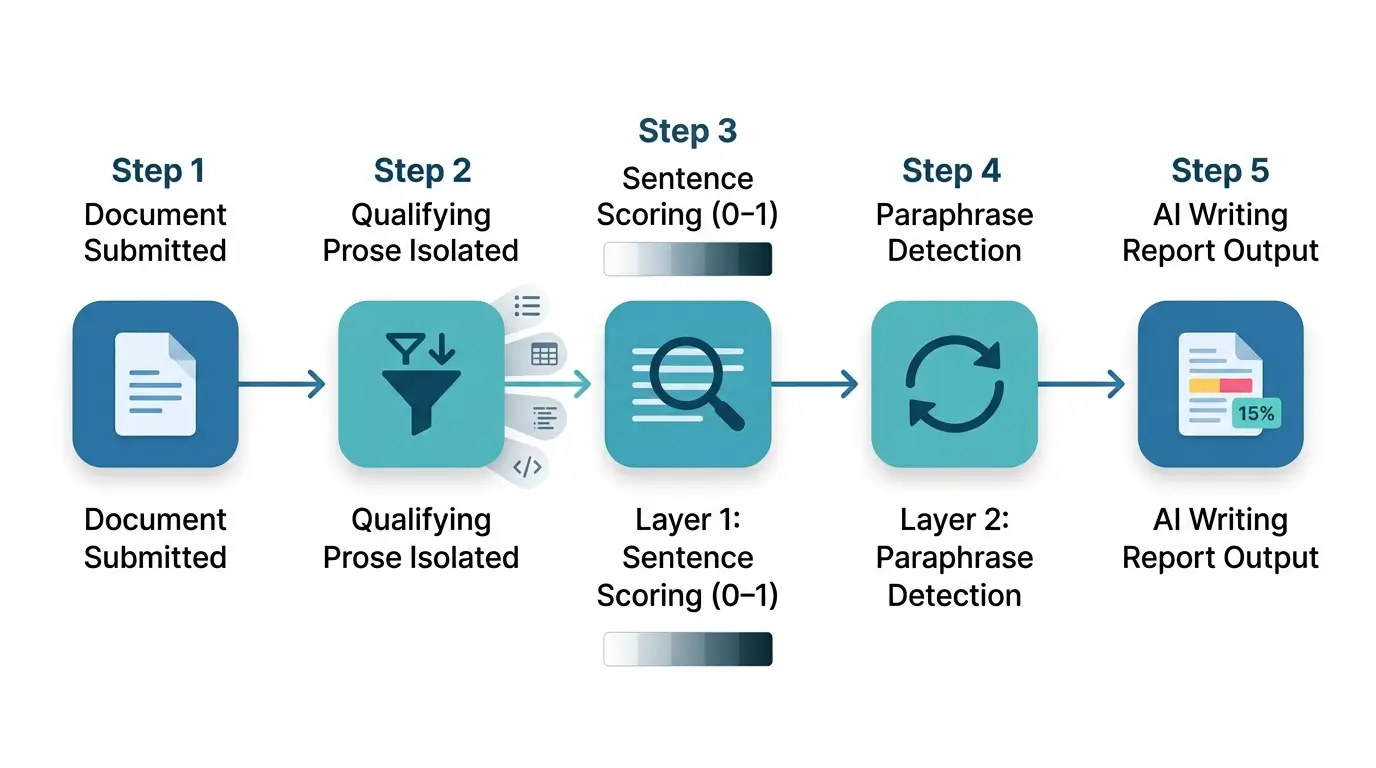
Turnitin's AI writing detector runs in two sequential passes, and understanding both explains most of what students get wrong about the tool.
What Turnitin Analyzes, and What It Skips
Turnitin only evaluates what it calls "qualifying text": prose sentences organized in paragraphs. It skips bullet points, numbered lists, code blocks, headers, and tables entirely.
This matters practically. If your document is structured mostly as lists or headers, common in business courses, lab reports, or technical writing, a smaller portion of your submission goes through AI detection. Your overall AI percentage reflects only the qualifying prose, not the full document.
Sentence-Level Scoring
For qualifying text, Turnitin scores each sentence on a scale from 0 to 1. Zero indicates human-written; 1 indicates AI-generated. Those sentence scores aggregate into the document-level percentage shown in the report.
This is probabilistic classification, not source-matching. Unlike Turnitin's Similarity Report, which flags text matching a specific source and links to it, the AI Writing Report has no original text to compare against. The system estimates likelihood based on statistical patterns alone. This is also why "can Turnitin detect plagiarism from ChatGPT" and "can Turnitin detect ChatGPT" are actually two different questions: plagiarism detection matches text to existing sources, while AI detection scores statistical writing patterns with nothing to match against.
The Paraphrase Detection Layer
Any sentence flagged as likely AI-generated then goes through a second layer of analysis. This pass checks whether the text was subsequently rewritten using an AI paraphrasing tool such as QuillBot. AI-generated text and AI-paraphrased text are highlighted in different colors, with a percentage breakdown for each. Understanding how AI writes like a human helps explain why this second layer exists in the first place.
What Perplexity and Burstiness Actually Mean
Perplexity measures how predictable the next word is. AI-generated text has low perplexity: the model reliably picks high-probability words, producing smooth, consistent prose. Burstiness measures variation in sentence complexity. Human writing naturally alternates between short, punchy sentences and longer, more complex ones. AI output tends to sustain uniform sentence length and structure throughout.
This is exactly why formal academic writing, doctoral dissertations, law review articles, and technical research papers, can look statistically similar to AI output even when written entirely by a human: it's deliberately structured, consistent in tone, and low in burstiness.
Turnitin's Two-Layer Detection Pipeline
Stage | What Happens |
1. Document submitted | Full text uploaded to Turnitin |
2. Qualifying prose isolated | Bullets, code, tables, and headers excluded |
3. Layer 1: Sentence scoring | Each sentence scored 0 (human) to 1 (AI) |
4. Layer 2: Paraphrase detection | Flagged sentences checked for AI-paraphrasing tools |
5. Output | Color-coded AI Writing Report with aggregate percentage |
Can Turnitin Detect Copy and Paste From ChatGPT?
Yes, and this is the scenario where Turnitin performs at its highest confidence.
Raw, unedited ChatGPT output submitted directly carries the full statistical signature of large language model generation: consistently low perplexity, uniform burstiness, and predictable vocabulary patterns across every sentence. There's nothing to disrupt the classifier's signal.
A 1,200-word essay generated by ChatGPT and pasted without editing will typically return an AI score between 85% and 100%, with nearly every qualifying sentence highlighted. If your professor has enabled AI detection, unedited AI output is the submission most likely to produce an unambiguous result.
Can Turnitin Detect ChatGPT If You Paraphrase?
It depends heavily on how much you changed and what tools you used.
Light manual editing, word swaps, sentence reordering. Still detectable in most cases. The underlying statistical pattern of large language model output persists through surface-level vocabulary changes. Turnitin's classifier evaluates deeper structural patterns, not just individual word choices.
AI paraphrasing tools, QuillBot and similar. Turnitin's second detection layer was built specifically for this scenario. Text rewritten by an AI paraphrasing tool is flagged in a distinct color from raw AI output. Detection confidence is lower than for unedited text, but the dual-classification system makes AI-paraphrased content a specific target, not an oversight. Tools differ a lot here: see whether Grammarly has a humanizer or whether Claude can humanize text for a comparison of approaches, and whether Undetectable AI actually works before relying on any single tool.
Heavy manual rewriting. This is where detection reliability drops significantly, and where the honest answer matters most.
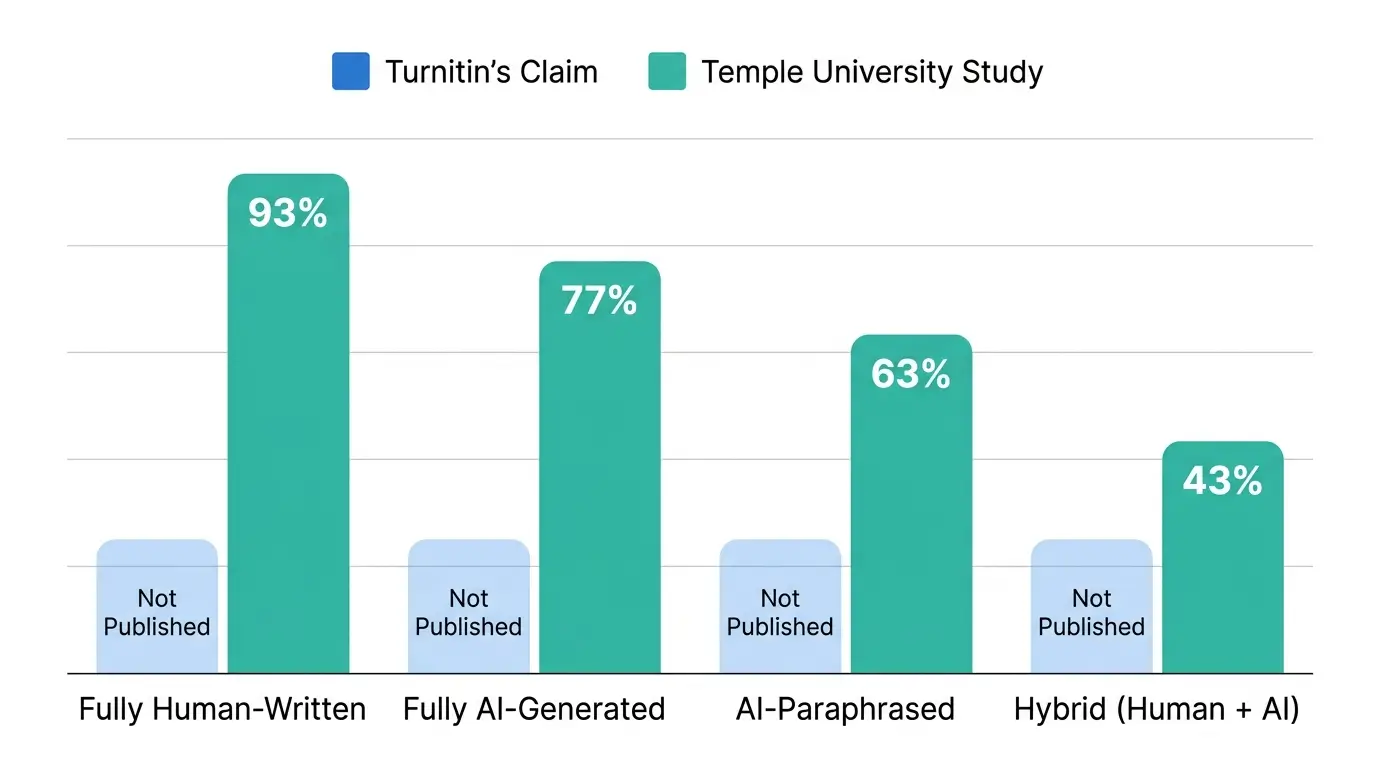
Researchers at Temple University evaluated Turnitin using 120 text samples across four categories: fully human-written, fully AI-generated, AI-generated with paraphrasing applied, and hybrid texts combining AI and human writing. Turnitin correctly identified 93% of fully human-written texts and 77% of fully AI-generated ones. For hybrid texts, the closest model to how students actually use AI, accuracy fell to 43%, and the flagged sections showed poor correlation with the portions that were actually AI-generated.
The practical implication: a document that starts as AI output but is substantially restructured, argued through with your own analysis, and integrated with course-specific material is significantly harder for Turnitin to score accurately. The tool wasn't designed for this use case, and its own data reflects that. If you're trying to make AI-assisted drafts read more naturally in the first place, how to make ChatGPT sound more human and how to prompt AI to write like a human cover the prompting side of this.
Can Turnitin Detect ChatGPT-4 and GPT-4o?
Yes, but with lower consistency than it detects GPT-3.5 output.
Turnitin's classifier was originally trained on GPT-3 and GPT-3.5 output patterns when the feature launched in April 2023. It has since expanded to include GPT-4, GPT-4o, Google Gemini Pro, and Meta's LLaMA. Newer models produce more stylistically varied text: higher perplexity, more sentence-length variation, which brings their output closer to human writing patterns and makes consistent classification harder.
Turnitin has stated it will continue expanding its detection models as AI tools evolve. It has not published model-by-model accuracy breakdowns.
\Model | Developer | Turnitin Support | Detection Confidence |
GPT-3.5 | OpenAI | Since April 2023 | Highest |
GPT-4 | OpenAI | Supported | High |
GPT-4o | OpenAI | Supported | Moderate to High |
Gemini Pro | Supported | High | |
LLaMA | Meta | Supported | Moderate |
Turnitin AI Detection Accuracy: What the Data Actually Shows
Two numbers circulate in discussions of Turnitin's accuracy, and they appear to contradict each other. They don't, but only if you understand what each one measures.
What Turnitin claims: a false positive rate below 1% for documents where more than 20% of the content is AI-written. This figure comes from internal testing on 800,000 academic papers written before ChatGPT existed, used as a calibration baseline for human writing. To hit that low false positive rate, Turnitin accepts a tradeoff: it may undercount AI content by up to 15%. A document scored at 50% AI may actually contain 65% AI-generated text.
What independent research found: the Temple University evaluation found an overall accuracy rate of approximately 86%, which sounds strong until you see the breakdown.
Metric | Turnitin's Internal Data | Temple University Study |
False positive rate | Below 1% | Not directly comparable |
Overall accuracy | Not published as a single figure | ~86% |
Fully AI-generated detection | Not published | 77% |
AI-paraphrased detection | Not published | 63% |
Hybrid (human + AI) detection | Not published | 43% |
Test conditions | 800,000 pre-ChatGPT papers, controlled baseline | 120 mixed real-world-style samples |
Turnitin's sub-1% false positive rate applies to clearly human-written documents in controlled test conditions. Temple's error rate applies to real-classroom conditions: mixed, partially edited, partially AI-generated submissions. Both sets of results are internally valid; the conditions they measure are simply different.
The practical conclusion: Turnitin is most reliable when confirming a document is human-written. A 0% AI score carries strong evidentiary weight. It's least reliable when scoring hybrid human-plus-AI documents, which is how most students who use AI actually submit work.
For how this compares with other detectors, see whether Copyleaks is accurate, whether ZeroGPT is accurate, or whether the JustDone AI detector is accurate.
Can Turnitin Falsely Flag Human Writing as AI?
Yes, and the risk isn't evenly distributed. Four student profiles carry elevated false positive risk:
Non-native English speakers. A 2023 Stanford-affiliated study raised concerns about higher false positive rates for English Language Learner writers. Turnitin published a rebuttal in October 2023 finding no statistically significant bias for texts over 300 words. For shorter submissions, false positive rates increase for all writers, but the effect is more pronounced for non-native speakers. Turnitin raised the minimum word count from 150 to 300 words specifically to reduce this risk.
Formal academic writers. Doctoral candidates, legal writers, and technical researchers write in a deliberately structured, low-burstiness register that overlaps with AI output patterns even when every word is human-generated.
Students writing on common topics. Widely-covered subjects produce predictable phrasing. An essay on climate policy or cognitive behavioral therapy that follows standard argumentation patterns may read as AI-like without any AI involvement.
Students submitting short documents. Below 300 words, Turnitin doesn't produce a reliable AI detection result.
How to Read a Turnitin AI Score
A Turnitin AI score is a probability estimate. It is not a verdict.
Unlike the Similarity Report, which links flagged text to a specific identifiable source, the AI Writing Report has no verifiable source. Turnitin cannot confirm which AI tool was used, or whether AI was used at all. It can only report that the statistical patterns in your text resemble large language model output.
Score Indicator | What It Means | What It Does NOT Mean |
0% | Classifier finds no AI-like patterns in qualifying prose | Absolute proof of no AI use, but a strong indicator |
*% (1-19%) | Low AI-like signal detected; flagged as unreliable | Evidence of AI use: the asterisk itself acknowledges high false positive risk |
20-100% (blue) | Estimated portion of qualifying prose resembling AI output | Proof of misconduct: a review signal, not a finding |
(gray dashes) | Document could not be processed | Any AI use conclusion |
! (red) | Technical processing error | Any AI use conclusion |
No institution can treat a Turnitin AI score as standalone proof of academic misconduct. The score opens a review. It does not close one.
Flagged by Turnitin? Here's What to Do, Step by Step
Read the report before reacting. Check which sentences are highlighted and whether the score carries an asterisk. A score of 1-19% is acknowledged by Turnitin as operating in its high-false-positive zone.
Assemble your writing process evidence, in order of persuasive value. Google Docs version history or Microsoft Word track changes showing incremental drafting over time is the most persuasive evidence in a formal hearing. Behind that: handwritten notes, research outlines, annotated source PDFs, and browser history showing research activity.
Confirm whether AI detection was enabled for your assignment. Ask your instructor directly; can professors detect ChatGPT walks through exactly what instructors can and can't see. If the feature wasn't activated, no AI score may appear in the instructor's view at all.
Contact your instructor before any formal process begins. Request a conversation, present your evidence, and walk through your argument and sources for the flagged sections.
Know what a misconduct finding actually requires. A Turnitin AI score alone, without corroborating evidence such as dramatic inconsistency with prior work, inability to explain your argument, or an admission, does not meet the evidentiary standard most institutions require. You have procedural rights.
How Should Instructors Use Turnitin's AI Detection Report?
The AI Writing Report is a review tool, not a verdict. Treating it as one exposes institutions to legitimate procedural challenges and harms students whose writing style happens to resemble AI output.
The score triggers a review; it doesn't conclude one. Examine the flagged passages in context of the assignment type, the student's prior work, and topic complexity.
Compare against the student's established writing. A sudden, unexplained shift in vocabulary or structural complexity, combined with a high AI score, carries more weight than a high score alone.
Talk to the student before initiating formal proceedings. Ask about the writing process and request draft evidence.
Set expectations before the assignment, not after. A syllabus specifying what AI tools are permitted, what must be disclosed, and what constitutes a violation gives students clarity and gives instructors a defensible policy baseline.
What This Guide Does Not Cover
This page explains how Turnitin's AI detection works and what the scores mean. It doesn't cover step-by-step strategies for evading AI detection, a full comparison between Turnitin and other detectors like GPTZero, or how Turnitin's traditional similarity and plagiarism detection functions work. If you're researching the broader landscape, how to rewrite text to avoid AI detection covers that adjacent topic in more depth.
If you want to check your own writing before you submit it, our AI Detector scans your text the way Turnitin does, and our AI Humanizer helps smooth AI-assisted drafts so they read naturally in your own voice.
Conclusion
So, can Turnitin detect ChatGPT? Yes, in most cases, but the answer depends entirely on the scenario. Unedited, copy-pasted ChatGPT output is caught with high confidence. Text run through an AI paraphrasing tool is caught with moderate confidence, since Turnitin built a dedicated layer for exactly that case. Heavily rewritten, human-restructured text is where the system genuinely struggles, dropping to just 43% accuracy on hybrid documents in independent testing.
What matters more than the score itself is what it actually represents: a probability estimate based on statistical writing patterns, not proof of misconduct, not confirmation that you used ChatGPT specifically, and not a substitute for a conversation with your instructor. Whether or not the feature is even enabled for your assignment depends on a three-step opt-in chain that many students never think to ask about.
If you're using AI tools as part of your writing process, the safest path isn't chasing a lower detection score. It's building a visible, honest writing process, drafts, notes, and revisions, that holds up regardless of what any detector reports.
Frequently Asked Questions
Does Turnitin automatically detect AI, or does my professor have to enable it?
AI detection is opt-in at every level. Turnitin licenses the feature to institutions, institutions activate it, and instructors enable it per assignment. If your professor didn't turn it on, no AI score appears in their report, regardless of what you submitted.
Can Turnitin tell which AI tool I used?
No. Turnitin's classifier identifies text that statistically resembles large language model output. It cannot distinguish between ChatGPT, Claude, Gemini, or any other specific tool, and it cannot access your ChatGPT account or conversation history. The report flags a probability of AI generation, not the source.
Does Turnitin store my paper in an AI detection database?
No. Turnitin's plagiarism database retains submitted text for future similarity comparisons. The AI detection feature does not add your submission to a separate AI database. Your paper is analyzed and scored, then the process ends.
Can a 0% AI score be trusted?
A 0% score is the most reliable result Turnitin produces. In both internal testing and the Temple University evaluation, fully human-written documents were correctly identified as human at rates above 93%. A 0% score strongly indicates human authorship, not an absolute guarantee, but the tool's strongest signal.
Is Turnitin biased against non-native English speakers?
For documents over 300 words, Turnitin's own research found no statistically significant bias between native and non-native English writers. For shorter texts, false positive rates rise for all writers, but the effect is more pronounced for non-native speakers. Meeting the 300-word minimum substantially reduces this risk.
What does the asterisk on a Turnitin AI score mean?
The asterisk appears when the AI score falls between 1% and 19%. Turnitin uses it to signal that results in this range carry a higher rate of false positives. An asterisk score is an unreliable indicator and should not be treated as evidence of AI use.
How to make sure ChatGPT is not detected?
There's no guaranteed way to make AI-generated text undetectable, and this guide doesn't recommend trying to evade detection. What actually reduces false flags is genuine human involvement: drafting in your own words, restructuring arguments around your own analysis, and citing course-specific sources, the exact pattern Temple's research showed Turnitin struggles to score accurately (43% accuracy on hybrid texts).
Is 25% on Turnitin too high?
It depends on context. A 25% AI score is above the 1-19% "unreliable" asterisk range, so Turnitin is expressing more confidence in that estimate. But 25% still means the large majority of your qualifying prose was scored as human-written. Whether it's "too high" depends on your institution's policy, whether AI use was permitted for the assignment, and whether the flagged sections match how you'd expect AI-assisted parts, if any, to appear. It is not, by itself, proof of misconduct.
Is it possible to get 0% AI on Turnitin?
Yes, and it's common for fully human-written work. Turnitin correctly identified human writing at rates above 93% in independent testing. Writing in your own process, with visible drafting history, naturally produces the sentence-level patterns Turnitin classifies as human.
Can a professor know if I use ChatGPT?
Only if AI detection is enabled for that assignment, and even then only as a probability estimate, not certain knowledge. Professors can't identify which specific tool was used, and they can't see your ChatGPT account or chat history. What often reveals AI use in practice isn't the Turnitin score alone; it's a mismatch between the submission and a student's known writing style, or an inability to explain the work's content and sources when asked directly. See can professors detect ChatGPT for a full breakdown.