Does Undetectable AI Work? We Tested 5 AI Detector
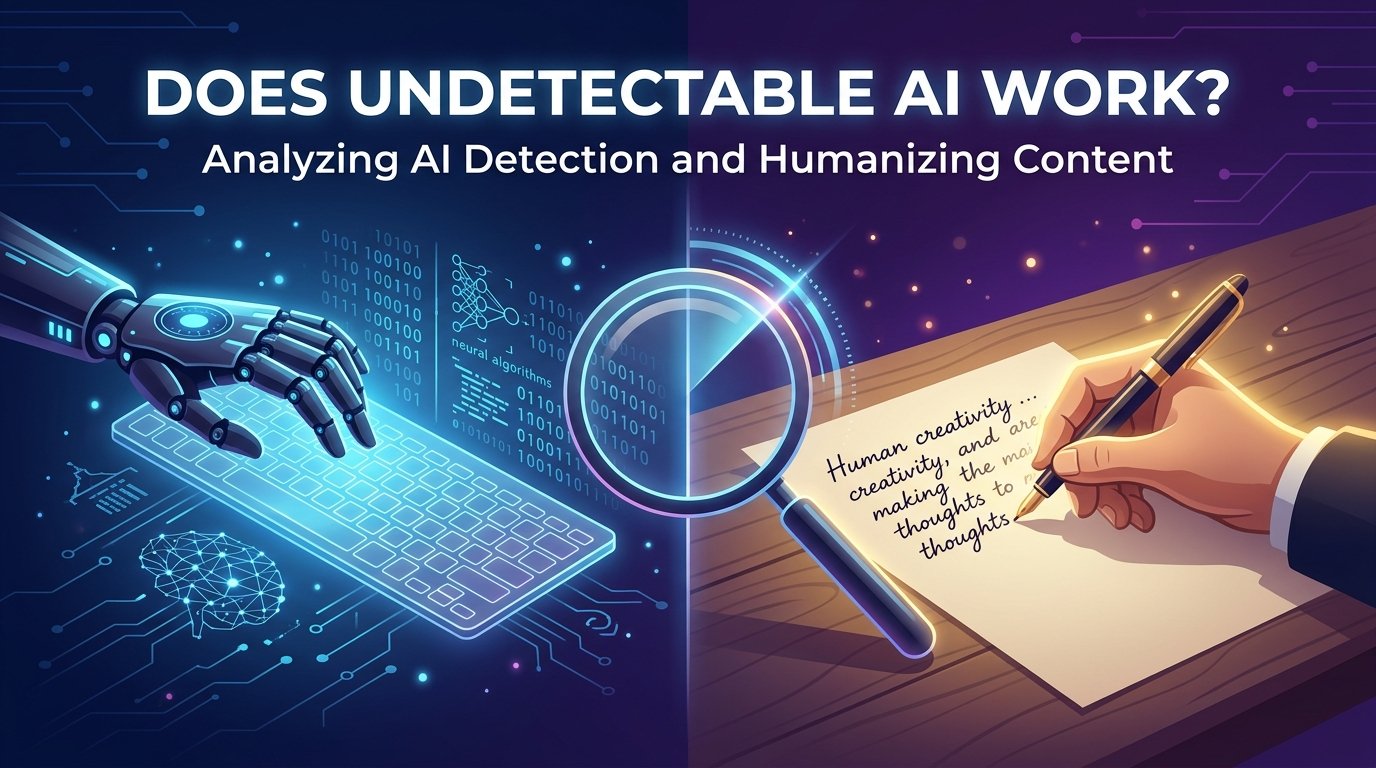
Does Undetectable AI work? We put it to the test against real detectors, Turnitin included, to see if it truly bypasses them. Here's what we found.
You paste your AI-written draft in, hit "humanize," and the score drops. Looks like a win, until you run the exact same text through a different detector and watch it get flagged instantly. Or worse, you submit it and a teacher, editor, or client notices something feels slightly off about a date, a term, or the flow of a paragraph that used to read just fine.
So does Undetectable AI actually work, or is it just moving the problem around instead of solving it? That's exactly what we set out to test.
This is an honest, independent review, not a sales pitch. We ran real text through the tool, checked its claims against published research, and tested it against five major detectors including Turnitin. We also broke down exactly where it wins, where it quietly fails, and what that means for your specific use case, whether that's a quick blog post or a graded assignment.
What You'll Find in This Review
How AI detectors actually spot machine-written text in the first place
Real test results against GPTZero, Copyleaks, Originality.AI, and Winston AI
Whether it can actually get past Turnitin (and why students get caught anyway)
The hidden formatting problem nobody warns you about
What a 40% detection score really means, and whether you should worry about it
Honest pricing, privacy notes, and whether the "#1 rated by Forbes" claim holds up
Which alternatives are worth trying instead
Here is the quick verdict before we go deep.
Evaluation Metric | Test Performance | Verdict |
Bypass Success Rate | Moderate to High (detector-dependent) | Beats basic detectors; struggles against deep classifiers |
Output Readability | Good (mode-dependent) | Simple modes read clean; aggressive modes can sound off |
Meaning Preservation | Inconsistent | Risk of small factual errors on academic or technical text |
Layout & Formatting | Poor | Strips headings, bold text, and bullet points |
Pricing Value | Fair | Starts near $9.99/mo; costs climb fast at high volumes |
Overall Rating | 4.0 / 5 | Solid for casual use, weak for high-stakes work |
Key takeaway: No AI humanizer can promise a 100% pass rate on every detector. Detector models update often, so a "pass" today can turn into a "fail" next month.
What Is Undetectable AI and How Does It Work?
Undetectable AI is a web-based tool that rewrites AI-generated text to sound more human, and it also includes a built-in AI detector to check that text. It launched in 2023 and quickly became one of the most recognized names in the AI humanizer category.
The tool does two main jobs. The humanizer rewrites your text. The detector estimates how likely that text is to be flagged as AI-written.
Here is how the workflow runs, step by step:
Paste your text. You drop in AI-generated content, often from ChatGPT, Claude, or Google Gemini. The humanizer accepts up to 10,000 characters at a time.
Pick your settings. You choose a writing mode like General Writing, Essay, Article, Marketing Material, or Story, plus a readability level (High School or University).
Hit humanize. The tool rewrites your text using its own trained model.
Run the pre-check. You can run the output through the built-in detector to preview the score before you use it.
Tip: The free version uses a weaker model than the paid tiers. If you test the free version and dislike the results, that's partly a tier issue, not necessarily a reflection of the paid product.
If you'd rather skip the guesswork and just check a piece of text right now, our own AI Detector gives you a quick, free read on how "AI-sounding" your draft is before you commit to any paid tool.
Why Can ChatGPT Be Detected in the First Place?
ChatGPT-generated text can be detected because it writes in very predictable mathematical patterns that AI detectors are trained to spot. A large language model picks each word based on probability, and that habit leaves a fingerprint in the text.
Think of it like this: AI writing is like a metronome, steady and even. Human writing is more like jazz, full of surprises and changes in rhythm.
Detectors mainly measure these signals:
Perplexity: how surprising the word choices are. AI text has low perplexity (predictable words); human text has high perplexity (unexpected choices).
Burstiness: how much sentence length and structure vary. AI text is uniform; human text bursts around, mixing short punchy lines with long flowing ones.
N-gram patterns: common word groups like "in today's fast-paced world." AI leans on these predictable phrases far more than real people do.
Shannon entropy: a measure of overall unpredictability. Low-entropy text is flat and repetitive, a classic AI signal.
Type-token ratio (TTR): the ratio of unique words to total words. AI models tend to keep this ratio unusually uniform.
A humanizer tries to break these patterns by swapping words and reshuffling sentences. The real question is whether it changes the deep structure of the writing or just the surface.
If you want a deeper breakdown of how models mimic human phrasing, see how AI writes like a human.
Fact: A 2023 study published in Patterns (Cell Press) found that AI detectors often wrongly flagged writing by non-native English speakers as AI-generated.
Does the Undetectable AI Humanizer Actually Work?
The Undetectable AI humanizer works well enough to lower detection scores on simple content, but its output quality is inconsistent and often needs manual cleanup. How good the result is depends on your content type, its length, and which mode you choose.
What It Does Well
For short, simple text, the tool delivers. Paste in a paragraph, a social post, or a short marketing blurb, and you get a readable rewrite back in seconds. The wording becomes less repetitive, and the prose feels more natural than raw model output. For casual jobs like blog intros, listicles, and product descriptions, that's often good enough.
Surface Fluency vs. Structural Rewriting
The software is highly effective at superficial rephrasing: swapping common AI words, using synonyms, and adjusting basic clauses. But it often struggles with deep structural rewriting. Instead of reorganizing the logic of a paragraph, it sometimes just rearranges the existing sentences, which is why advanced detectors that read paragraph rhythm can still catch the underlying machine fingerprint.
Where It Falls Short: Factual Drift
Aggressive rewriting modes can change the meaning of your text, causing small but serious factual errors. This is known as factual drift, and it shows up as:
A wrong date or a swapped number
A mangled technical term
A twisted definition that no longer means the same thing
For a casual blog, this may not matter much. For a research paper, a legal note, or a compliance document, it's a real problem. Never just check the detector score. Always proofread the actual words.
The Coherence Drop on Long Content
On longer content, the output becomes less coherent and loses its natural flow. Short inputs fare well, but long paragraphs come back with awkward phrasing and weaker logic. For anything over a thousand words, expect to spend real time cleaning it up.
For tips on writing prompts that reduce this problem from the start, check how to prompt AI to write like a human.
Key point: A lower detector score does not mean better writing. A tool can make text "less AI" while also making it less accurate and harder to read.
The Hidden Problem: It Strips All Your Formatting
Undetectable AI automatically removes all formatting from your text the moment you paste it in. This is the limitation most reviews ignore, and for content creators, it's the most painful one.
Paste in content with headings, bullet points, or bold text, and the output comes back as a plain block of unformatted text, every single time. None of the writing modes preserve your layout.
For one short paragraph, you'll barely notice. For a structured blog post or article, it means rebuilding the entire piece by hand: re-adding H2s, H3s, bold text, lists, and links inside your CMS.
Stage | What Happens |
Structured draft (H2s, H3s, bold, lists) | Original formatting intact |
Pasted into Undetectable AI editor | Formatting stripped on input |
Humanized output | Delivered as one plain block of text |
Manual rebuild | You re-add all headings, bold, and links by hand |
That time cost adds up fast. The minutes you save on rewriting can vanish into the minutes you spend reformatting.
Tip: Before you humanize a structured article, save a clean copy of your original formatting somewhere else. You'll need it to rebuild the layout afterward.
Testing Undetectable AI Against Top AI Detectors
Undetectable AI's bypass performance is uneven. It often beats basic detectors but gets flagged by advanced, deep-learning ones. Not all detectors are built the same, which is why results swing so much.
Detector | Typical Result | Why |
GPTZero | Often passes | Relies heavily on basic perplexity and burstiness |
Copyleaks | Mixed results | Advanced pattern recognition still catches some sentences |
ZeroGPT | Often passes | Lower detection thresholds are easier to clear |
Originality.AI (v3.0/v4.0) | Often flagged | Deep classifiers see past simple word swapping |
Winston AI | Moderately bypassed | Strong deep-learning model catches structural signals |
Passing one detector proves nothing about the others, which is also why detector scores in general are shaky signals. If you're weighing other detector tools people commonly ask about, see whether Justdone's AI detector is accurate.
Fact: A 2023 study in the International Journal for Educational Integrity (Springer) tested 14 AI detection tools and found they were "neither accurate nor reliable," with results biased toward classifying text as human-written.
This matters because of two errors every detector makes. A false positive flags human writing as AI. A false negative misses AI writing and calls it human. Both happen often, which is why no single score should ever be trusted on its own. Some writers try switching tools instead of chasing a lower score; if that's you, it's worth checking whether Grammarly has a humanizer built into its editor.
Does Undetectable AI Work for Turnitin?
No, Undetectable AI cannot promise a pass on Turnitin, and relying on it for schoolwork carries a serious risk of academic penalties. Turnitin uses its own deep detection model, trained specifically on student essays and academic journals, and updates it regularly, so no humanizer can reliably stay ahead of it.
Turnitin actually runs two separate systems:
System | What It Checks |
Similarity Report | Matches your text against other sources to find copied writing (plagiarism) |
AI Writing Indicator | A separate classifier that estimates the probability your text was AI-generated |
A low similarity score does not mean you passed the AI check. You can score 0% on plagiarism and still get flagged as AI-written. Many students learn this the hard way.
For a deeper look at this exact issue, see does Humanize AI work on Turnitin.
On top of the software, teachers don't rely on tools alone. They notice missing citations, uniform pacing, and a voice that doesn't match your past work. Classroom platforms are also adding their own checks; see does Google Classroom have an AI detector for how that works.
Key point: Using a humanizer to hide AI writing in a class that bans it is a policy violation, no matter what the detector says. The risk sits with you, not the tool.
The safer path is honesty. According to the Committee on Publication Ethics (COPE), AI tools cannot be listed as authors, and writers must be transparent about how they used them.
Is a 40% AI Detection Score Bad?
A 40% AI detection score is a probability estimate, not a fact. It means the detector found a moderate mix of AI-like patterns in your text. It does not mean that exactly 40% of your words were written by a machine.
This is a common myth worth clearing up. The percentage is the detector's confidence level, not a word count. A 40% score really means: "I am somewhat unsure, but I see some machine-like patterns here."
Whether 40% is "bad" depends on your situation:
For a casual blog post: usually not a concern at all.
For a client project: might be worth a quick edit for peace of mind.
For a strict school submission: even a moderate score could raise questions.
If you land on a borderline score, here's what to do:
Verify every fact, date, and source is still correct.
Add your own voice, opinions, and real examples.
Vary your sentence length to boost burstiness.
Cut generic filler phrases that AI loves to use.
Tip: Never chase a perfect 0% score. Real human writing rarely scores a clean zero, and over-editing can strip the life out of good content.
Can You Trust Undetectable AI? (Legitimacy, Privacy, and Pricing)
Yes, Undetectable AI is a legitimate, working platform, but some of its marketing claims are exaggerated and worth a closer look.
The "Forbes" Claim
The website displays a claim about being rated "#1" by Forbes, but there's no direct source link attached to back this up, and independent searches don't turn up this specific rating. Treat bold marketing badges like this as advertising, not proof, until you can verify them yourself.
Privacy and Data
Before you paste sensitive work into any online tool, check its privacy policy to see how your text is stored and whether it's used to train future models. Avoid uploading private, confidential, or personal information into any humanizer.
Pricing and Value
Undetectable AI uses a volume-based pricing ladder. Based on public pricing, plans start around these levels:
Plan | Words per Month | Monthly Price |
Entry | 10,000 words | ~$9.99/mo |
Mid-Tier | 50,000 words | ~$19.00/mo |
Agency | Bulk volumes | $80+/mo |
Annual billing brings the price down, but credits usually don't roll over month to month, so unused words are lost.
Tip: Always check current pricing on the official site before subscribing. The plan that feels roomy in month one can feel tight by month four.
Does Undetectable AI Help With SEO Content?
Google does not use third-party AI detector scores to rank your website, so a "human" score from Undetectable AI does not directly help your SEO. Google ranks pages based on whether they're helpful, original, and made for people first.
According to Google's official guidance, the search engine rewards high-quality, people-first content, no matter how it's produced. Using AI to help create content is fine; using it to churn out low-value pages is not.
The real risk isn't detection. It's Google's Scaled Content Abuse policy, which targets low-quality content made at scale mainly to game search rankings, whether a human or an AI wrote it.
So for SEO, the goal isn't to fool a detector. The goal is to build content that shows real Experience, Expertise, Authoritativeness, and Trust (E-E-A-T). A rewrite tool can't add those things. Only you can.
Key point: For website content, quality and originality matter far more than a low AI score. A "human-sounding" but useless article will still fail in search.
Alternatives to Undetectable AI
Undetectable AI is the best-known name, but several alternatives offer better formatting retention, deeper rewrites, or richer editing tools.
Alternative | Main Focus | Best For | Edge Over Undetectable AI |
Phrasly AI | Writing quality | Bloggers and agencies | Keeps your formatting intact |
Leap AI | Sentence-level analysis | SEO and technical writers | Shows detection risk per sentence |
QuillBot | Paraphrasing and grammar | General editing | Full writing suite with citations |
GPTinf | Deeper rewriting | Short high-stakes copy | Changes patterns, not just words |
If you want to try a tool built specifically to rewrite text naturally without losing your meaning, you can test our AI Humanizer directly.
Other AI models get asked about often too. If you're curious, see can Claude humanize text or how to make ChatGPT sound more human.
For a more general approach that doesn't rely on a paid tool at all, see how to rewrite text to avoid AI detection.
Conclusion
So, does Undetectable AI work? Overall, it's a good fit for casual, short-form rewrites but a poor fit for high-stakes academic or technical writing.
You should use it if you are:
A content marketer polishing short web copy
A blogger softening AI-assisted drafts
Someone who wants a familiar brand with many writing modes
You should avoid it if you are:
A student submitting through Turnitin
A writer working with dense, technical, or citation-heavy content
A publisher who needs formatting and links kept intact
The best way to think about it isn't "good or bad," but "good for what?" For fast, low-stakes rewrites, it delivers. For serious work, its limits show fast.
If you want a quick second opinion on any draft, run it through our free AI Detector before you publish.
Final tip: Use any humanizer as an editing helper, not a shortcut. Always read the policy of whoever will see your work, and remember that a detector score is a signal, not a permission slip.
Frequently Asked Questions
Does Undetectable AI actually work?
Yes, in a limited way. It rewrites AI text and lowers scores on basic detectors like GPTZero and Copyleaks. But it often gets flagged by advanced detectors like Originality.AI, and its output can lose facts or formatting.
Is Undetectable AI free?
It offers a limited free trial with restricted word counts. For ongoing use, you need a paid plan, which starts around $9.99 per month for 10,000 words.
Does Undetectable AI check for plagiarism?
It includes a built-in AI detector, but it's not a full plagiarism scanner. For real plagiarism checks, use a dedicated tool like Copyleaks or Turnitin.
Can AI humanizers bypass Turnitin?
No tool can reliably bypass Turnitin. Turnitin uses a deep detection model that updates often, and its AI writing indicator works separately from its plagiarism check. Using a humanizer to hide banned AI use is a policy violation.
Is Undetectable AI safe to use?
The platform itself is legitimate and safe to use. Still, avoid pasting private or sensitive information into it, and read its privacy policy to see how your text is handled.
Does Undetectable AI change the meaning of my text?
It can. Aggressive rewriting modes sometimes cause "factual drift," changing dates, numbers, or technical terms. Always proofread the output before you use it.
Is 40% AI detection bad?
Not necessarily. A 40% score means the detector is moderately confident your text has AI-like patterns. It's not a measurement of how much of the text is literally AI-written. Whether it's "bad" depends on the context: for a casual blog it's a non-issue, for a strict academic submission it's worth a manual edit.
What is the most undetectable AI?
No single tool is guaranteed undetectable across every detector, since detection models are updated constantly. Tools that combine deeper structural rewriting (not just synonym swaps) with formatting retention tend to perform more consistently than basic paraphrasers.
Can you trust Undetectable AI?
Mostly, yes. It's a legitimate, functioning platform that does what it claims at a basic level. But some marketing claims, like its unverified "#1 rated by Forbes" badge, are exaggerated, and you should avoid uploading sensitive or confidential text to any online humanizer.
What AI is better than ChatGPT?
There's no single "better" AI; it depends on the task. Claude tends to be strong for long-form writing and nuanced instructions, Google Gemini integrates well with search and Workspace tools, and specialized tools often outperform general chatbots for narrow jobs like humanizing text or detecting AI content.
Which AI does Elon Musk use?
Elon Musk's company xAI develops Grok, the AI chatbot integrated into X (formerly Twitter), which Musk has publicly promoted and used as his primary AI product.
What is the best alternative to Undetectable AI?
It depends on your need. Phrasly is strong for keeping formatting, Leap offers sentence-level analysis, and QuillBot is best if you want a full grammar and paraphrasing suite. Test the free version of each before you buy.