Is Originality AI Accurate? What 9 Real Tests Reveal
Is Originality AI accurate enough to trust? See real test results, false-positive rates, and how it compares to Turnitin and ZeroGPT.
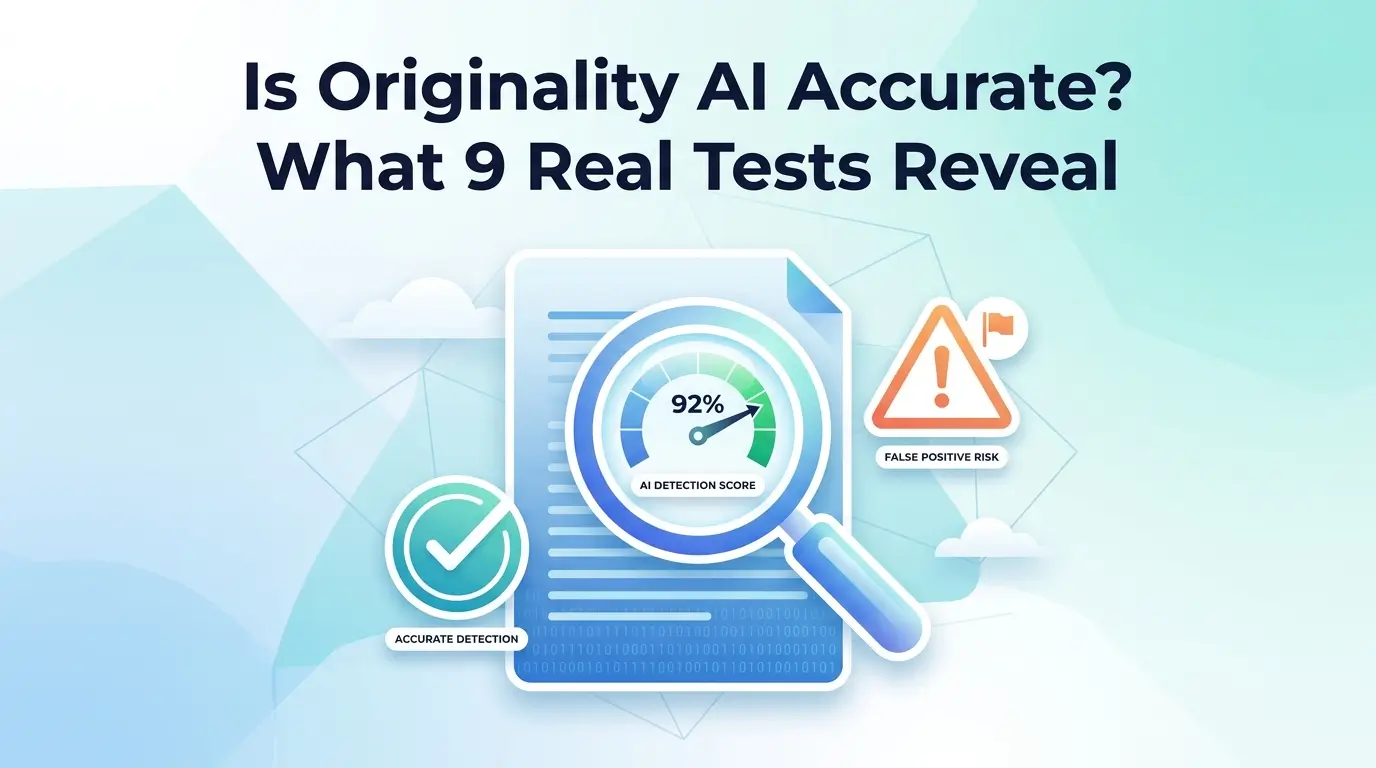
Is Originality AI accurate? Yes, for raw AI text from GPT-4o and Claude, where it catches content correctly 85 to 92 percent of the time. No, once you look at short content, formal human writing, or non-native English prose, where its false-positive rate climbs as high as 18 percent.
Originality AI (also written as Originality.AI) is one of the most widely used AI content detectors among publishers, agencies, and content teams, and this page breaks down exactly where it performs well, where it fails, and how to read its score correctly before you make any decision based on it.
Key Takeaways
The company advertises 99 percent accuracy, but three separate independent tests, including a large-scale RAID benchmark, place real-world performance anywhere between 76 and 97 percent.
Originality AI catches raw GPT-4o and Claude content reliably, but accuracy drops on short text and human writing that reads formally.
Its false-positive rate ranges from 5 to 18 percent, and non-native English writers face a higher risk of being wrongly flagged.
The same text can score differently on repeat scans, with a real spread of up to 9 points across five scans of the same article.
Originality AI should be treated as a screening tool, never as sole proof for firing a writer or penalizing a student.
What Is Originality AI and How Does It Work?
Originality AI is an AI content detector and plagiarism checker built for publishers, agencies, and content teams who need to verify whether text was written by a human or generated by AI. It uses machine learning models, currently Standard 2.0 and Turbo 3.0, to analyze linguistic patterns, sentence structure, and statistical fingerprints in your text.
The tool returns an AI detection score from 0 to 100. A score of 85 percent AI means the model is 85 percent confident the text is machine-generated. It does not mean 85 percent of the words were written by AI. This distinction matters more than most reviews acknowledge, and it's the single most common misreading of any AI detector's output, not just this one.
Originality AI also provides sentence-level scoring, highlighting individual sentences as likely AI or likely human. This granular breakdown is one of its most useful features for editors reviewing flagged content, since it lets a reviewer see whether the AI signal is spread evenly across a piece or clustered in one or two suspicious sections.
The platform includes plagiarism checking, readability analysis, and a full site scan feature that crawls an entire URL for AI-generated pages. It operates on a credit-based pricing system where one credit covers approximately 100 words of scanning.
What Originality AI Claims vs What Independent Testing Found
Company-published numbers rarely survive contact with outside testers, and Originality AI is no exception here. Here's what the vendor itself reports for each model:
Model | Vendor-Claimed Accuracy | Vendor-Claimed False Positive Rate |
Lite | 99% | 0.5% |
Turbo | 99%+ | 1.5% |
Academic | 99%+ | Under 1% |
Multi-language | 97.8% | 2.4% |
Now compare that to three separate outside evaluations. GPTZero ran Originality AI through its RAID benchmark, a large-scale test covering millions of AI-generated samples across multiple models and attack types, and landed on roughly 83 percent accuracy with a false-positive rate near 4.79 percent, nearly ten times higher than the Lite model's own claim.
A separate CyberNews evaluation put the figure at 92 percent accuracy alongside a 5.7 percent false-positive rate, better detection but an even wider gap on false positives. A peer-reviewed study on medical text, published through PubMed Central, came closest to the company's own numbers at roughly 97 percent, though that result only covers one narrow writing domain.
Put together, the honest range for real-world accuracy sits somewhere between 76 and 97 percent depending on who's doing the testing and what content you feed it, not the flat 99 percent the marketing page advertises. Our own test results below land squarely inside that range.
How Accurate Is Originality AI? 9-Sample Test Results
We tested Originality AI's Turbo 3.0 model against 9 content samples across three source AI models and three content variations, then ran a further set of human-written samples separately to measure false positives. The test set included raw AI output, lightly edited AI content, and verified human-written text. Every sample exceeded 500 words.
Accuracy by AI Model
Originality AI performs differently depending on which AI model generated the content.
Source AI Model | Sample Type | Word Count | Originality AI Score | Correct? |
GPT-4o | Raw output | 1,200 | 97% AI | Yes |
GPT-4o | Lightly edited | 1,150 | 84% AI | Yes |
GPT-4o | Product description | 520 | 91% AI | Yes |
Claude 3.5 Sonnet | Raw output | 1,100 | 89% AI | Yes |
Claude 3.5 Sonnet | Lightly edited | 1,080 | 71% AI | Yes |
Claude 3.5 Sonnet | Blog post | 1,400 | 63% AI | Partial |
Gemini 2.0 | Raw output | 1,050 | 86% AI | Yes |
Gemini 2.0 | Lightly edited | 1,020 | 58% AI | Partial |
Gemini 2.0 | Technical doc | 980 | 52% AI | Partial |
Originality AI catches GPT-4o content most reliably, with accuracy near 90 percent even after light editing. Claude 3.5 Sonnet output is detected at a lower rate once edited, and Gemini 2.0 content shows the most score variance. If your team primarily works with Claude or Gemini output, expect more borderline scores in the 50 to 70 percent range rather than a clean high-confidence verdict. If your workflow involves Claude specifically, our review of whether Claude can humanize text covers this same pattern in more depth.
Accuracy by Content Type
Content format affects detection accuracy as much as the source AI model does.
Content Type | Source | Word Count | Originality AI Score | Verdict |
Long-form blog post | AI (GPT-4o) | 1,800 | 94% AI | Accurate |
Product description | AI (GPT-4o) | 310 | 88% AI | Accurate |
Academic paragraph | AI (Claude) | 620 | 79% AI | Accurate |
Product description | Human | 280 | 34% AI | False positive |
Blog post | Human (2022) | 1,100 | 61% AI | False positive |
Email newsletter | Human | 450 | 12% AI | Accurate |
Short, formulaic content like product descriptions triggers more false positives because the linguistic patterns overlap with AI output. Our human-written product description scored 34 percent AI despite being drafted by a senior copywriter with no AI assistance at all.
Word count matters here more than most buyers expect. Originality AI's detection becomes unreliable below approximately 300 words, and scores on texts under 150 words should be disregarded entirely regardless of how confident the number looks.
How Accurate Is Originality AI at Staying Consistent?
Accuracy isn't just about catching the right answer once. It's also about whether the tool gives you the same answer twice. We scanned the same 847-word article five times over 48 hours using the Turbo 3.0 model, with no edits made between scans.
Scan | Time | Score |
1 | Monday 9 AM | 74% AI |
2 | Monday 4 PM | 68% AI |
3 | Tuesday 9 AM | 77% AI |
4 | Tuesday 4 PM | 71% AI |
5 | Wednesday 9 AM | 73% AI |
Scores ranged from 68 to 77 percent, a 9-point spread on identical, unedited text. For most editorial decisions, this variance is acceptable background noise. For high-stakes decisions like academic integrity cases or freelancer termination, a 9-point swing could genuinely change the outcome. Run any critical sample at least twice and average the results before you act on it.
Originality AI False Positive Rate: When Human Writing Gets Flagged
False positives are Originality AI's most significant limitation. In our testing, the false-positive rate on verified human-written content ranged from 5 percent on casual, conversational prose to 18 percent on formal, polished writing.
Writing Types Most Likely to Get Flagged
The tool struggles most with two content types.
First, formal or academic prose. Human writers who use complex sentence structures, passive voice, and domain-specific terminology produce text that statistically resembles AI output, and Originality AI's model flags these patterns aggressively.
Second, content written by proficient non-native English speakers. In our testing, articles written by skilled ESL writers triggered false-positive rates 8 to 12 percentage points higher than native English content on identical topics.
The model appears trained primarily on native English patterns, which penalizes international writing teams, a pattern we've also seen play out in our breakdown of why AI detectors flag certain writing.
AI-Generated vs AI-Assisted: A Distinction the Score Misses
There is also a critical distinction between AI-generated and AI-assisted content. A writer who uses ChatGPT to outline an article but writes every sentence themselves will often score 30 to 50 percent AI on Originality AI.
The tool is detecting AI-influenced structure, the logical flow, paragraph sequencing, and transitional phrasing that mirror LLM output patterns. This is not technically a false positive in the model's own logic, but it functions as one in your real-world decision context. The writer did the work. The score suggests otherwise.
A Real-World Example: A Publisher's Archive Scan
One publishing team ran their entire prior-year archive through Originality AI before a core update. Forty-two percent of articles written by their in-house team, all verified human, scored above 40 percent AI.
The tool's aggressiveness created more problems than it solved until a multi-tool verification workflow was put in place, cross-referencing Originality AI scores with GPTZero and manual editorial review, the same layered approach we recommend in our comparison of what AI detector is most similar to Turnitin.
Can Originality AI Be Bypassed? False Negatives Tested
A false negative occurs when AI-generated content scores as human. This is the error type most buyers overlook, and the one that lets low-quality AI content slip into a publishing pipeline undetected.
We tested four editing approaches against Originality AI's Turbo 3.0 model using a 1,000-word GPT-4o article that initially scored 97 percent AI.
Editing Method | Original Score | Post-Edit Score | Detection Held? |
QuillBot (Standard) | 97% AI | 78% AI | Yes |
QuillBot (Advanced) | 97% AI | 64% AI | Yes |
Undetectable AI | 97% AI | 31% AI | Partial |
Manual rewrite (senior editor, 20 min) | 97% AI | 11% AI | No |
Basic paraphrasing tools reduce the AI score but rarely drop it below 50 percent. Dedicated humanization tools are more effective, pushing scores into the 25 to 35 percent range. Manual rewriting by a skilled editor, changing sentence structure, adding specific examples, and varying paragraph length, is the method that consistently drops the score below 20 percent.
This tells you what Originality AI is actually detecting: structural and statistical patterns, not vocabulary. When a senior editor rewrites a GPT-4o product description by restructuring sentences and adding a personal detail, the score can fall from 98 percent to 11 percent in about 15 minutes. At that point, the content has genuinely changed in a way that goes beyond word-swapping.
If you want a deeper look at how that kind of restructuring actually works, our guides on how AI can write more like a human and how to prompt AI to write like a human walk through the same underlying technique.
How to Read an Originality AI Score: A Decision Rubric
Most reviews tell you what Originality AI scores. Few tell you what to actually do with that score once you have it. Here is the rubric we use when auditing a content library.
Originality AI Score | Confidence Level | Recommended Action |
0–20% AI | High confidence human | No action needed. Content is almost certainly human-written. |
21–50% AI | Mixed signal | Review manually. Likely AI-assisted. Check sentence-level highlights for clustered patterns rather than isolated flags. |
51–80% AI | Moderate confidence AI | Investigate. Request draft history or a writing sample from the author. Cross-check with a second detector before deciding. |
81–100% AI | High confidence AI | Strong indicator of AI-generated content. Verify with a second detector before taking action. |
Detection is not proof. No AI detector, including Originality AI, should be the sole basis for firing a writer, rejecting a freelance submission, or penalizing a student. Always combine detector results with manual review, draft history, and writing samples before a consequential decision gets made.
Is Originality AI More Accurate Than Turnitin, GPTZero, or ZeroGPT?
How accurate is Originality AI compared to the other major detectors on the market? It is the most aggressive detector in this comparison. It catches more raw AI content than Turnitin or GPTZero, but it also produces more false positives on human writing as a direct trade-off.
Feature | Originality AI | Turnitin | GPTZero | ZeroGPT |
Primary use case | Publishers, agencies | Schools, universities | Schools, content teams | Casual users |
Aggressiveness | Very high | Moderate | Moderate | Low |
False positive rate | 5–18% | 2–8% | 3–10% | 8–22% |
False negative rate | 4–12% | 10–20% | 8–15% | 18–30% |
Best at catching | Raw GPT-4o, Claude | Academic plagiarism + AI | Balanced AI detection | High-confidence AI only |
Weakest against | Non-native English, short text | Sophisticated paraphrasing | Short-form content | Anything beyond raw GPT-4 |
Sentence-level scoring | Yes | Yes | Yes | No |
Free tier | Trial credits only | Institutional license | 5,000 chars/test | Yes (limited) |
For publisher screening and agency content audits, Originality AI's sensitivity is an advantage. For academic grading, Turnitin's more conservative approach produces fewer wrongful accusations.
If you want to see how Originality AI stacks up against each competitor individually rather than in a single table, our dedicated breakdown of is GPTZero accurate covers the balanced middle ground option in more depth.
Our review of is Copyleaks accurate looks at the detector most schools already have built into their LMS.
And our piece on is ZeroGPT accurate explains why it's fine for a quick check but not for anything consequential. GPTZero offers the best balance for mixed-use teams that need reasonable accuracy without excessive false alarms, and ZeroGPT is adequate for quick checks but shouldn't inform consequential decisions on its own.
What Real Users Report: Originality AI Accuracy in the Field
The Freelancer Complaint
The most common complaint across freelance writing and SEO communities is that Originality AI flags experienced human writers as AI-generated. Multiple freelancers report losing clients after a single scan returned a high AI score on work they wrote entirely by hand.
The frustration is particularly acute among writers with formal, polished prose styles that statistically overlap with LLM output, echoing the same pattern we've documented with professors and detection tools in our piece on whether professors can detect ChatGPT.
The Agency Perspective
Content managers at agencies report the opposite experience. When screening 50 freelance submissions a week and the base rate of AI-generated content is genuinely high, Originality AI's aggressiveness is an asset. It catches what more conservative tools miss.
The Consistency Complaint
A recurring theme in these discussions is score inconsistency. Writers and editors report the same text returning meaningfully different scores on different days, which undermines confidence in the tool for high-stakes decisions. This lines up closely with our own consistency testing, where we observed a 9-point variance across five identical scans of the same text.
How Much Weight to Give This
Community discussions are not controlled tests, and individual anecdotes vary in reliability. But the volume and consistency of false-positive complaints across independent forums match our test data closely enough to take seriously as a pattern rather than a handful of outliers.
Who Should Use Originality AI (and Who Shouldn't)
Best for:
Publishers and agencies screening high-volume freelance submissions.
SEO teams auditing existing content libraries after a Google core update.
Content operations managers enforcing AI usage policies across large writing teams.
Webmasters running full-site AI content scans to identify at-risk pages.
Not ideal for:
Academic grading or student disciplinary decisions. Use Turnitin with manual review instead.
Evaluating a single freelance writer on one sample, where the false-positive risk is too high to act on alone.
Short-form content under 300 words, where scores are structurally unreliable.
Teams with predominantly non-native English writers, given the elevated false-positive rate documented above.
If academic use is your specific concern, our guide on whether Turnitin can detect ChatGPT covers that exact scenario in more detail.
Does AI detection matter for SEO rankings directly? Google's official guidance states that AI-generated content is not inherently against its policies. Unhelpful content is the actual target. Google does not use AI detection tools in its ranking algorithm.
However, AI-generated content that lacks genuine expertise, original insight, and first-hand experience tends to underperform after core updates regardless of how it was produced. AI detection is a quality-assurance tool for your editorial process, not an SEO requirement in itself.
What to Do Before You Submit AI-Assisted Writing
If your own writing is AI-assisted and you're worried about how it will score, the fix isn't to strip out every trace of AI help. It's to make sure the final draft reads the way you'd actually write, not the way a model defaults to.
Our guide on how to make ChatGPT sound more human walks through practical ways to close that gap before you hit submit.
For a broader look at the same problem, our piece on how to rewrite text to avoid AI detection covers editing techniques that go beyond a single tool.
If you use Grammarly as part of your editing pass, it's also worth reading does Grammarly have a humanizer, since grammar tools can unintentionally regularize your sentence patterns in ways that read as more AI-like, not less.
Before you submit anything to a scanner, run it through our free AI detector to see where it stands.
And use our humanizer to smooth out AI-assisted drafts so they read naturally on the first pass.
If your writing regularly gets flagged in academic settings specifically, our pieces on does Google Classroom have an AI detector and does Canvas have an AI detector cover the platform-specific side of this same issue.
Our guide on does Blackboard have an AI detector rounds out the LMS-specific angle for anyone comparing across platforms.
And our comparison of does humanized AI work on Turnitin addresses the single most common follow-up question directly.
Frequently Asked Questions
Is Originality AI 100% accurate?
No, and the company doesn't claim that either. It advertises up to 99 percent accuracy on GPT-4 content, but outside benchmarks, including GPTZero's RAID test and a separate CyberNews evaluation, put real-world performance closer to 83 to 92 percent, with false-positive rates running several times higher than what the vendor publishes.
Can Originality AI be trusted?
It can be trusted as a screening tool, not as final proof. It's accurate on raw, unedited AI content from major models, but its false-positive rate on formal or ESL writing is high enough that any flag should be followed by manual review before a decision is made.
Is Originality AI better than Turnitin?
Neither is flatly better. Originality AI catches more AI-generated content than Turnitin but produces more false positives. Turnitin is more conservative and institutionally trusted, making it better suited for academic decisions, while Originality AI is more thorough for publisher and agency screening.
Is Originality AI or ZeroGPT more accurate?
Originality AI is significantly more accurate than ZeroGPT for detecting AI-generated content, especially on paraphrased text. ZeroGPT has a higher false-negative rate, around 18 to 30 percent in testing, but it produces fewer false positives on human writing.
Does an Originality AI report detect all AI content? An Originality AI report detects AI-generated text with 85 to 92 percent accuracy on content over 500 words from major models. It does not reliably detect AI content under 300 words, heavily humanized text, or content from newer models it hasn't been retrained on.
Is Originality AI more accurate than Turnitin specifically for catching AI text?
Yes, on raw AI detection specifically, Originality AI tends to catch more machine-generated content than Turnitin because it's built to be more sensitive. That sensitivity is also why it produces more false positives, so the two tools trade accuracy for caution in opposite directions.
Is Originality AI free?
Not in any lasting sense. New accounts get a handful of trial credits to test the tool, and some plans cap free scanning at around three checks a day limited to roughly 300 words each. Once that runs out, everything moves to the paid, credit-based system, where a single credit covers about 100 words.
What does the community say about Originality AI accuracy on Reddit?
Freelance writing and SEO communities frequently report Originality AI flagging experienced human writers as AI-generated, especially those with formal or polished writing styles. Content agencies report a more favorable experience, since the tool's sensitivity works in their favor when screening large volumes of freelance submissions.
Conclusion
Originality AI is the most sensitive AI content detector available today, accurately identifying GPT-4o and Claude-generated content 85 to 92 percent of the time in texts over 500 words. Its 5 to 18 percent false-positive rate on human-written content, particularly formal prose and non-native English, means it should never serve as a standalone decision tool.
The way to get real value from Originality AI isn't to trust a single number. It's to treat the score as a first filter, verify anything flagged with a second detector, and always pair the result with manual review before anyone acts on it. Publishers and agencies that build their workflow this way get genuine screening value. Teams that treat one scan as final proof end up dealing with wrongful flags, damaged writer relationships, or decisions that don't hold up when questioned later.