Why Do AI Detectors Flag My Writing? (Even When I Wrote It)
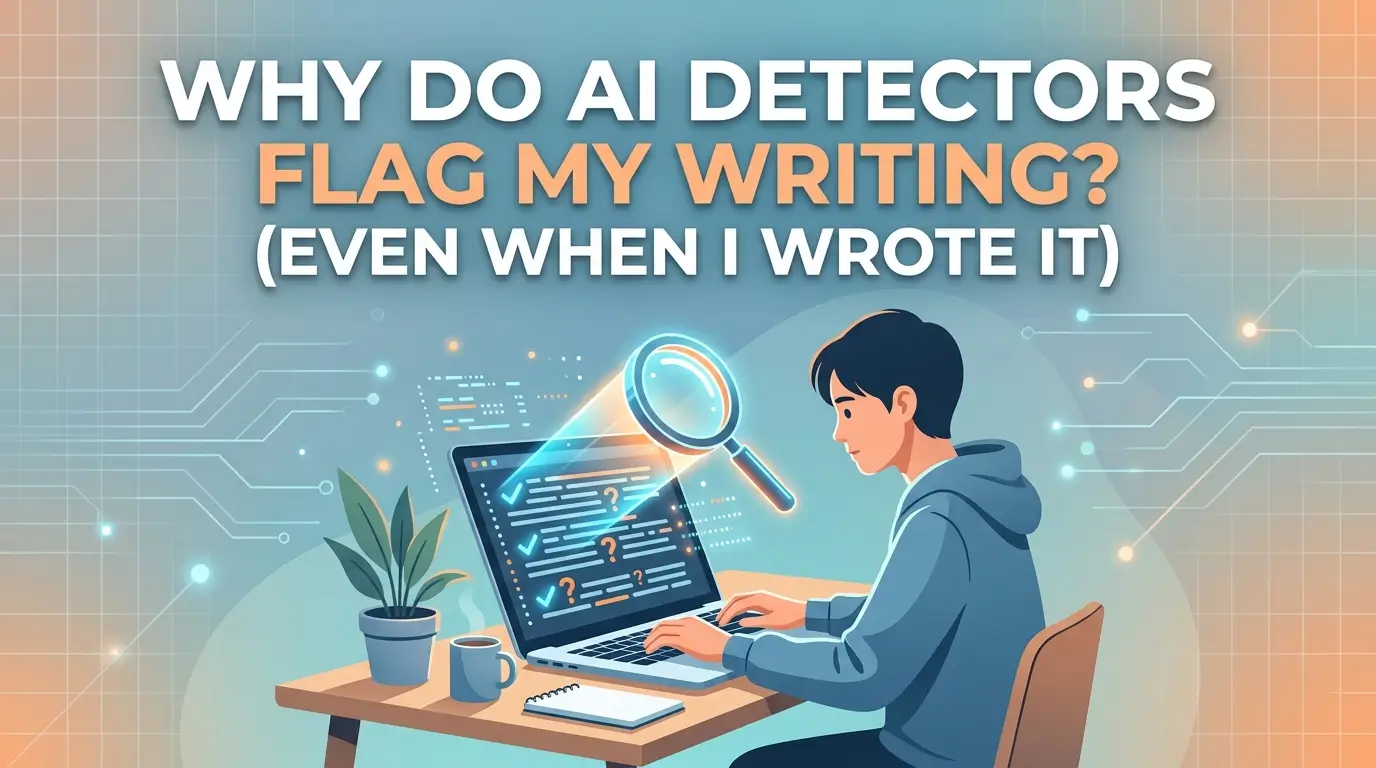
Wondering why AI detectors flag your writing as AI even though you wrote it yourself? Learn the real causes & how to fix flagged sections properly.
You wrote every word yourself. You know you did. So why does the detector keep saying otherwise?
If you're asking why do AI detectors flag my writing, here's the uncomfortable truth. These tools don't read for authorship at all. They run statistical analysis on your sentences and ask one question. Does this pattern look like something a language model would produce?
If the answer is yes, the detector flags it. It doesn't matter who actually typed it, how long you spent on it, or how many drafts you went through to get it right.
The detector has never seen your notebook, your research, or the three hours you spent rewriting a single paragraph. It only sees the finished sentences, measured against a statistical model of what AI-generated text usually looks like.
This is a real problem for a growing number of people. Students are being called into academic integrity meetings over essays they wrote entirely themselves. Freelance writers are losing clients over articles that scored high on a tool the client trusts more than they trust the writer.
Content teams watch months of SEO work get rejected because a QA process built around a single detector score doesn't leave room for nuance. None of these situations mean the writing was dishonest. They mean the writing matched a pattern, and patterns are all a detector can actually see.
At Brevity Editorial, we review writing that's been flagged by AI detectors and fix it through manual, sentence-level human editing. We find exactly what triggered the flag and rewrite those parts by hand. You get your document back with tracked changes, so nothing about your original meaning gets lost along the way.
Key Takeaways
AI detectors flag patterns, not authorship
Low perplexity, uniform sentence length, and style fingerprinting cause most false flags
Grammarly, templates, and formal ESL writing are common triggers
Your fix depends on which of three scenarios applies to you
Detectors disagree with each other, so no single score is proof
Manual editing fixes flags without touching your facts or voice
Why Does My Writing Get Flagged as AI When I Wrote It Myself?
Three technical mechanisms are behind most false flags. None of them have anything to do with whether a human actually wrote the text.
Perplexity
This measures how predictable each word choice is. Language models almost always pick the most statistically likely next word, and careful human writers do the same thing without even realizing it.
Academic writing, professional copy, and anything that's gone through a few rounds of polishing tends to score low on perplexity. Detectors read that low score as a machine signal, even when it's just someone writing carefully.
Burstiness, or the lack of it
Burstiness measures how much your sentence length varies. Real human writing has rhythm. A long sentence that builds through several clauses, then something short. A fragment. Then a sentence that runs on a bit longer again.
AI-generated text tends to sit in a narrow band, usually somewhere around fifteen to twenty words per sentence, over and over. If your own natural style happens to fall into that same range, your burstiness score drops and your flag risk goes up with it.
Stylometric fingerprinting
This one compares your syntax, word choice, and transition habits against the statistical fingerprint of typical LLM output. Follow standard writing conventions closely enough, and your style can match that fingerprint even though you never touched an AI tool.
If you want to see the other side of this coin, we've written about how AI writes like a human, which shows exactly what these systems are comparing your writing against.
There's a fourth factor worth understanding too, even though it's less talked about. It's how much AI-generated text you've personally read in the last year or two. Writers who edit AI drafts for a living, or who simply read a lot of AI-assisted content online, sometimes absorb its rhythms without realizing it.
Stylometric drift is real. The more often your eyes pass over machine-smooth prose, the more your own instincts for pacing and phrasing can start to echo it, even in writing where no AI tool was ever opened. This isn't a flaw in your writing. It's a side effect of how much of the internet's text now comes from somewhere else.
What Specifically Triggers an AI Flag
Detectors don't flag intent. They flag patterns. Here are the specific ones that get genuine human writing mistaken for AI output.
Over-polished grammar from tools like Grammarly
Grammar tools smooth out sentence structure and clean up the small imperfections detectors associate with human authorship. One freelance writer told us her draft scored 100% human before she ran it through Grammarly.
After the tool fixed her commas and tightened a few sentences, the exact same piece came back 100% AI. If this sounds familiar, our piece on whether Grammarly has a humanizer built in explains what's actually happening under the hood.
Template-driven structure
A standard introduction, three body points, and a tidy conclusion. Transitions like "Furthermore" and "In conclusion." These show up constantly in the text LLMs were trained on, so writing that leans on them heavily can read as machine-made even when it isn't.
Uniform sentence length
Stretched across paragraph after paragraph. This is the burstiness problem from a writer's side rather than a technical one. It's also one of the easiest things to fix once you know it's happening.
Stock phrases
Lines like "It is important to note that" or "In today's fast-paced world" appear millions of times in LLM training data. Use them often and you're writing in the exact vocabulary detectors are trained to recognize.
Formal or cautious ESL writing
Non-native English writers often lean on conservative vocabulary and simpler sentence structures to avoid grammar mistakes. That restraint can end up looking a lot like the controlled, careful output of an AI system.
If this describes your writing, it's worth reading how to prompt AI to write like a human, not to use AI, but to understand what patterns are being flagged against.
Heavily edited professional content.
Executive statements, agency deliverables, anything that's passed through several rounds of committee review. Multiple editing passes strip out individual voice and even out the structure until the whole thing reads as machine-clean, even when five different people worked on it.
Technical and repetitive subject matter.
Some writing is naturally repetitive because the subject demands it. Instructions, specifications, legal language, and technical documentation all rely on consistent terminology because clarity matters more than variety.
A detector doesn't know that. It just sees repetition and low perplexity, and it flags accordingly, regardless of whether the repetition was necessary or lazy.
Outline generators and AI-assisted SEO tools.
Even if you never generate a single sentence with AI, using an outline tool or an SEO optimizer that suggests headings and structure can nudge your writing toward the same shape thousands of other pieces already have.
Writing tools push uniformity by design. They're built to help you rank and read cleanly, and the side effect is writing that looks statistically similar to everyone else using the same tools, AI or not.
How Different AI Detectors Score the Same Document
One thing that surprises almost everyone the first time it happens: run the exact same document through Turnitin, GPTZero, Originality AI, Copyleaks, and ZeroGPT, and you'll likely get five different scores. Sometimes the gap is small. Sometimes one tool says 8% and another says 60% on the same paragraph.
This isn't a bug. Each detector is trained on a different dataset, weights perplexity and burstiness differently, and sets its own thresholds for what counts as a flag.
Turnitin leans heavily on academic writing patterns since it's built for classrooms. Originality ai is tuned more for marketing and SEO content, where template structures are common. GPTZero was one of the earliest tools and has been updated repeatedly as newer models have changed what "AI-sounding" text actually looks like. Copyleaks and ZeroGPT each have their own quirks, and neither is immune to false positives on formal or technical writing.
The practical takeaway is simple. If a client, professor, or QA process cares about a specific detector's opinion, that's the one you need to satisfy, not just any detector. A 70% flag on one tool might be an 18% on another, and that difference changes what kind of fix you actually need.
What a False AI Flag Can Actually Cost You
It's easy to treat a flagged score as a minor annoyance until it starts affecting something that matters. Students facing an academic integrity review can lose grades, credits, or standing over work they wrote honestly.
Disputing that process often means gathering draft history and defending your own writing style to people who trust the software more than they trust you. Freelancers can lose ongoing client relationships over a single flagged article, even after years of reliable work, because a client's QA workflow treats the detector score as final.
Agencies risk losing entire content batches if even a handful of articles trip a threshold, since many clients now reject full deliveries rather than individual pieces. None of these outcomes reflect on whether the writing was actually good, honest, or original.
They reflect on whether the writing happened to match a statistical pattern a piece of software was trained to catch. That gap between actual authorship and detected authorship is exactly what manual review exists to close.
Practical Ways to Reduce False Flags Before You Submit
A few habits genuinely help, whether or not you ever send us a document.
Read your draft out loud. If every sentence lands at roughly the same length and rhythm, break some up and let others run longer. Add a specific detail or example that only you could know, a real date, a real name, a number you actually remember, instead of a vague placeholder.
Go easy on heavy AI-assisted grammar rewrites right before you submit. That's often the last step that pushes a genuinely human draft over the line. And don't rely on a single detector's score as the final word, since different tools weigh these signals differently.
Write your first draft somewhere that saves version history, whether that's Google Docs, Word with track changes on, or any tool that timestamps your edits. If a flag ever does happen and you need to prove authorship, that revision trail is often more convincing than any explanation you could give after the fact.
Keep an eye on how you use editing tools too. Grammarly, Hemingway, and similar tools are useful, but running every sentence through an aggressive rewrite pass right before submission is one of the most common ways genuinely human writing ends up looking machine-made. Use them to catch real errors, not to smooth every sentence into the same shape.
None of this is about tricking a detector. It's just how naturally varied human writing already behaves before editing tools flatten it out.
How AI Detection Scores Should Be Read
Your AI score is a probability estimate, not proof of anything. Here's a practical way to read it.
Score | What It Typically Indicates | Recommended Action |
0 to 15% | Low flag risk; most detectors classify as human | No action needed unless a reviewer requires a specific threshold |
16 to 40% | Mixed signal; some sections carry AI-like patterns | Review flagged sections; consider targeted revision |
41 to 70% | Significant AI pattern detection; likely to trigger rejection | Manual review recommended; sections need sentence-level rewriting |
71 to 100% | High AI signal across the document | Substantive editorial revision required |
Detectors don't agree with each other, and that's worth sitting with for a second. Originality AI, GPTZero, Turnitin, Copyleaks, and ZeroGPT all use different models and thresholds, so a score from one doesn't predict a score from another.
If a specific tool matters for your situation, check its track record first. We've broken down whether ZeroGPT is accurate, whether Copyleaks is accurate, and whether GPTZero is accurate. If you're being scored through a school platform specifically, see whether Google Classroom has an AI detector built into it.
You can check your own score right now with our free AI content detector before deciding what to do next.
Which Situation Are You Actually In?
Your next step depends on which of these three actually describes you.
Scenario 1: You wrote it yourself and got falsely flagged.
No AI involved, or maybe just a grammar tool, and your writing happens to be formal, polished, or built around a standard structure. This is a genuine false positive, and it shows up most often in academic writing, professional copy, and ESL writing.
Pull together your draft history and any version notes your software saved. Then consider manual editorial review to bring back natural sentence variation without changing a word of what you actually said.
Scenario 2: You used AI to outline or draft, then rewrote it yourself.
AI-originated phrasing tends to survive light editing more than people expect, so detectors still pick up traces of it. If this is where you're at, how to make ChatGPT sound more human is worth reading before your next draft.
For something already flagged, the fix is targeted. Find the specific sections still carrying that structure and rewrite just those, with real detail and natural rhythm.
Scenario 3: The content is mostly AI-generated and needs real rework.
Light editing hasn't fixed the flag because the text is still statistically close to LLM output. This calls for actual sentence-level rewriting with real expertise and a genuine voice running through it, not another quick pass through the same kind of tool that created the problem.
What Happens During Manual Review
Here's the process we run on every flagged document.
Document intake and detector identification. You tell us which detector produced the flag. We look at the output to see which sections scored highest and why.
Sentence-level diagnostic markup. We read the whole document and mark every sentence carrying an AI-pattern trigger, whether that's low burstiness, predictable phrasing, template transitions, or stock phrases.
Manual rewrite of flagged sections. A human editor rewrites each flagged section by hand, aiming for specificity and a natural voice rather than randomness. Facts, citations, and your argument structure stay exactly as they were. No automated paraphrasing tool touches the document at any stage. If you're weighing your options here, our note on how to rewrite text to avoid AI detection is worth a read first.
Tracked-changes delivery. You get a tracked-changes version with a comment explaining every edit, plus a clean final document.
Optional second-pass review, with authorship documentation guidance included if your case is being formally disputed by a school or client.
Manual Editorial Review vs. AI Humanizer Tools
AI Humanizer Tool | Manual Human Editorial Review | |
Process | Automated synonym replacement and restructuring | Human editor rewrites every flagged sentence by hand |
Voice preservation | Often strips voice, adds generic phrasing | Keeps your tone, register, and intent |
Meaning accuracy | Can introduce factual errors or break citations | Facts and citations checked and preserved |
Plagiarism risk | May match existing published phrasing | Editor checks originality on every rewrite |
Transparency | No tracked changes, no explanation | Full tracked-changes document with comments |
Automated tools solve a statistical problem by creating a different one. They change your words without understanding what those words actually meant to say.
It's fair to ask whether these tools even do what they claim, and the answers vary a lot. We've reviewed whether Undetectable AI works and whether Claude can humanize text, and results are inconsistent enough that we wouldn't recommend leaning on them for anything with real stakes.
If you'd rather try something lighter yourself first, our own AI text humanizer is free to use. For academic or client-facing work, though, human review is still the safer route.
How This Works in Practice
A content agency submitted twelve blog articles that Originality AI had flagged between 45% and 68%. The writer had used ChatGPT for outlines, then written each article by hand.
Our diagnostic found the residual patterns concentrated in topic sentences and conclusions, the parts that stayed closest to the original AI structure. Those are usually the parts writers touch least when they're editing an outline into a full draft. After we hand-rewrote those sections, all twelve articles came back under 15% on resubmission, and the agency's client accepted the full batch.
A graduate student's dissertation chapter got flagged by Turnitin at 38%, despite no AI ever being used. It was a textbook false positive: formal academic register, long stretches of uniform sentence length, and a lot of conventional hedging language that academic writing conventions actually encourage.
After targeted revision, the chapter resubmitted at 4%. This kind of thing worries a lot of students, understandably, so we've written separately about whether professors can detect ChatGPT and whether Turnitin can detect ChatGPT if you want more context.
A freelance writer's landing page got rejected after Copyleaks flagged it as AI-generated. She'd written it herself and used Grammarly for a final polish. That polish had normalized every sentence to roughly the same length and stripped out her natural contractions.
Restoring her voice resolved the flag without touching a single claim on the page. She now runs every deliverable through manual review before sending it to that client.
Who This Service Is Built For
Content managers and SEO teams flagged by Originality AI, Copyleaks, or client-side QA tools
Freelance writers whose work gets rejected by clients running AI detection
Students and researchers flagged by Turnitin or institutional detectors. If this is you, does AI humanization work on Turnitin is worth reading
Professional writers whose proposals or executive statements keep getting flagged
Agencies producing content at volume who need ongoing editorial QA
Non-native English writers whose formal style keeps triggering false positives
This service is not built for passing fully AI-generated content off as human-written with no real contribution behind it. It's editorial work aimed at originality and genuine voice. If the content needs to exist, it needs a real person's thinking somewhere in it.
Pricing and Turnaround
Pricing is per word. Standard turnaround is 48 hours from submission, and rush turnaround is 24 hours (a rush fee applies to documents over 3,000 words). One revision round is included in every project.
Agencies and content teams submitting five or more documents a month can ask about batch pricing at intake.
Frequently Asked Questions
What should I do if my writing keeps getting flagged as AI?
Start by figuring out which situation actually applies to you: genuine false positive, light AI-assisted drafting, or something closer to fully AI-generated. Confirm the score with a detector, then focus only on the sections that are actually flagged instead of rewriting the whole piece from scratch. Sentence-level manual editing works better than running the same draft through another automated tool.
How do I avoid AI detection when writing?
Vary your sentence length on purpose, skip the stock transitional phrases, and don't lean too hard on grammar tools that flatten your natural phrasing. Write with specific, concrete detail instead of general statements that could apply to almost anything. Save your draft somewhere with version history so you have a record if you ever need one.
Is it possible to get 0% AI on Turnitin?
It's possible, though not guaranteed for every piece of writing, since the score reflects statistical patterns rather than a strict pass or fail line. Naturally varied, genuinely human writing tends to score very low. For flagged academic work specifically, can Turnitin detect ChatGPT covers how the system actually weighs different signals.
Can AI text detectors be wrong?
Yes, regularly. These tools measure statistical likelihood, not authorship, and documented false positives are common, especially for formal, polished, or ESL writing. The fact that different detectors disagree on the exact same document is itself good evidence that no single score should be treated as proof of anything.
Will your edits change what my writing says or break my citations?
No. Every edit preserves your meaning, factual claims, and citations exactly as they were. You get a tracked-changes document so you can review each change individually and reject anything that doesn't reflect what you meant.
Will my document stay private?
Yes. All documents are handled under confidentiality, and an NDA is available on request. Files are deleted after delivery unless you ask us to retain them, and your content is never used to train AI models.
How fast can you turn this around?
Standard turnaround is 48 hours from submission. Rush turnaround is 24 hours. Batch submissions of five or more documents get confirmed at intake based on total word count and current queue.
Conclusion
Getting flagged by an AI detector doesn't mean you did anything wrong, and it definitely doesn't mean a machine wrote your work. Most of the time, it just means your writing happens to be predictable, uniform, or too polished for a detector that was never designed to judge authorship in the first place.
What matters is knowing which situation you're actually in and fixing only the sections that need it, with real sentence-level editing rather than another automated pass. That's the difference between guessing your way through a flag and actually resolving it.
If your writing keeps coming back flagged, run it through our free AI content detector to see where you stand, and reach out when you're ready for a manual review that keeps your voice and your facts exactly as you intended them.