Is Turnitin Accurate? Similarity vs AI Score
Is Turnitin accurate? Real test data shows AI detection accuracy from 61% to 98%, depending on the study. See what that means for you.
Is Turnitin accurate? For text-matching against its 1.2-billion-document database, yes, reliably. For its AI writing detector, it depends heavily on what you're measuring: unedited AI text gets caught at 90 to 95 percent, while human-written academic prose gets wrongly flagged somewhere between 1 and 12 percent of the time depending on writing style and language background. Turnitin produces two separate scores in every report, and confusing the two is the single most common mistake students and educators make when reading a result.
This article breaks down what each score actually measures, what independent testing found versus what Turnitin claims, and what a flagged report should actually mean for you.
Key Takeaways
Similarity score and AI score measure different things, don't confuse them.
Turnitin claims 98% AI-detection accuracy, but independent tests show lower numbers, especially on non-native English writing.
A high score doesn't automatically mean plagiarism or AI use. Context matters.
Some universities, like Vanderbilt, have disabled Turnitin's AI detector over false positives.
Never treat a Turnitin score as final proof, always pair it with human review.
Is Turnitin Accurate? It Depends on Which Score You Mean
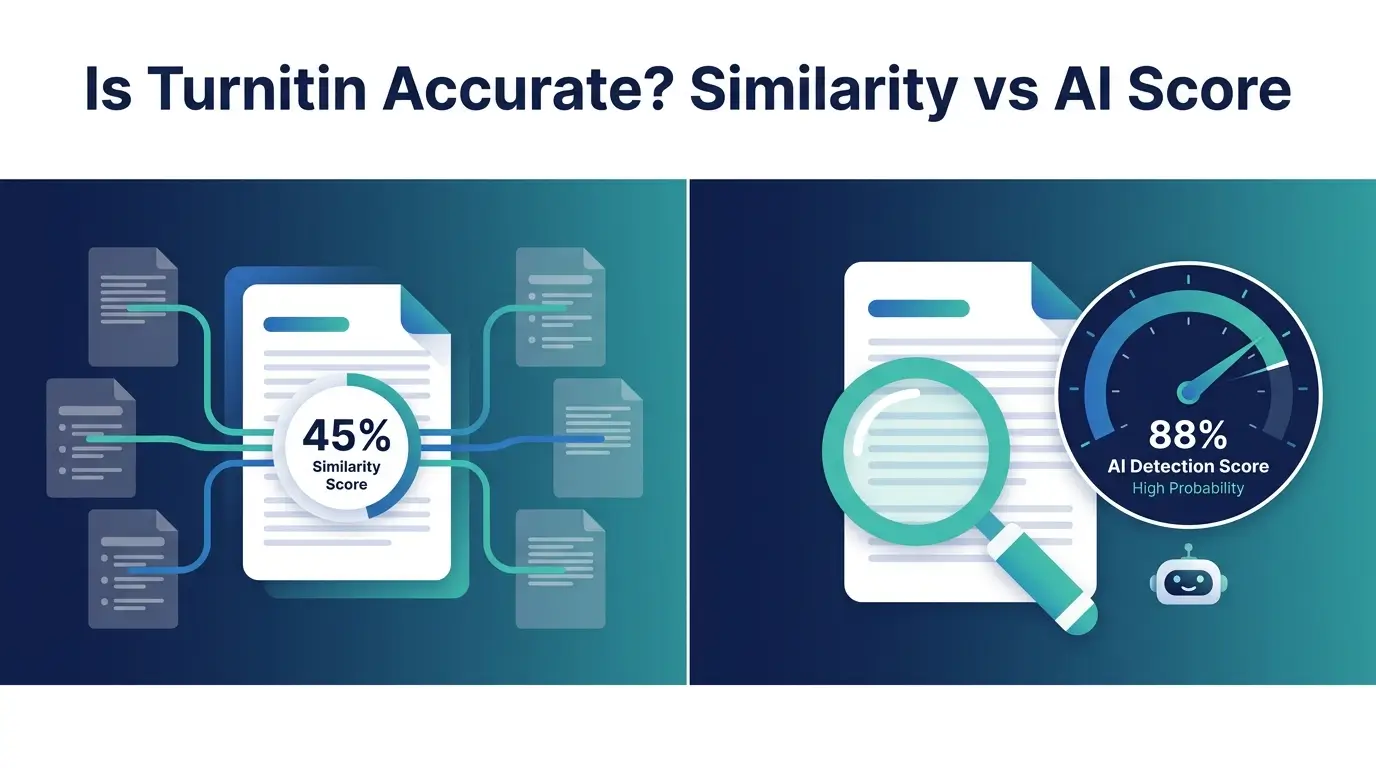
Turnitin produces two separate scores in every report, and they measure fundamentally different things.
The similarity score tells you what percentage of your text matches strings of words already in Turnitin's database. The AI probability score tells you what percentage of your qualifying prose matches statistical patterns associated with large language model output.
One measures overlap. The other measures a probability estimate. Conflating them is the most common mistake students and educators make when interpreting a Turnitin report.
Score | What It Measures | What the Percentage Means | Known Reliability |
Similarity Score | Text overlap against 1.2B+ known sources | % of your words matching existing documents | High for verbatim matches; inflates on quotes, bibliographies, and common phrases |
AI Probability Score | Statistical resemblance to LLM output | % of qualifying prose classified as likely AI-generated | 90 to 95% on unedited AI text; 1 to 12% false-positive rate on human writing depending on conditions |
Turnitin's own documentation calls the AI score a "risk indicator," not a forensic finding. The similarity score is more mature and more reliable, but it still requires human interpretation before anyone acts on it.
How Does Turnitin Work? Text-Matching vs AI Classification
Turnitin runs two parallel detection systems on every submission. Understanding both is necessary before you can evaluate whether either one is accurate.
The Similarity Engine (Text-Matching)
When you submit a paper, Turnitin's text-matching algorithm breaks your document into small string segments and compares each one against its database. That database includes over 1.2 billion student papers, current and archived web pages from internet crawling, and more than 90,000 academic journals and publications.
When a segment matches a source, Turnitin highlights it and links to the original. The similarity score is the total percentage of your text that matched something in the database.
This is a mechanical process. It does not evaluate intent, context, or whether a match constitutes plagiarism. A properly cited quotation and a copied paragraph look identical to the similarity engine.
The AI Writing Detector (Probabilistic Classification)
Is Turnitin's AI detector accurate in the same way the similarity engine is? Not quite, because it works on a completely different principle. Instead of comparing your text to known sources, it evaluates the statistical properties of your prose at the sentence level.
The classifier is trained on paired samples of human-written and AI-generated text. It looks for patterns in word predictability, called perplexity, sentence complexity variation, called burstiness, and phrasing conventions that differ between human writers and large language models like GPT-4, Claude, and Gemini. If you want a deeper look at how those same signals get exploited to make AI writing pass as human, our guide on how AI can write more like a human covers the same underlying mechanics from the other direction.
Each sentence receives an individual probability score. Those sentence-level scores are then aggregated into the overall AI percentage you see in the report.
Turnitin also runs a secondary layer for AI paraphrasing detection. If the system identifies text that appears AI-generated but shows signs of being rewritten by a paraphrasing tool, it flags that content separately.
Two system parameters matter for accuracy. Turnitin requires a minimum of 300 words of qualifying prose before the AI detector runs, since submissions below that threshold lack sufficient signal. And scores below 20 percent are now marked with an asterisk, indicating lower reliability.
What Turnitin Says About Its Own Accuracy
Turnitin reports that its AI writing indicator achieves 98 percent accuracy with a false-positive rate below 1 percent for documents containing more than 20 percent AI-generated text.
The company tested the system on 800,000 academic papers written before ChatGPT's public release, using them as a verified human baseline. On that corpus, fewer than one in 100 human-written papers was incorrectly flagged above the 20 percent AI threshold.
There is a tradeoff behind that number. To keep the false-positive rate low, Turnitin accepts a false-negative rate of approximately 15 percent. That means if the detector reports that 50 percent of a document is AI-written, the actual amount may be closer to 65 percent. The system is designed to err on the side of not accusing human writers, which means it misses some AI-generated content by design.
These are strong numbers by the standards of the field. The caveat is that they come from Turnitin's internal testing on curated samples under controlled conditions, not from the messier, more varied writing institutions actually submit every day.
Is Turnitin's AI Detector Accurate? Independent Test Results
Independent researchers testing Turnitin under real-world conditions have produced lower accuracy figures and higher false-positive rates than the company's own numbers. Three studies are particularly important here.
Stanford HAI Study (91 TOEFL Essays)
Researchers at Stanford's Human-Centered AI institute tested seven major AI detectors on 91 TOEFL practice essays written by non-native English speakers. The headline finding: 61 percent of those essays were incorrectly classified as AI-generated.
The same detectors produced far lower false-positive rates on essays written by native English speakers. The study concluded that AI detection models show systematic bias against non-native English writing, because formal second-language academic patterns overlap with patterns the models associate with AI output. This is the same structural problem we cover in more general terms in our piece on why AI detectors flag certain writing across tools beyond just Turnitin.
Temple University Study (120 Samples)
Researchers at Temple University's Center for Student Success tested Turnitin's AI detector on 120 text samples across four categories.
Human-written texts were correctly identified 93 percent of the time. Fully AI-generated texts were detected 77 percent of the time. Disguised AI text, meaning content paraphrased to evade detection, dropped to 63 percent. Hybrid texts combining AI and human contributions were correctly identified only 43 percent of the time.
Overall accuracy landed at approximately 86 percent, with a 14 percent error rate concentrated in the disguised and hybrid categories. The researchers also found that the detector's flagged sections did not accurately pinpoint which specific portions of hybrid papers were AI-generated.
Pre-2022 Human Paper Testing (50 Verified Samples)
A separate independent test ran 50 verified human-written papers through Turnitin's AI detector. Every paper in the sample was written before ChatGPT's release, eliminating any possibility of AI assistance.
The results: 34 percent of the papers scored above 20 percent AI probability. Eighteen percent scored above 50 percent. Three papers, or 6 percent of the sample, scored above 80 percent.
The highest-scoring papers shared specific traits: heavily structured formal writing with explicit signposting, citation-dense STEM methodology sections, and prose written by non-native English speakers who had mastered formal academic conventions.
Why Turnitin Claims 98% Accuracy but Independent Tests Find Lower Numbers
The gap between Turnitin's published numbers and independent findings is real, but it isn't evidence of deception. The numbers measure different things under different conditions.
Different Sample Populations
Turnitin tested on 800,000 pre-ChatGPT papers, a clean, verified human baseline. Independent researchers test on current real-world submissions where human writing is messier, more formulaic, and harder to distinguish from AI output.
Different Definitions of "False Positive"
Turnitin's under-1-percent figure applies specifically to documents where more than 20 percent of the text is AI-generated. On fully human documents with no AI content at all, the false-positive rate is higher, because the threshold for a "false" flag is lower.
Different Confidence Thresholds
A false positive at Turnitin's 98 percent confidence level is genuinely rare. At the 50 percent threshold, the level at which many institutions begin investigating, false positives are more common. Most independent studies don't specify which threshold they're measuring against.
Different Model Versions
Turnitin has updated its AI classifier multiple times since its April 2023 launch. A study conducted in mid-2023 and a study conducted more recently are evaluating different detection systems, even though both are called "Turnitin."
When you see conflicting accuracy numbers anywhere in this space, not just for Turnitin, the first question worth asking is: what sample, what threshold, and what model version.
Is Turnitin's Similarity Score Accurate? What the Percentage Actually Means
A 25 percent similarity score does not mean 25 percent of your paper is plagiarized. It means 25 percent of your text matches strings of words found somewhere in Turnitin's 1.2-billion-document database. Is 25 percent on Turnitin too high, then? Not automatically. It depends entirely on what's driving that number.
What the Similarity Percentage Measures (and What It Doesn't)
The similarity engine detects text overlap. It does not detect plagiarism. Plagiarism is an intent-based judgment that requires human evaluation of context, citation, and attribution, and Turnitin cannot make that judgment on its own.
A paper with a 30 percent similarity score that consists entirely of properly attributed quotations and a long bibliography may contain zero plagiarism. Is 30 percent on Turnitin high in that case? Numerically yes, but substantively no. A paper with a 5 percent similarity score that copies a single uncited paragraph from a source may contain serious misconduct despite the low number.
Database Scope: What Turnitin Compares Against
Turnitin's matching database is the largest in academic publishing. It includes over 1.2 billion student papers submitted since the platform's launch, current and archived web pages from continuous internet crawling, and more than 90,000 academic journals, periodicals, and publications, along with a repository of previously submitted student work across participating institutions.
The breadth of this database is why Turnitin's similarity engine is more reliable than most competitors for text-matching. It's also why similarity scores tend to run higher than students expect. The database is so large that common academic phrasing will almost always produce some matches.
Known Similarity Score Inflation Sources
Several common elements inflate similarity scores without indicating plagiarism at all.
Bibliographies and reference lists. Published titles, author names, and journal citations match thousands of other papers by design.
Block quotations. Properly cited direct quotes are still text overlap, even when handled correctly.
Common academic phrases. Expressions like "in conclusion" or "further research is needed" appear in millions of documents, so they register as matches regardless of originality.
Assignment prompts and template language. If your professor's prompt is in the database, any repetition of that language will register as a match, which is out of your control entirely.
Self-matches. If your institution stores submissions in Turnitin's global repository, a draft you submitted earlier may match your final version.
Similarity Score Interpretation Guide
Can Turnitin be wrong about what a score means, even when the percentage itself is accurate? Yes, in the sense that a technically correct number can still be misread without context. Here's a general guide for interpreting the ranges.
Score Range | Typical Meaning | Action |
0–15% | Normal for original academic writing with standard citations | Usually no review needed |
15–25% | Common for papers with extensive quotations or long bibliographies | Quick check of flagged sources is prudent |
25–40% | May indicate heavy paraphrasing, insufficient original analysis, or bibliography inflation | Review flagged passages in context |
40%+ | Significant overlap with existing sources; warrants close examination | Detailed passage-by-passage review required |
Is a 24 percent Turnitin score bad, based on that table? It sits right at the edge of the normal range, and whether it's a problem depends entirely on what's generating the overlap, not the number by itself. These ranges are guidelines, not rules. A lab report with standard methodology language may legitimately score 30 percent, while a creative writing assignment scoring 20 percent deserves more scrutiny than the number alone suggests.
How Accurate Is Turnitin's AI Detector for Your Type of Writing?
AI detection accuracy varies significantly depending on what kind of text you submit. The detector performs best on long-form, varied prose written by native English speakers and worst on short, formulaic, or non-native writing.
Text Type | Expected AI Detection Accuracy | False-Positive Risk | Key Limitation |
Undergraduate humanities essays | High (90–95%) | Low | Most reliable category for the detector |
Graduate theses and dissertations | Moderate (80–90%) | Moderate | Formal structure and signposting trigger flags |
STEM lab reports | Moderate (75–85%) | Moderate to High | Passive voice and formulaic methods sections resemble AI patterns |
Literary analysis and creative writing | High (90–95%) | Low | Varied, distinctive prose is easy for the model to classify |
Non-native English academic writing | Low to Moderate (60–80%) | High | Documented bias; formal L2 patterns overlap with AI output |
Short submissions (under 300 words) | Unreliable | Very High | Insufficient linguistic signal; detector may not run at all |
Code, formulas, and equations | Not applicable | N/A | The AI detector analyzes prose only |
Heavily edited AI-human hybrid drafts | Low (40–65%) | Moderate | Temple study found 43% accuracy on hybrid texts |
These ranges synthesize findings from the Stanford HAI, Temple University, and independent studies referenced earlier. Your individual result will vary based on your specific writing style, submission length, and the Turnitin model version your institution uses.
Why Turnitin Flags Human-Written Papers: 7 Common Triggers
If your original writing received a high AI probability score, one or more of these factors likely contributed.
1. Heavily Structured Formal Writing
Papers with numbered arguments, explicit signposting, and consistent parallel structure across sections score higher, because formal structure is a feature the detector weights heavily even though it's also a feature of good academic writing.
2. Citation-Dense Technical Prose
STEM methodology sections with dense citation blocks, passive constructions, and precise terminological repetition resemble AI output patterns, and the more precisely a paper follows a genre template, the more suspicious the detector finds it.
3. Non-Native English Academic Writing
International students who have internalized formal American academic conventions often produce writing that overlaps with the statistical patterns the model associates with LLM output, and the Stanford HAI study documented this bias across seven detectors, not just Turnitin.
4. Highly Polished Graduate-Level Prose
Some of the strongest academic writing in independent test samples received the highest AI scores, meaning students who worked hardest to master academic conventions are sometimes the most likely to be flagged.
5. Heavy Paraphrasing of Sources
Paraphrasing that preserves the original source's logic, structure, and vocabulary, even after rewording, can produce patterns the detector reads as AI-like.
6. Repetitive Sentence Structure
Uniform sentence lengths, identical paragraph rhythms, and generic transitions reduce the burstiness variation the detector uses to identify human writing.
7. Common Topics With Generic Phrasing
Essays on widely assigned topics often produce familiar arguments and phrasing that overlap with both AI training data and existing student submissions already in the database.
None of these are writing flaws. They're features of competent academic writing that happen to overlap with patterns the model associates with AI output.
How Do Universities Respond to Turnitin's Accuracy Limitations?
Institutions are split on how to handle Turnitin's AI detection results, and their policies directly affect what a score means for you.
Vanderbilt: Disabling AI Detection Entirely
Vanderbilt University disabled Turnitin's AI detection feature entirely. The university cited the tool's activation with less than 24 hours' notice, no opt-out option, and insufficient transparency about the detection methodology.
Vanderbilt calculated that at Turnitin's claimed 1 percent false-positive rate, approximately 750 of the 75,000 papers submitted in 2022 could have been incorrectly flagged.
Temple: Treating Scores as Conversation Starters
Temple University conducted its own institutional evaluation using the 120 controlled text samples referenced earlier. After finding 86 percent overall accuracy but only 43 percent accuracy on hybrid texts, Temple researchers recommended that faculty treat AI scores as conversation starters rather than evidence of misconduct.
Penn's Warren Center: No Sole-Evidence Policy
The Warren Center at the University of Pennsylvania published guidance urging faculty not to use AI detection scores as sole evidence in academic integrity cases. The guidance emphasizes that a detection score without supporting evidence, such as drafts, source notes, or version history, is an inadequate basis for a formal misconduct referral.
The Broader Trend
The broader trend across higher education is toward treating Turnitin's AI indicator as one signal among many, not as a verdict on its own.
Is Turnitin More Accurate Than Grammarly, GPTZero, or Originality AI?
No single detector is universally more accurate than the others. Performance varies by text type, submission length, and language background, which is why comparing raw claimed-accuracy numbers alone is misleading.
Dimension | Turnitin | Grammarly AI Detector | GPTZero | Originality AI |
Claimed accuracy | 98%+ (<1% FPR) | Not publicly specified | 98%+ (self-reported) | 99%+ (self-reported) |
Independent FPR estimate | 1–12% (varies by text type) | Limited independent data available | 3–8% | 2–6% |
Minimum word count | 300 words | ~150 words | 250 words | 50 words |
Non-native English bias | Documented (Stanford HAI) | Not independently tested at scale | Documented (similar model architecture) | Less documented |
Text-matching / similarity | Yes, 1.2B+ document database | No, AI detection only | No, AI detection only | No, AI detection only |
Institutional integration | Canvas, Blackboard, Moodle | Partial | LMS integrations available | Standalone only |
Student self-access | No, institution-licensed only | Yes, free tier available | Yes, free tier available | Yes, paid, no free tier |
Turnitin's Advantage: Training Corpus and LMS Integration
Turnitin's primary advantage is its massive training corpus of real student submissions and its deep LMS integration.
If you want to see exactly how it plugs into the platforms your school uses, our breakdown of does Canvas have an AI detector covers that integration from the LMS side directly.
Our companion piece on does Blackboard have an AI detector rounds out the same picture for the other major platform.
Is Grammarly's AI Detector as Accurate as Turnitin?
Independent comparison data is genuinely limited here. Turnitin has a larger training corpus and more institutional validation, but Grammarly performs comparably on standard academic prose, and neither tool has published peer-reviewed accuracy benchmarks at a forensic standard.
Our dedicated piece on does Grammarly have a humanizer looks at where Grammarly's tools overlap with detection concerns more broadly.
Is GPTZero More Accurate Than Turnitin?
On raw AI content specifically, the two land in a similar range, but GPTZero tends to perform better on shorter, more stylistically varied text.
Our full breakdown of is GPTZero accurate goes deeper into where it wins and where it doesn't.
How Copyleaks, ZeroGPT, and Originality.ai Compare
For the other major detectors, our review of is Copyleaks accurate covers the tool most schools already have built into their LMS.
Our piece on is ZeroGPT accurate looks at the option casual users reach for instead.
Our analysis of is Originality AI accurate focuses on the publisher and agency side of this same question rather than the classroom.
If you want a single article that maps every major AI detector against Turnitin specifically in one place, our guide on what AI detector is most similar to Turnitin does exactly that.
Why Cross-Checking Beats Trusting One Tool
The most reliable approach in practice is cross-checking. If Turnitin, GPTZero, and Originality AI all return low scores on the same text, the probability of a false positive from any single tool drops substantially.
What Should You Do If Turnitin Flags Your Writing as AI-Generated?
For Students
Review the report carefully first. Check which specific passages were flagged and at what confidence level, since Turnitin does not mark your paper as definitively AI-written. It provides a probability estimate for qualifying prose only.
Gather your writing process evidence next. The strongest defense is documentation. Pull your version history from Google Docs or Word, and collect your outlines, handwritten notes, research screenshots, and annotated sources. These show a human drafting process that no AI detector can replicate.
Talk to your instructor early and calmly. Explain that the paper is your own work, share your drafts and notes, and offer to walk through your argument and source choices. A respectful conversation is more effective than treating the report as an accusation.
Request a formal review if needed. If your institution has an academic appeal process, use it, ask for clarity on the policy and your rights, and bring your process evidence to the review.
If you're specifically worried about how AI-assisted drafts read once you've used a tool to help outline or polish them, our guide on how to make ChatGPT sound more human and our piece on how to prompt AI to write like a human both cover practical ways to close that gap honestly before submission.
For a more direct answer on this exact platform, our article on does humanized AI work on Turnitin addresses the question most students actually have, and our separate piece on whether Turnitin can detect ChatGPT specifically narrows in on that one model.
For Educators
Treat the score as a starting point, not a finding. A 40 percent AI probability on a student paper is a reason to look more closely, not a reason to initiate misconduct proceedings on its own.
Compare with the student's previous writing. Sudden changes in vocabulary, complexity, or structure may warrant attention, but weigh them against topic, time pressure, and revision support before drawing conclusions.
Ask the student to explain their process. Request drafts, notes, and a walkthrough of their research and drafting timeline. Most students who wrote their own work can do this easily and without hesitation.
Cross-check with a second detector before acting. If Turnitin flags a paper but other tools do not, the disagreement itself is evidence that the classification is uncertain rather than settled.
Where Turnitin Is Not Reliable Enough to Act On
No detection tool is infallible, and Turnitin's output should not be treated as conclusive in a few specific scenarios.
Submissions under 300 words, since the detector lacks sufficient linguistic signal and may not even run at all.
Non-prose content. Code, mathematical equations, data tables, and formulas are not evaluated by the AI classifier.
Non-native English writing under 500 words, which carries documented, elevated false-positive risk based on the research cited earlier in this piece.
Hybrid AI-human drafts, the weakest category overall. The Temple study found only 43 percent accuracy on texts combining AI and human contributions.
Any disciplinary decision based solely on a detection score. No commercial AI detector, including Turnitin, GPTZero, Grammarly, or Originality.AI, has published peer-reviewed validation data at a standard that would justify treating its output as forensic evidence in misconduct proceedings.
Turnitin's own documentation uses the phrase "risk indicator" for a reason. A risk indicator prompts investigation. It does not replace it.
Frequently Asked Questions
Is Turnitin 100% accurate?
No. Turnitin's text-matching engine is highly reliable for verbatim overlap, but its AI detector produces false positives on 1 to 12 percent of human-written academic text depending on writing style, length, and language background. No commercial AI detector achieves 100 percent accuracy.
What does a 25% Turnitin similarity score mean?
A 25 percent similarity score means 25 percent of your text matches sources in Turnitin's database. It does not mean 25 percent is plagiarized. Bibliographies, block quotes, and common academic phrases routinely inflate this number without indicating misconduct.
Is 25% on Turnitin too high?
Not automatically. A 25 percent similarity score is common for papers with extensive quotations or long bibliographies, and it usually just warrants a quick check of which passages were flagged rather than any assumption of wrongdoing.
Is a 24% Turnitin score bad?
Generally no. It sits within the range typical of well-cited academic writing. Whether it's a concern depends on what's generating the overlap, such as quotes and references, rather than the number by itself.
Is 30% on Turnitin high?
It can be, but context matters more than the figure. A paper heavy on quotations or standardized methodology language can legitimately reach 30 percent, while the same score on a creative writing piece with no citations deserves closer review.
Can Turnitin be wrong?
Yes. Both its similarity and AI scores are statistical measurements, not judgments. A high similarity score can come from proper citations, and a moderate AI score can come from formal human writing. The tool can be technically accurate in what it measures while still being misread as proof of something it never claimed to prove.
Is Turnitin biased against non-native English writers?
Yes, on short texts specifically. The Stanford HAI study found AI detectors flagged 61 percent of non-native English essays as AI-generated. Turnitin's own testing shows the bias is less significant on submissions over 300 words, but risk remains elevated for shorter L2 writing.
Is Grammarly's AI detector as accurate as Turnitin?
Independent comparison data is limited. Turnitin has a larger training corpus and more institutional validation, but Grammarly performs comparably on standard academic prose. Neither tool has published peer-reviewed accuracy benchmarks at a forensic standard.
Will checking my paper in Turnitin store it and flag it later?
It depends on your institution's settings. Some Turnitin configurations store submissions in the global repository, which can cause future self-matches on your own work. Ask your instructor or IT department whether your institution uses the no-repository option.
Can Turnitin detect AI-generated code or formulas?
No. Turnitin's AI writing detector analyzes prose only. Code, mathematical equations, data tables, and other non-prose content are not evaluated by the AI classifier, though they may appear in the similarity report if they match existing sources.
Conclusion
Turnitin's similarity engine is a reliable text-matching tool backed by the largest academic document database in the world. Its AI writing detector is a useful signal for identifying unedited AI output, but it isn't a verdict, and it should never be the sole basis for an academic misconduct decision.
The most accurate approach combines the detector's output with draft history, source verification, and human judgment. A single percentage, whether it's a similarity score or an AI probability, doesn't tell the full story of how a paper was actually written.
If you want to check where your own AI-assisted writing stands before you submit it anywhere, our guides on how to rewrite text to avoid AI detection and can Claude humanize text cover the editing side of this problem in detail.
If your concern is specifically about a school platform beyond Turnitin itself, our piece on does Google Classroom have an AI detector and our review of is JustDone's AI detector accurate round out the platform-specific side of this question.
Run your own writing through our free AI detector to see where it stands before you submit it anywhere, or use our humanizer to smooth out AI-assisted drafts so they read naturally on the first pass.